

Deal teams lose more time to their CRM than to any single stage of a deal. Logging meetings, hunting for the partner who knows a founder, and rebuilding a contact record that should already exist all happen between the work that actually moves a deal forward.
A CRM for deal teams is meant to remove that overhead by capturing relationships and activity on its own, then surfacing the path to the people who matter. Most of the tools that claim to do this were built for sales pipelines where a contact is a lead you close once and forget. Investors, corporate development teams, and lenders work differently, because the same people come back across funds, rounds, and years.
This guide is for venture capital (VC) and private equity (PE) deal teams that run on the warm-network playbook. It compares eight CRMs for deal teams on what they actually do, and lists pricing where the company publishes it. You will find a quick comparison table, and also a framework of capabilities worth testing in any tool.
Quick Overview of 8 Top CRMs for Deal Teams
The table below shows you eight CRMs side by side with pricing, who each one fits best, and the features that set it apart. Each tool then gets its own section further down, with a detailed look at what it does and how it's priced.
Tool | Pricing | Best for | Key features |
Rings AI | Not public, free trial | Investors who want relationships and deals in one place | Logs email and meetings on its own, maps your team's network, comes with funding data |
Carta | Not public, custom quote | Firms already running funds on Carta | Deal tracking linked to your live fund numbers, auto-written investment committee summaries |
Meridian | Not public, custom quote | PE and VC teams focused on sourcing | Alerts when target companies make moves, suggests new leads, builds deal sheets from decks |
Affinity | Not public, around $2,000/user/year | Firms that want relationship tracking to run itself | Logs contacts automatically, shows the warmest path to a person, deal reporting |
Attio | Free to $69/user/month | Teams that want to design their own workflow | Set up your own structure, AI fills in fields, strong tools for developers |
Altvia | Not public, custom quote | Firms standardized on Salesforce | A CRM built on Salesforce, handles fundraising and investor email |
4Degrees | Around $250/user/month | Emerging and mid-market deal teams | Scores how strong each relationship is, maps shared connections, keeps records updated |
Xpedition | Not public, custom quote | Firms standardized on Microsoft Dynamics | A CRM built on Microsoft Dynamics, tracks deals and fundraising |
Why Generic CRMs Don't Fit How Private Equity Actually Works
Private equity is structurally different from almost every other business that runs on a CRM, and that difference is exactly why most CRMs struggle inside a fund. Understanding where the mismatch comes from makes it clearer why a purpose-built system is worth the investment in 2026.
Private Equity Doesn't Run on a Sales Funnel
Most CRMs were built for businesses with customers, invoices, and predictable revenue pipelines. The job is scale: move thousands of leads, renewals, and support tickets through a funnel that looks roughly the same every quarter. Salesforce, HubSpot, and their competitors were designed for that world, and they handle it well.
A fund has none of those things. Instead, the work that defines the firm looks like this:
No customers or recurring revenue: There are limited partners (LPs) with complex commitment structures, not a billing pipeline.
A pipeline driven by relationships, not inbound volume: Deal quality comes from who you know and how fast you can move.
Workflows with no generic equivalent: Tracking banker coverage, running a live deal process, and managing LP conversations through a raise don't map to a standard sales funnel.
The Workarounds Quietly Kill Adoption
When a firm forces a horizontal CRM into this shape, the gaps get patched by hand:
Custom fields stand in for real deal stages.
Data gets exported to a spreadsheet because the system can't produce the view the team needs.
A separate doc tracks which partner owns which banking relationship.
None of that is the CRM doing the work. It's people doing the CRM's work for it, and that's the point where the tool stops earning its place. Associates and partners are rational about where their time goes, so a system that adds data entry without giving anything back gets abandoned. Once the senior team stops logging deals and meeting notes, the data is incomplete, and a CRM you can't trust as the source of truth isn't really functioning as one.
A Purpose-Built Platform Encodes How Funds Operate
A CRM built for investors starts from different assumptions. It understands that:
A contact is not just a contact. Someone at a bank, an LP, a portfolio-company executive, and a target company are genuinely different, and conflating them only creates noise.
A deal stage means something specific. It maps to diligence work, IC timelines, and document workflows, not an abstract win-probability percentage.
Fundraising runs on its own clock. It's paced by fund-close mechanics, not a sales quota.
That's the difference between a CRM that's just a place to file information and one that mirrors how the firm already works.
Core Capabilities to Evaluate in a CRM for Deal Teams
These are the capabilities that separate a deal CRM your team actually uses from one that sits empty. Score every tool you demo against the eight below before you compare price.
Automatic relationship and activity capture: The CRM logs emails and meetings on its own by reading your email and calendar, so records stay current without anyone typing them in. Tools that need manual entry go stale within a quarter and people stop trusting them.
Deal pipeline visibility: You can see where every opportunity sits and who is moving it, with stages that match how your firm sources and closes. Contacts should stay as lasting records, so a founder you passed on shows up with full history when they come back two rounds later.
Network mapping and warm intro paths: The tool shows who on your team has the strongest connection to a target, and the best ones reach past colleagues to the investors, board members, and advisors around a company. This is how relationship-led firms get into deals that never reach a competitive process.
Data enrichment and company records: Records fill in automatically with funding history, headcount, and round data from a maintained database, so your team judges companies instead of typing them in. Check how often it refreshes and whether enrichment costs extra.
Fundraising and LP relationship tracking: The same system tracks the LP side, with a separate pipeline for commitments and records that persist across funds. Fundraising is a long relationship process, and LPs are exactly the recurring contact a sales CRM handles poorly.
AI assistance grounded in your context: Useful AI reads your team's own history and drafts meeting prep and relationship summaries, rather than producing generic text. Test it on your real data, and be wary of anything promising full autopilot on deal judgment.
Integrations and where the CRM lives: The CRM should sit inside Gmail or Outlook, the browser, and your phone, so the record is in front of you when you need it. Integrations also decide whether it fits your stack or forces an unplanned migration.
Onboarding, migration, and security: A good vendor moves your full process history, not just contacts, with hands-on help rather than a self-serve import. Security standards and privacy controls matter early, since review can stall a purchase at a regulated firm.
The 8 Best CRMs for Deal Teams
If relationships are your edge, start with Rings AI, Affinity, and 4Degrees. If sourcing is the bottleneck, look at Meridian. If you're already committed to Salesforce, Dynamics, or Carta, you can check out Altvia, Xpedition, or Carta.
1. Rings AI
Rings AI is a CRM built for investors and other teams that run on recurring relationships, such as VC, PE, and dealmaking finance. It treats people and companies as lasting records, so a contact's emails, notes, and process history live at the person and company level rather than disappearing when a single deal closes. That design suits firms where the same founders, co-investors, and LPs come back across funds and years.
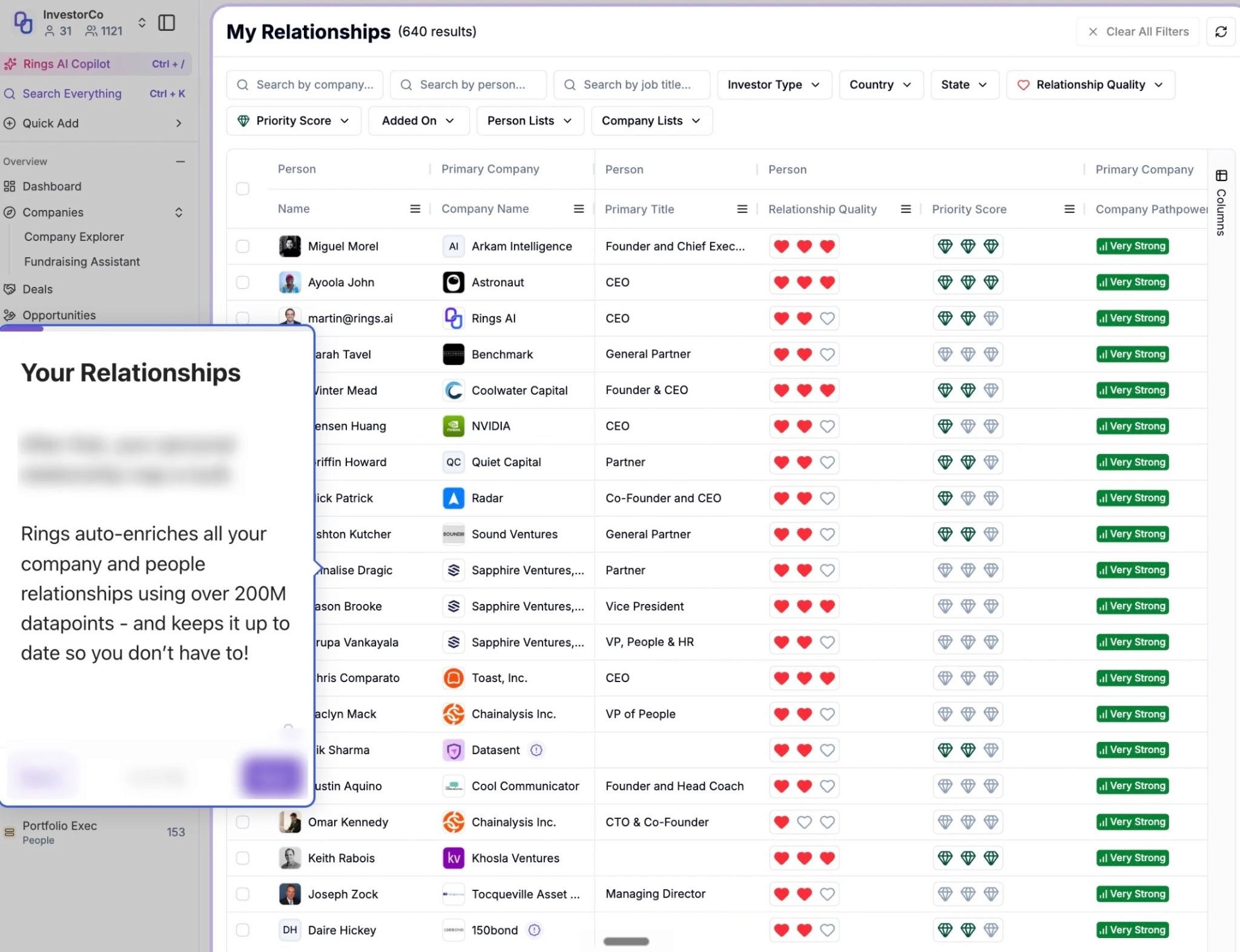
Rings can run as a full standalone CRM or sit on top of an existing one as an enrichment layer, which gives teams a way to adopt it without ripping out what they have. It is a good fit for a firm that wants deals, fundraising, and network mapping in one place without stitching together three tools.
Key features
Rings builds your team's relationship graph automatically from email and meeting activity, including historical activity from before you started, and scores every relationship.
Pathpower maps your team's network across a target company and includes the surrounding investors, board members, and advisors, not only direct employees.
People-first processes let you run deal pipelines, fundraising, events, and intros on the same persistent contact records.
The platform ships with more than 150 million global data points, including round-by-round funding data, overlaid with your own relationship history.
AI produces meeting prep dossiers, relationship summaries, and process briefs using your team's knowledge, market data, and the web.
A Chrome extension works inside Gmail and LinkedIn, and the iOS app is built to match the web app for partners on the move.
A human data team handles migration from major CRMs, and the platform meets U.S. and global security standards with three layers of user-level privacy.
Pricing
Rings AI does not publish prices on its website, so the exact figure depends on team size and is set through a demo. Migration support from your current CRM is handled by the Rings data team as part of onboarding.
2. Carta
Carta is best known for cap table and fund administration, and in 2026 it added a Deal CRM after acquiring ListAlpha. The CRM is part of Carta's wider platform for private capital, which means it can connect deal and relationship tracking to live fund accounting in the same system.
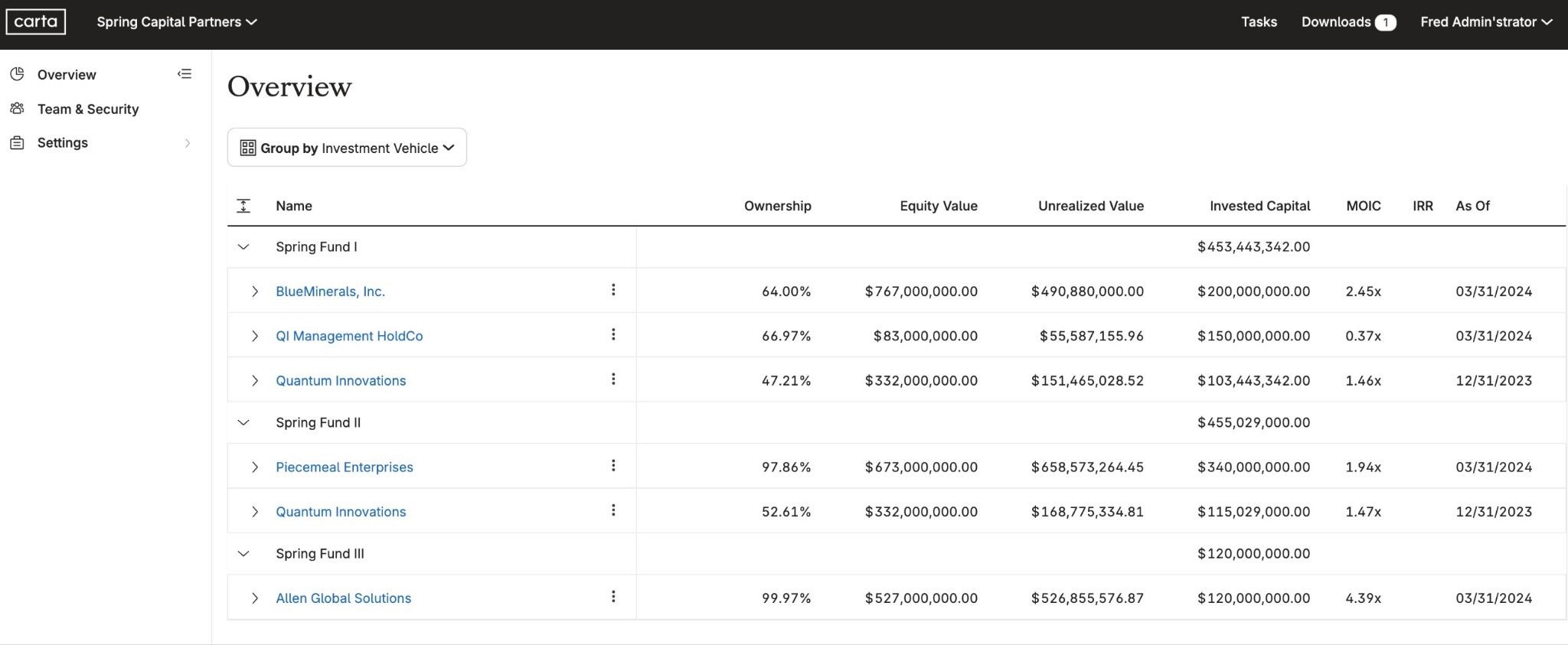
That tie to fund data is the main reason a firm already running on Carta would choose it, because LP records can show real performance figures without a separate export. The trade-off is that the CRM is newer than most tools here and works best for firms already inside the Carta ecosystem rather than as a standalone pick.
Key features
The Deal CRM lets teams find proprietary leads and track targets through a sourcing funnel.
AI captures interactions across Outlook and Google Workspace and links founders, advisors, and co-investors to deals automatically.
An AI agent can generate an Investment Committee one-pager from years of history in seconds.
LP records can surface live fund metrics such as IRR, TVPI, DPI, and carry pulled from Carta's fund accounting.
Deal and relationship tracking connect to back-office workflows across the Carta platform, from sourcing through exit.
Interaction history is queryable, so teams can ask about past contact with a target and get an answer.
Pricing
Carta does not publish prices for its Deal CRM, so cost is set by quote and usually depends on which parts of the broader Carta platform a firm already uses. The CRM is positioned as an addition to Carta's fund administration and cap table products rather than a cheap standalone tool. Firms not already on Carta should expect the conversation to cover the wider platform, not the CRM alone.
3. Meridian
Meridian is a CRM aimed at private equity and venture deal teams with a clear focus on sourcing. It leans into finding and tracking targets early, using market signals and pattern matching against a firm's own history of successful deals. The product suits a team whose main pain is filling the top of the funnel rather than managing relationships that already exist. Its sourcing focus is a strength for proactive origination and a trade-off for firms that care more about long-term relationship depth than about finding new names.
Key features
Signal alerts flag hiring spikes, product launches, and fundraising chatter at target companies.
Predictive sourcing surfaces new targets based on patterns in a firm's past wins.
Email and meeting activity auto-tags to the right company across Outlook and Google Workspace.
AI extraction generates tear sheets from decks and CIMs.
The platform includes more than 26 million enriched company records plus a live contact database with verified leadership contacts.
Benchmarking compares a deal against a firm's own history and public comparables.
Pricing
Meridian does not publish pricing, so cost is arranged by quote and likely scales with team size and data needs. The product is venture-backed and positioned toward firms that want sourcing depth, which usually means a per-seat or platform fee set in conversation. Expect enrichment volume and the contact database to factor into the final number.
4. Affinity
Affinity is a relationship intelligence CRM widely used across venture capital and private equity. Its defining strength is automatic capture, where it reads email and calendar metadata to log activity and map which colleague has the strongest connection to a founder or investor. Affinity suits firms that want relationship intelligence to work in the background, and the main trade-off is cost, since it sits at the higher end of this list.
Key features
Affinity automatically logs emails, meetings, and contacts by reading communication metadata, with no manual entry required.
Relationship mapping identifies which team member has the strongest path to a given founder, investor, or operator.
Company profiles are enriched automatically with funding history, growth metrics, and firmographic data.
Chrome and Outlook extensions bring records and enrichment into the inbox and browser.
Teams can set custom deal criteria, such as stage and headcount, and use analytics to surface matching opportunities.
Reporting covers interactions and investor updates with customizable formats.
Pricing
Affinity prices by quote and does not list public figures, though resellers and reviews report a starting point near $2,000 per user per year, usually with seat minimums. Billing is annual and per user, and there is no free trial. Tier names are Essential, Advanced, and Enterprise, with capability and support rising at each level.
Essential (custom quote, reported from roughly $2,000/user/year): Includes core CRM, automatic capture, and basic reporting for small teams.
Advanced (custom quote): Adds workflow automation, advanced integrations, custom fields, and enhanced reporting for growing teams.
Enterprise (custom quote): Adds advanced security controls, dedicated support, custom onboarding, and API access for large teams.
5. Attio
Attio is a flexible CRM that lets teams shape their own setup with custom objects and a clean, document-style interface. It is not built only for investors, which makes it broader than most tools here and a fit for deal teams that want to design their own workflow rather than adopt a fixed one. Its strength is configurability and a strong developer API, so technical teams can extend it.
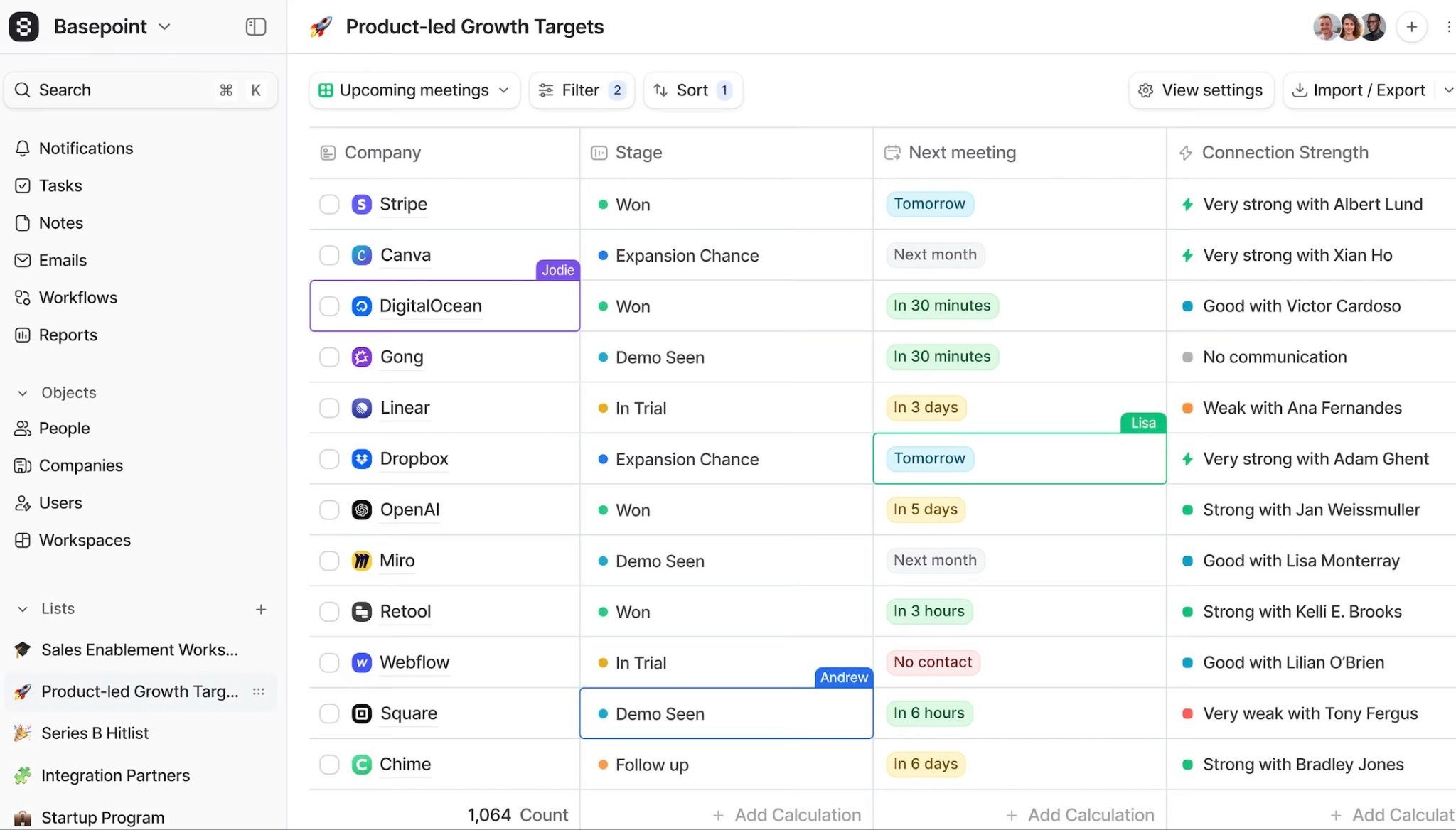
The trade-off is that the investor-specific depth, such as round data and warm-intro mapping, is something you assemble rather than something that arrives built in.
Key features
Custom objects let teams model deals, people, companies, or anything else around their own workflow.
AI attributes auto-fill custom fields, summarize records, classify contacts, or run a web research agent.
Email and calendar sync captures activity, with communication intelligence showing first and last interactions and connection strength.
Company and people enrichment fills in firmographics, funding raised, and social profiles.
Reporting includes insight and funnel reports, with limits that rise by plan.
A developer platform offers an API, webhooks, an app SDK, and an MCP server (Pro plan and above for the MCP server and advanced access).
Call Intelligence records and analyzes meetings (Pro plan and above).
Pricing
Attio uses a per-seat subscription with monthly and annual billing, and annual billing saves about 20%. There is a genuine free tier for up to three seats, plus a free start with no credit card required. Higher tiers add objects, automation credits, call intelligence, and security controls, and credits for enrichment and AI scale with the plan.
Free ($0, up to 3 seats): Includes real-time contact syncing, automatic enrichment, and up to three custom objects.
Plus ($29/user/month billed annually, $36 monthly): Adds private lists, enhanced email sending, no seat limit, and up to five objects.
Pro ($69/user/month billed annually, $86 monthly): Adds Call Intelligence, sequences, advanced permissions, up to 12 objects, and priority support.
Enterprise (custom quote): Adds unlimited objects, unlimited teams, single sign-on, and advanced security and admin controls.
6. Altvia
Altvia is a private capital platform built on Salesforce, serving private equity, venture, and fund-of-funds managers across the fund lifecycle. Building on Salesforce gives it deep customization and a familiar foundation for firms already standardized on that platform.
It covers CRM, investor communication, and reporting in one place, which suits firms that want fundraising and IR handled alongside deals. The trade-off is the Salesforce base, which brings interface complexity, longer implementation timelines, and ongoing admin work to keep it running.
Key features
Altvia provides CRM, data management, and investor communication tools built on Salesforce.
AIMe, the built-in AI assistant, surfaces insights, automates routine tasks, and simplifies data entry.
Customizable dashboards show deal sources, valuation trends, and capital-raising progress.
Altvia Correspond sends targeted mass emails using dynamic contact lists for investor outreach.
The platform covers fund and portfolio management, performance metrics, benchmarking, and compliance reporting.
The Salesforce foundation allows extensive customization of objects, fields, and workflows.
Pricing
Altvia does not publish pricing, so cost is quoted on request and typically reflects the Salesforce platform underneath plus Altvia's own licensing. Firms should expect implementation and ongoing administration to add to the seat cost, which is common for Salesforce-based products. Support is offered by phone, email, and an online help desk.
7. 4Degrees
4Degrees is a relationship intelligence and deal flow platform built by former investors for venture capital and private equity teams. It focuses on tracking relationships, mapping networks, and sourcing through warm introductions, with relationship intelligence available out of the box rather than as a paid add-on.
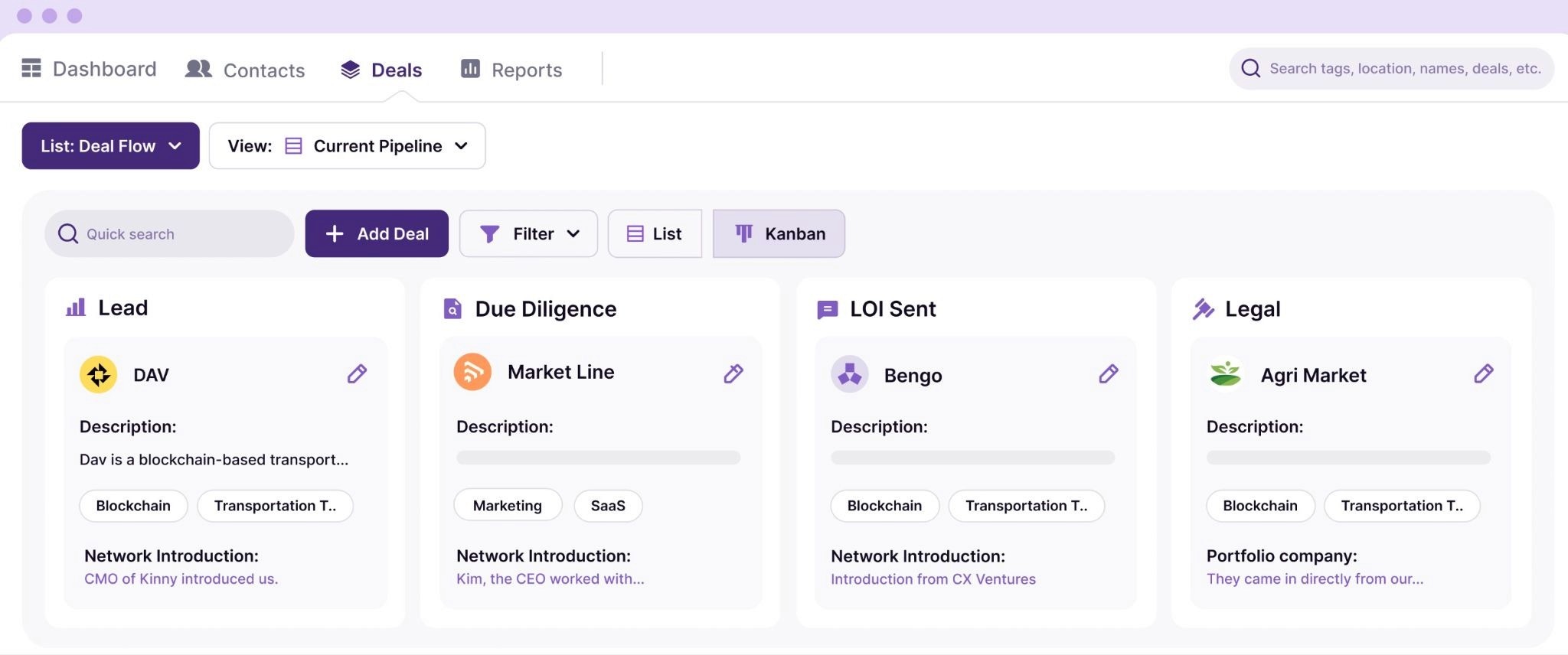
This deal CRM is aimed at emerging managers and mid-market deal teams that want strong relationship features at a lower total cost than the most expensive tools here. Very large firms with complex back-office needs may outgrow it pretty quickly.
Key features
Automated capture syncs with email and calendar to log meetings and communication history.
Relationship strength signals estimate connection depth from how often people interact.
A network graph visualizes overlapping connections across partners and team members.
Deal and pipeline tracking covers sourcing through close, alongside portfolio and LP relationship tracking.
Automatic enrichment pulls from third-party sources including Crunchbase, Clearbit, and PitchBook.
Customizable deal pipelines work without expensive add-ons or custom development.
Pricing
4Degrees does not publish official tiers, though forums and user reviews put it around $250 per user per month.
8. Xpedition
Xpedition offers a private equity and venture CRM built as an accelerator on Microsoft Dynamics 365. It adds industry-specific features for deal flow, fundraising, and investor relations on top of the Dynamics platform, which makes it a natural fit for firms already standardized on Microsoft. The product covers the deal pipeline from origination to close along with fundraising target tracking.
The trade-off mirrors other platform-based tools, since the value depends on committing to the Microsoft Dynamics and Power BI ecosystem rather than adopting a lightweight standalone CRM.
Key features
The CRM manages the full deal pipeline from origination to close with configurable dashboards.
Investment profiles let teams group and analyze deals by stage, sector, or type.
Fundraising tools track, nurture, and progress fundraising targets and committed investor vehicles.
Investor relations features record interactions with current and prospective investors.
AI dashboards surface insights across deals and relationships.
The platform integrates natively with Microsoft Dynamics 365 and Power BI.
Pricing
Xpedition does not publish pricing, so cost is quoted on request and generally sits on top of Microsoft Dynamics 365 licensing. As an accelerator rather than a standalone product, its total cost depends on the underlying Dynamics setup and any Power BI use. Firms not already on Microsoft should factor that platform commitment into the decision.
Choose Rings as your CRM
Rings is a CRM built for investors, not a sales tool reworked to fit a fund. People and companies stay as permanent records, so emails, notes, and meetings live in one place and don't disappear when someone leaves.
It brings the tools deal teams usually juggle into one system:
Automatic relationship capture: Team email and meetings logged to the right contacts and companies for you.
Sourcing and deal tracking: A sourcing engine and flexible deal modules you can fit to your pipeline.
Notes and files in one hub: Tied to the right contact or deal, and searchable across the team.
Copilot: Quick meeting prep, relationship catch-ups, and answers from your team's history.
It's focused on the work investors actually do, and it stays easy enough that the team keeps using it. That's what makes a CRM worth having.
Every firm runs a bit differently, so the best way to see if it fits is to look at it against your own process.
Book a demo and we'll show you how Rings works for your deal team.