
Limited Partners (LPs) commit capital to a fund with a long-term horizon, often seven to ten years. During that time, their visibility into what is happening inside the fund is limited.
That visibility largely comes from LP reporting.
LP reporting is how fund managers communicate performance, portfolio progress, and key investment decisions to their investors. It gives LPs a clear picture of how capital is being deployed and how the strategy is unfolding. However, poor reporting creates uncertainty and weakens investor confidence.
In this guide, we’ll explore how LP reporting works and how fund managers can structure updates that keep investors informed and aligned.
What is LP Reporting?
LP reporting refers to a structured communication framework that helps investors track the progress of the fund. It provides visibility across multiple dimensions, including financial performance, portfolio development, exits, and operational updates.
Most funds follow a predictable reporting cadence:
Quarterly reports summarizing fund performance and portfolio activity
Capital call notices when additional capital is required
Distribution notices when returns are paid back to LPs
Annual reports or investor meetings that provide a broader strategic overview
Each of these communications helps limited partners understand the fund’s trajectory and evaluate how it aligns with the strategy originally presented during fundraising.
This context is especially important because LPs usually invest across multiple funds simultaneously. Without clear reporting, it becomes difficult for them to assess performance or allocate future capital.
Why LP Reporting Matters
LP reporting is not just a compliance requirement. It is one of the most important ways fund managers maintain transparency and build credibility.
Strong reporting accomplishes three things.
Builds investor trust: Consistent and transparent reporting reassures LPs that their capital is being managed responsibly.
Reinforces the investment strategy: Regular updates show how new investments, portfolio developments, and exits align with the fund’s original thesis.
Supports future fundraising: Clear reporting builds a documented track record, making it easier for LPs to evaluate and commit to future funds.
What LPs Actually Want to See in Reports
Many fund managers assume LPs want extremely detailed financial models. In practice, most investors are looking for a clear picture of the fund’s progress and direction.
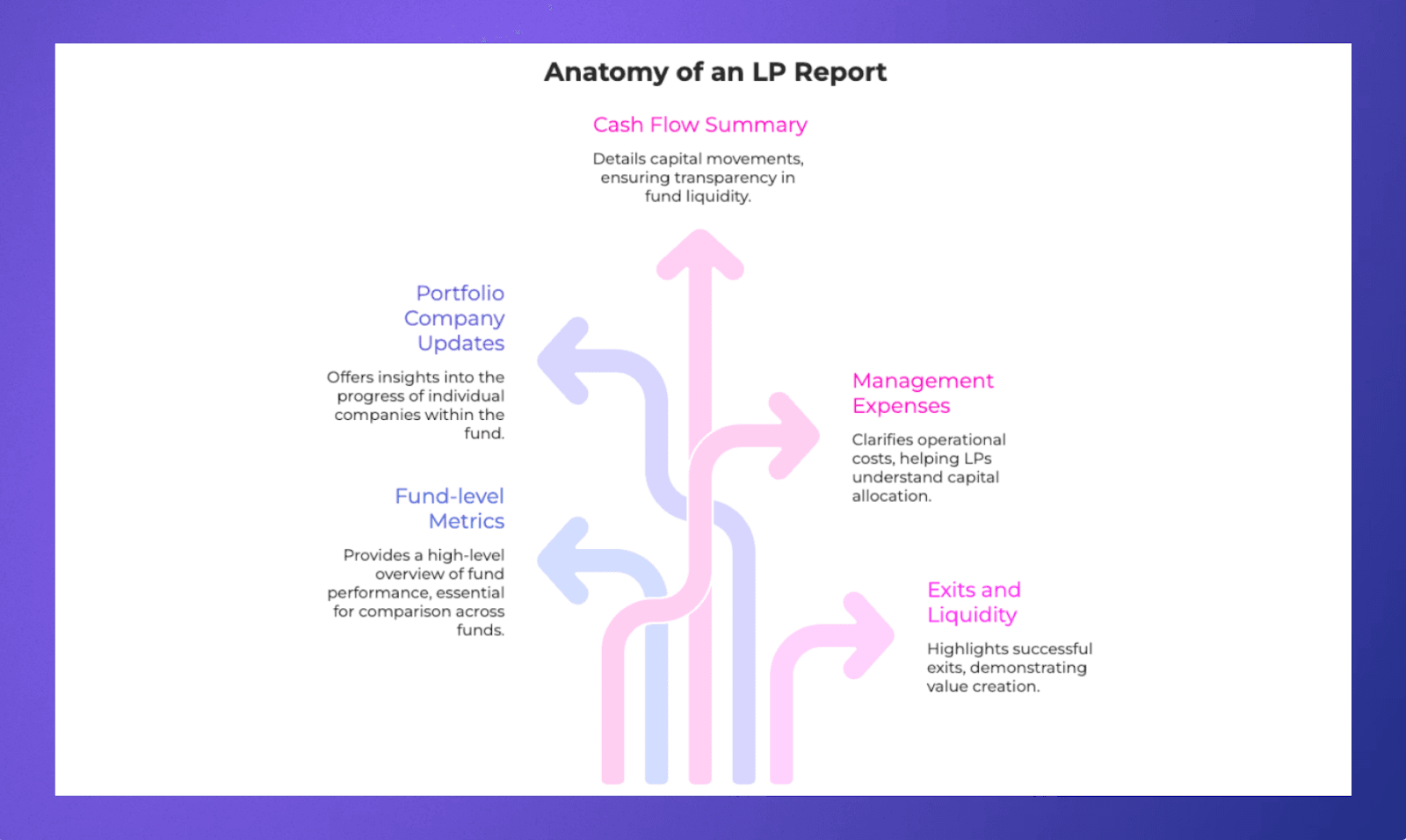
The most effective reports balance financial metrics with strategic context. Here are the core components LPs expect.
1. Fund-level performance metrics
At the highest level, LPs want to understand how the fund is performing overall.
Key metrics often include:
IRR (Internal Rate of Return)
TVPI (Total Value to Paid-In)
DPI (Distributed to Paid-In)
RVPI (Residual Value to Paid-In)
These metrics help investors compare performance across funds. However, numbers alone are rarely enough. LPs also need context explaining why those numbers look the way they do.
2. Portfolio company updates
Portfolio updates provide insight into how the companies inside the fund are progressing between funding rounds or liquidity events.
These updates often highlight:
Revenue growth or major financial milestones
Product launches or market expansion
Leadership changes
Follow-on funding rounds
Strategic partnerships or acquisitions
Short narrative summaries explaining why these developments matter are often more useful than raw numbers alone.
3. Cash flow summary
LPs closely track how money moves in and out of the fund. A cash flow summary provides a clear breakdown of capital calls, distributions, and the current balance of committed versus deployed capital.
This section typically outlines:
Capital called during the reporting period
Distributions returned to LPs
Remaining committed capital
Net cash position of the fund
This transparency allows LPs to monitor liquidity and understand how their capital commitments are being utilized over time.
4. Management expenses and fees
Another important part of LP reporting is transparency around fund expenses and management fees. LPs expect a clear summary of operational costs associated with managing the fund.
This section usually includes:
Management fees charged during the reporting period
Operating expenses, such as legal, compliance, or administrative costs
Any other fund-level expenses allocated to investors
Providing this information ensures LPs understand how much of their capital is going toward operational management versus investments.
5. Exits and liquidity events
Exits are naturally one of the most anticipated sections in any LP report.
These updates may include:
Acquisition announcements
Secondary sales
IPOs
Partial liquidity events
Along with the financial outcome, many fund managers include a short explanation of the exit strategy and what contributed to the result. This helps LPs understand how value was created and realized within the portfolio.
How Often Should LP Reporting Happen?
Most funds send formal reports quarterly. Quarterly reporting strikes a balance between providing timely updates and avoiding excessive administrative overhead. A typical reporting cycle might look like this:
Quarterly
Fund performance metrics
Portfolio updates
New investments
Operational changes
Annually
Full performance summary
Detailed portfolio review
Strategic outlook for the coming year
In addition, LPs receive capital call and distribution notices whenever capital movements occur. Beyond formal reporting, many GPs also maintain informal communication through investor updates, webinars, or annual meetings.
Common Challenges in LP Reporting
Despite its importance, LP reporting can become difficult as funds grow and portfolios expand. Many firms face challenges such as:
Fragmented data sources: Investment information often lives across spreadsheets, emails, portfolio dashboards, and internal notes, making it difficult to consolidate accurate reports.
Manual reporting workflows: Many teams still compile LP updates manually each quarter, pulling financial data, gathering portfolio updates, and formatting reports.
Tracking investor relationships: Beyond financial updates, firms must also track conversations, follow-ups, and introductions with LPs, which can become difficult without a centralized platform like Rings AI.`
4 Best Practices for Clear LP Communication
While every fund has its own style, the most effective LP reporting tends to follow a few shared principles.
1. Keep reports structured and scannable
Most LPs review dozens of fund updates every quarter. Reports that are easy to scan, using clear sections, concise summaries, and simple visuals, are far more effective than dense documents.
2. Focus on clarity, not volume
More information does not always mean better reporting. Instead of overwhelming LPs with raw data, focus on highlighting the developments that actually matter. A concise explanation of key changes often provides more value than pages of metrics.
3. Maintain a consistent format
Consistency helps LPs quickly understand each report. Using the same structure every quarter makes it easier for investors to:
Track performance over time
Compare updates across periods
Find the information they need quickly
4. Provide context around performance
Numbers without explanation can create confusion. For example, a decline in portfolio valuations may reflect broader market conditions rather than company-specific issues. Providing context helps LPs interpret the data accurately and maintain confidence in the strategy.
Improve Your LP Reporting With Rings AI
As funds grow, LP reporting becomes more complex. Investment data, portfolio updates, and investor communication often end up scattered across spreadsheets, emails, and internal tools.
Strong LP reporting depends on having clear visibility into both fund performance and investor relationships.
Rings AI, an extended relationship management (XRM) system, helps bring this information together. By connecting data from email, calendar activity, and professional networks, Rings builds a complete view of the relationships surrounding a fund.
Teams can track interactions with LPs, monitor portfolio developments, and maintain organized records of investor communication. This makes it easier to prepare updates, understand how relationships evolve, and ensure the right information reaches the right stakeholders.
Book a demo with Rings AI to see how relationship intelligence can simplify investor communication and reporting workflows.