
Relationship intelligence is the ability to understand who knows whom, how well, and why that relationship matters right now. It combines interaction history, context, and recency into a clear picture teams can actually use. Done well, it helps teams make better decisions without relying on memory, guesswork, or scattered notes.
Most CRMs were not built for this. Relationship context gets buried in deals, emails, and documents. Teams lose visibility as timelines stretch and people change roles. Rings AI is designed to solve that problem. It captures relationship context automatically, keeps it tied to people and companies, and gives teams a shared view of their network with depth. Book a demo to see how Rings AI helps teams use relationship intelligence.
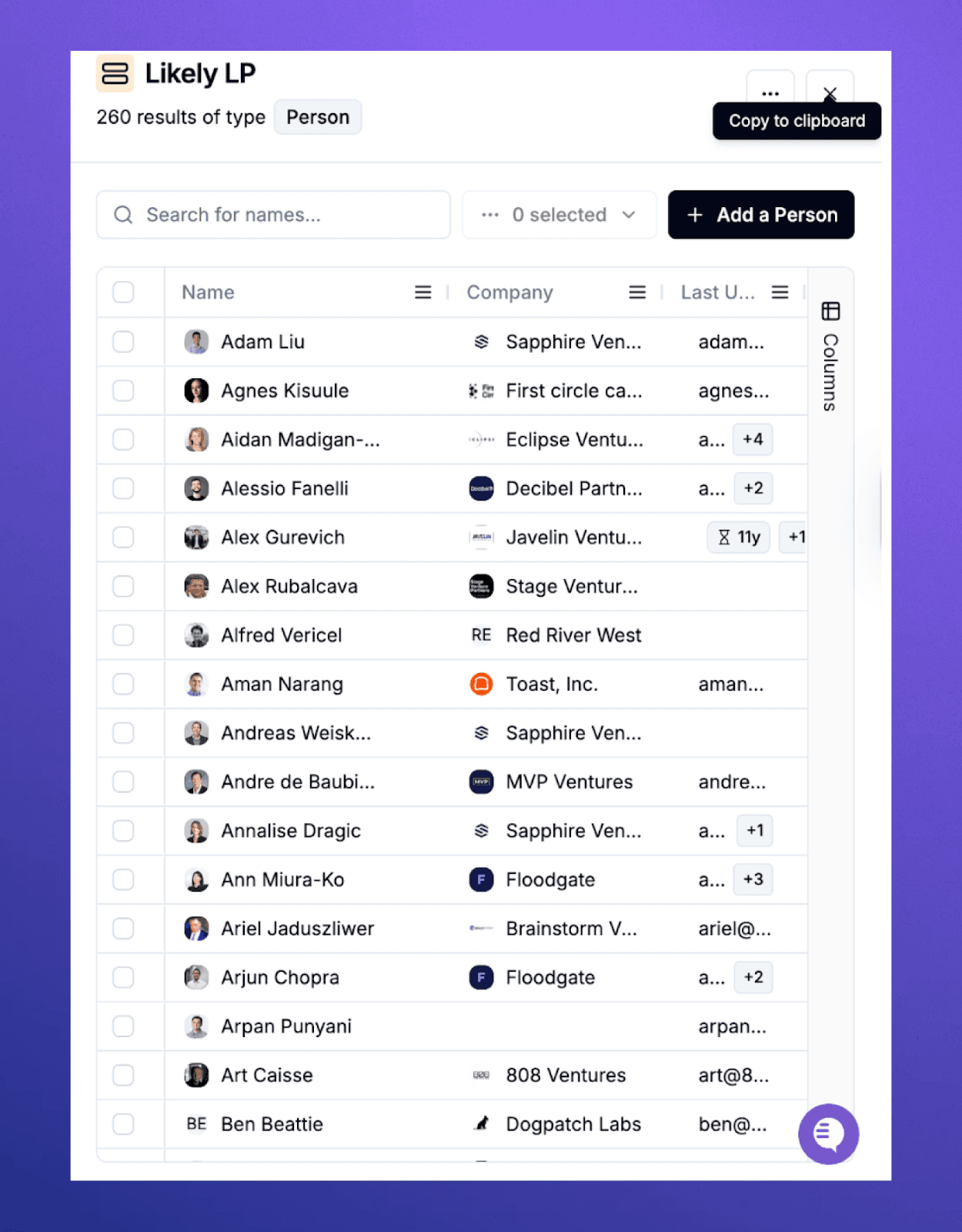
What is Relationship Intelligence
Relationship intelligence is the ability to understand relationships as active, evolving assets, not static records.
At its core, it answers a few operational questions teams deal with every day:
Who actually knows this person
How strong that relationship is
What the history looks like across time, not just the last interaction
How recent and relevant that connection is right now
This goes beyond contact data or activity logs. Relationship intelligence connects interactions, context, and continuity into a single view that teams can rely on when making decisions.
Traditional systems struggle here because they fragment context. Emails live in inboxes. Notes live in documents. Deals come and go. Over time, it becomes difficult to see the full relationship story in one place. This is especially visible in long-running deal flow, where conversations pause, restart, and resurface over months or years
True relationship intelligence depends on structure. It requires relationships to persist independently of transactions, with history attached to people and companies rather than individual processes. Research shows long-term context consistently outperforms short-term activity tracking.
When done well, relationship intelligence turns scattered interactions into shared understanding. It gives teams a reliable way to see how relationships have developed and where they stand today, without relying on memory or guesswork.
Why is Relationship Intelligence Important
Relationship intelligence matters because decisions in relationship-driven work are rarely made in isolation.
Teams constantly decide who should lead a conversation, when to re-engage, and how to approach someone based on past context. Without a shared view of relationships, those decisions default to memory, assumptions, or the loudest voice in the room.
The impact shows up quickly:
Warm paths are missed because no one knows who has history
Conversations restart without acknowledging prior context
Handoffs break down as teams grow or roles change
Decisions rely on personal knowledge instead of shared understanding
Over time, this creates inconsistency. Some relationships move forward smoothly. Others stall for reasons that are hard to explain after the fact.
Relationship intelligence reduces that friction by making context visible across the team. It gives decision-makers a clear view of relationship strength, recency, and history before they act. That clarity improves coordination, reduces duplicated effort, and leads to more intentional outreach.
Organizations that manage relationships as long-term assets make better decisions and sustain performance over time, compared to teams that rely on fragmented information and individual memory.
As teams scale, this becomes less about efficiency and more about reliability. Relationship intelligence ensures that understanding does not disappear when people change roles, deals pause, or time passes.
5 Step Process of How Relationship Intelligence Works
Relationship intelligence is not a single feature. It works through a sequence of steps that build on each other.
Capture
Relationship data starts with accurate capture. Emails, meetings, and interactions need to be logged automatically so context does not depend on manual updates. When capture is incomplete, everything downstream weakens.
Connect
Captured activity needs to be tied to the right people and companies. This is where systems move beyond transactions. Relationships persist even as deals change, pause, or close.
Measure
Once connections exist, strength can be assessed. Relationship intelligence looks at signals like frequency, recency, and depth of interaction. This creates a more reliable picture than static labels or self-reported fields.
Share
Intelligence only matters if it is visible. Relationship context must be accessible across the team so decisions are not siloed. Shared visibility reduces guesswork and improves coordination, especially as teams grow.
Apply
The final step is use. Relationship intelligence informs who should engage, when to reach out, and how to approach a conversation. Research from Harvard Business Review shows that teams make better decisions when relationship context is integrated into daily work rather than reviewed separately.
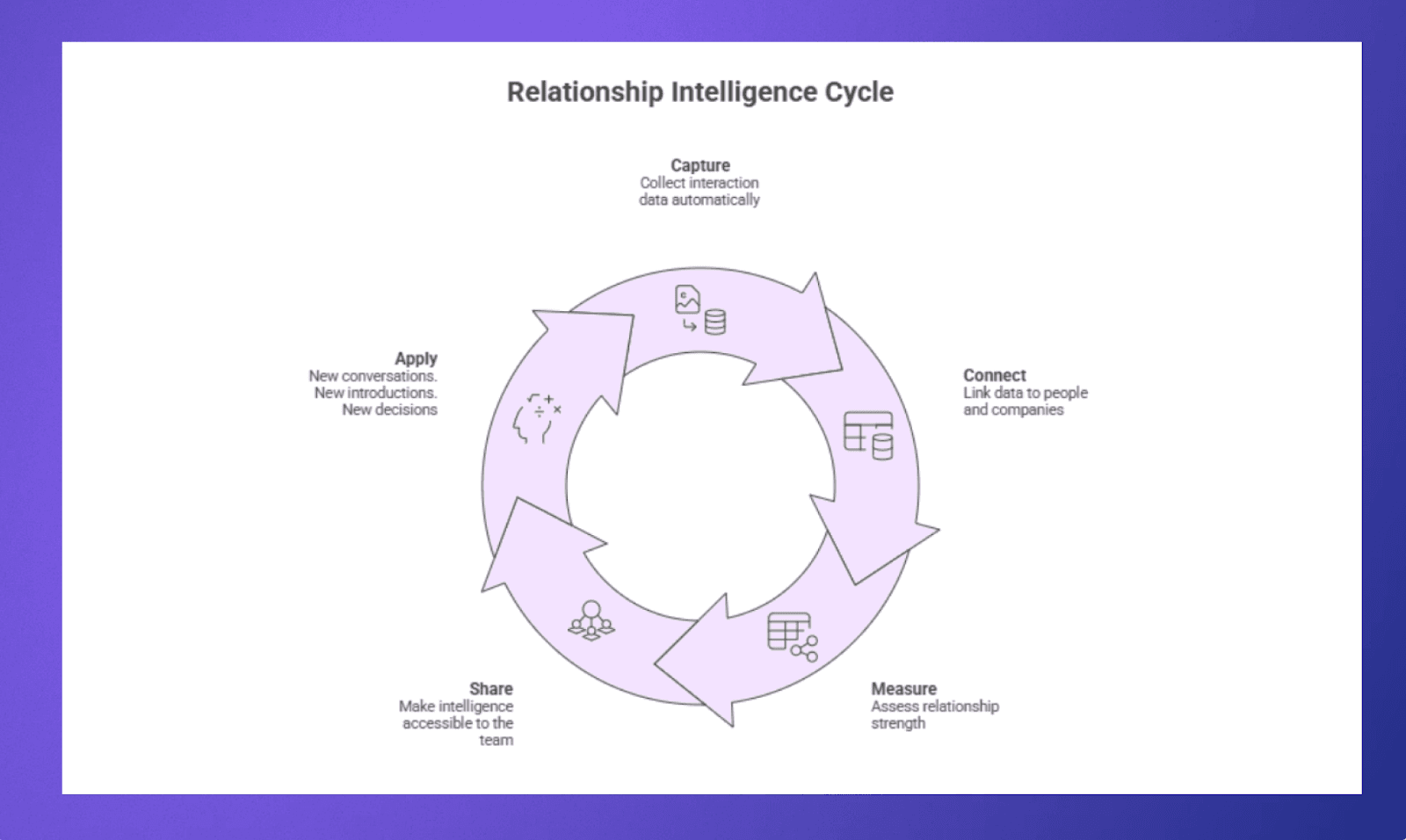
When these steps work together, relationship intelligence becomes part of how teams operate, not something they check after the fact.
5 Key Benefits of Relationship Intelligence
Relationship intelligence delivers value when it improves how teams decide and act, not when it adds more data.
Clear visibility into real relationships
Teams gain a clear view of who has real relationships and why they matter. This reduces reliance on assumptions and prevents decisions based on incomplete or outdated context.
Better coordination across the team
Shared relationship context improves handoffs and collaboration. Teams can align on who should lead outreach and how conversations should be approached, especially in non-linear deal flow.
Consistent context over long timelines
Relationship intelligence ensures continuity over time. As roles change or timelines stretch, context does not disappear. Decisions remain grounded in history rather than personal memory.
More efficient use of time and effort
When relationship strength and history are visible, teams avoid redundant conversations and unnecessary outreach. Time is spent acting on informed opportunities instead of rediscovering context.
Greater confidence in decisions
Decisions backed by relationship intelligence are easier to defend. Leaders can explain why a path was chosen, based on shared data rather than intuition alone. Organizations with better access to contextual information make more reliable decisions over time.
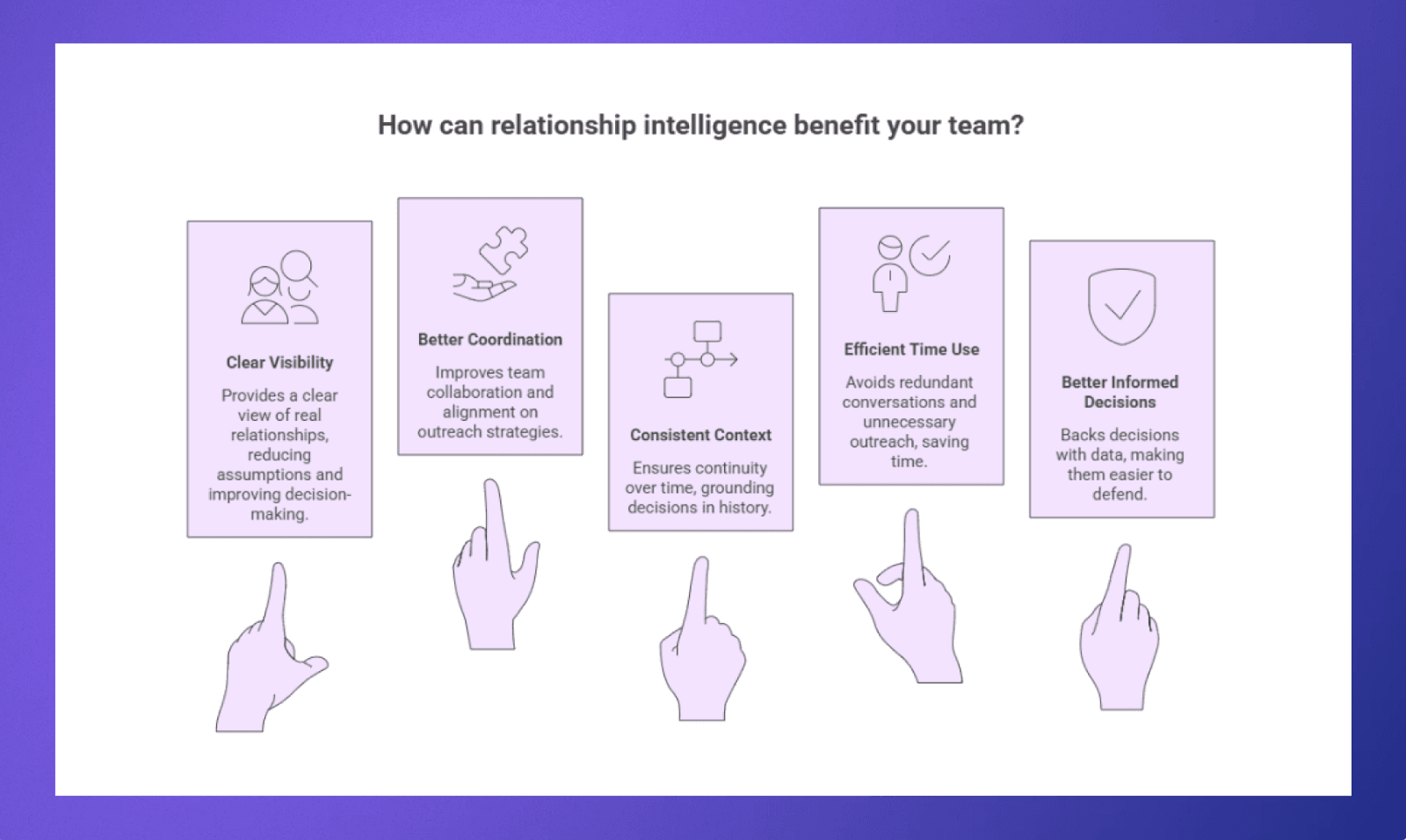
These benefits compound as teams grow. Relationship intelligence turns individual knowledge into an institutional asset instead of a personal one.
Where Traditional CRMs Fall Short
Traditional CRMs were built to track activity, not relationships.
They organize work around deals, stages, and records that open and close. Relationship context gets attached to transactions instead of people. Over time, that structure breaks down for teams working on long timelines.
Common gaps show up quickly:
Relationship history is fragmented across deals, emails, and documents
Past decisions are hard to reconstruct once a deal closes or stalls
Teams cannot easily see who knows whom or how strong those connections are
Context lives in individual inboxes instead of the system of record
As timelines stretch, these gaps compound. Teams rely on memory instead of shared data. New team members lack context. Coordination slows as people double-check information outside the CRM.
This is why many teams invest heavily in customization but still struggle. Configuration can change fields and views, but it does not fix a data model that treats relationships as temporary. CRMs fail most often when systems do not reflect how work actually happens over time.
For relationship-driven teams, the limitation is structural, not operational. Without a relationship-first foundation, CRMs capture activity but fail to deliver relationship intelligence.
How Rings AI Helps Teams Use Relationship Intelligence
Rings AI is built to make relationship intelligence usable in day-to-day work, not something teams have to infer or maintain manually.
Relationship context lives at the person and company level
Rings AI stores emails, meetings, notes, and decisions with people and companies, not buried inside closed or stalled deals. This keeps context intact as timelines stretch and relationships resurface. It also prevents history from being lost when deals pause or change shape.
Relationship strength is measured, not assumed
Rings AI analyzes email and LinkedIn activity across the team to understand how strong relationships actually are. This replaces guesswork with shared visibility and helps teams decide who should engage and when.
This depth is what turns contact data into real relationship intelligence, instead of static records.
The full team network is visible in one place
Teams can see who knows whom across the firm, not just their own contacts. That makes collaboration easier and reduces redundant outreach. It also helps teams surface the right introductions faster without relying on memory.
Context is surfaced when it matters
Rings AI summarizes relationship history, past conversations, and notes so teams can get up to speed quickly. This reduces prep time and ensures conversations start informed, even when ownership changes.
No heavy configuration to keep it usable
Relationship intelligence in Rings AI does not depend on constant customization or admin work. Context is captured automatically, ownership is clear, and reviews are lightweight. The system stays accurate without teams having to rebuild it as processes evolve.
For relationship-driven teams, this is what makes relationship intelligence sustainable, not just available.
Use Relationship Intelligence Where Decisions Are Made With Rings AI
Relationship intelligence only matters if your team can use it in real work. Rings AI keeps relationship context visible, shared, and accurate across long timelines, without added process or configuration.
Book a demo to see how Rings AI helps teams use relationship intelligence to make better decisions.
Learn more about XRM vs CRM, what is a CRM or CRM for venture capital firms.