
Most deal teams begin with a spreadsheet. It’s familiar, flexible, and already part of the workflow. For a small pipeline and a single operator, tracking company names, stages, check sizes, and notes in rows and columns can feel sufficient. Early on, the limitations are not obvious.
But as complexity increases, more deals enter the funnel, multiple partners interact with the same founder, and LP updates reference historical conversations, what started as a simple tracker gradually becomes the place where institutional memory either survives or fragments.
The real question isn’t whether spreadsheets work. It’s whether they remain sufficient as deal volume, relationships, and reporting demands grow.
This article breaks down where each approach fits, where each falls short, and how to decide which supports your deal workflow over the long term. As your process evolves, systems built for relationship-led investing, such as Rings AI, become part of that evaluation. If you’re assessing whether your current setup can support disciplined deal execution, book a demo.
CRM vs Spreadsheet: What’s the Difference
Both CRM and a spreadsheet can track deals. You can list company names, stages, expected close dates, and notes in either system. The difference is not whether they store information. It is how they structure, connect, and preserve that information over time.
A spreadsheet is a table. A CRM is a system. As deal complexity increases, that distinction becomes operational.
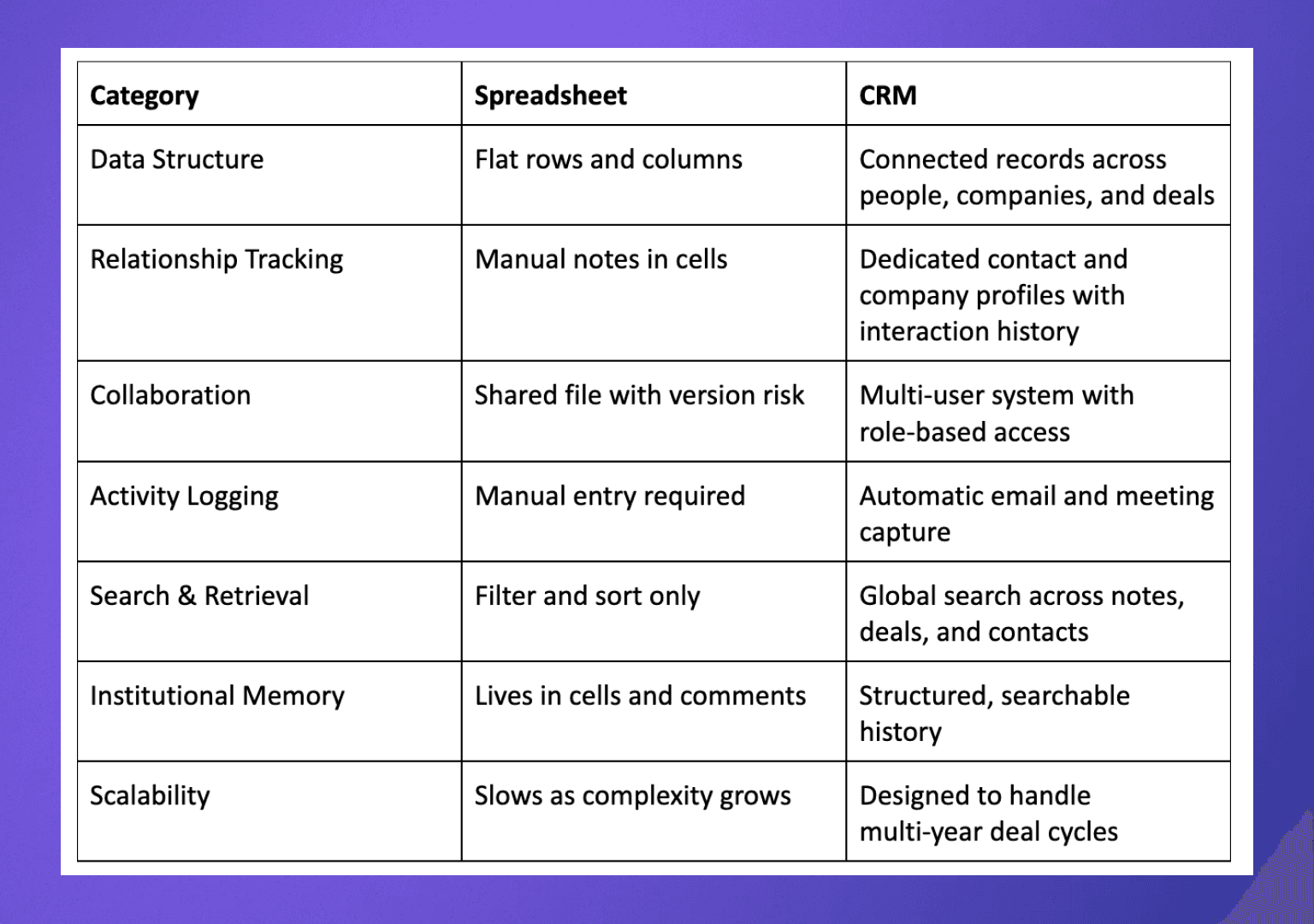
For a single operator tracking a small pipeline, a spreadsheet may be sufficient. As multiple stakeholders, overlapping fundraising cycles, and long-term portfolio oversight come into play, structure begins to matter more than simplicity.
Why a Spreadsheet isn’t Enough for Deals?
Spreadsheets work well when deal activity is limited, and ownership is centralized. As soon as multiple partners, associates, or operating team members begin contributing to the same pipeline, the limitations become structural rather than cosmetic. What once felt flexible starts to introduce friction, duplication, and blind spots.
The core issue is not that spreadsheets cannot store information. It is that they do not connect it. A founder’s prior conversations, a banker’s introduction history, diligence notes, and LP update references all sit in separate cells or tabs. Over time, context becomes fragmented, and teams rely more on memory than on record. That creates risk in long-cycle investing, where decisions often reference conversations that happened years earlier.
Operational strain typically appears in predictable ways:
Manual updates create inconsistencies across versions of the same file
Relationship history lives outside the sheet, usually in inboxes
Notes become unstructured and difficult to search at scale
Collaboration introduces overwrites, formatting drift, and version control issues
Reporting for LP updates requires separate aggregation and reconciliation
As deal flow expands, spreadsheets become harder to govern and easier to misinterpret. For firms managing active pipelines alongside fundraising and portfolio oversight, the lack of structured relationship context becomes more noticeable with each additional deal.
How CRMs Add Structure That Spreadsheets Can’t?
A CRM is not simply a more advanced spreadsheet. It is a structured system built to connect people, companies, deals, and interactions into a unified record.
Instead of isolating information inside rows and tabs, a CRM links it across the entire relationship lifecycle. That distinction becomes meaningful as soon as a firm manages multiple parallel conversations, overlapping deal stages, and long-term LP engagement.
In a spreadsheet, context must be entered manually and interpreted manually. In a CRM, activity, communication history, and relationship ownership are captured and organized automatically. This reduces administrative overhead while increasing clarity around who has interacted with whom, what was discussed, and how a deal has progressed over time.
CRMs add structural advantages that spreadsheets cannot replicate at scale:
Dedicated profiles for every contact and company with centralized interaction history
Automatic email and calendar syncing that eliminates manual logging
Role-based access and real-time collaboration across the team
Searchable notes and files connected directly to deals and stakeholders
Reporting views that reflect live pipeline status without rebuilding formulas
The structural foundation of a CRM determines whether information remains static or becomes actionable intelligence. For deal teams operating across long timelines, structure is not a luxury. It is what turns scattered data into shared institutional memory.
Cost and Complexity Considerations
Spreadsheets become a problem as deal volume increases and manual coordination begins, absorbing time that should be spent on underwriting and relationship management.
Key considerations include:
Upfront Cost: Spreadsheets are low-cost; CRMs require subscription investment
Administrative Time: Spreadsheets demand manual updates and reconciliation
Reporting Effort: LP updates often require rebuilding formulas and consolidating tabs
Collaboration Risk: Version control issues increase with team size
Scalability: Complexity grows faster than the spreadsheet structure can handle
Research from Deloitte on private equity operations highlights that firms investing in scalable infrastructure tend to improve governance and execution discipline. For teams comparing systems, evaluations such as Rings AI vs Pipedrive illustrate how CRM structure differs from manual tracking approaches.
In long-cycle deal environments, the true cost is rarely the software itself. It is the operational friction that accumulates when the structure does not scale.
CRM vs Spreadsheet: Which Is Better for Long-Term Deal Execution?
The right choice depends on how your deal workflow operates today and how it is likely to evolve. A spreadsheet can support early momentum, but long-term execution introduces coordination, visibility, and reporting demands that rarely remain static. The decision is less about preference and more about scale, collaboration, and institutional memory.
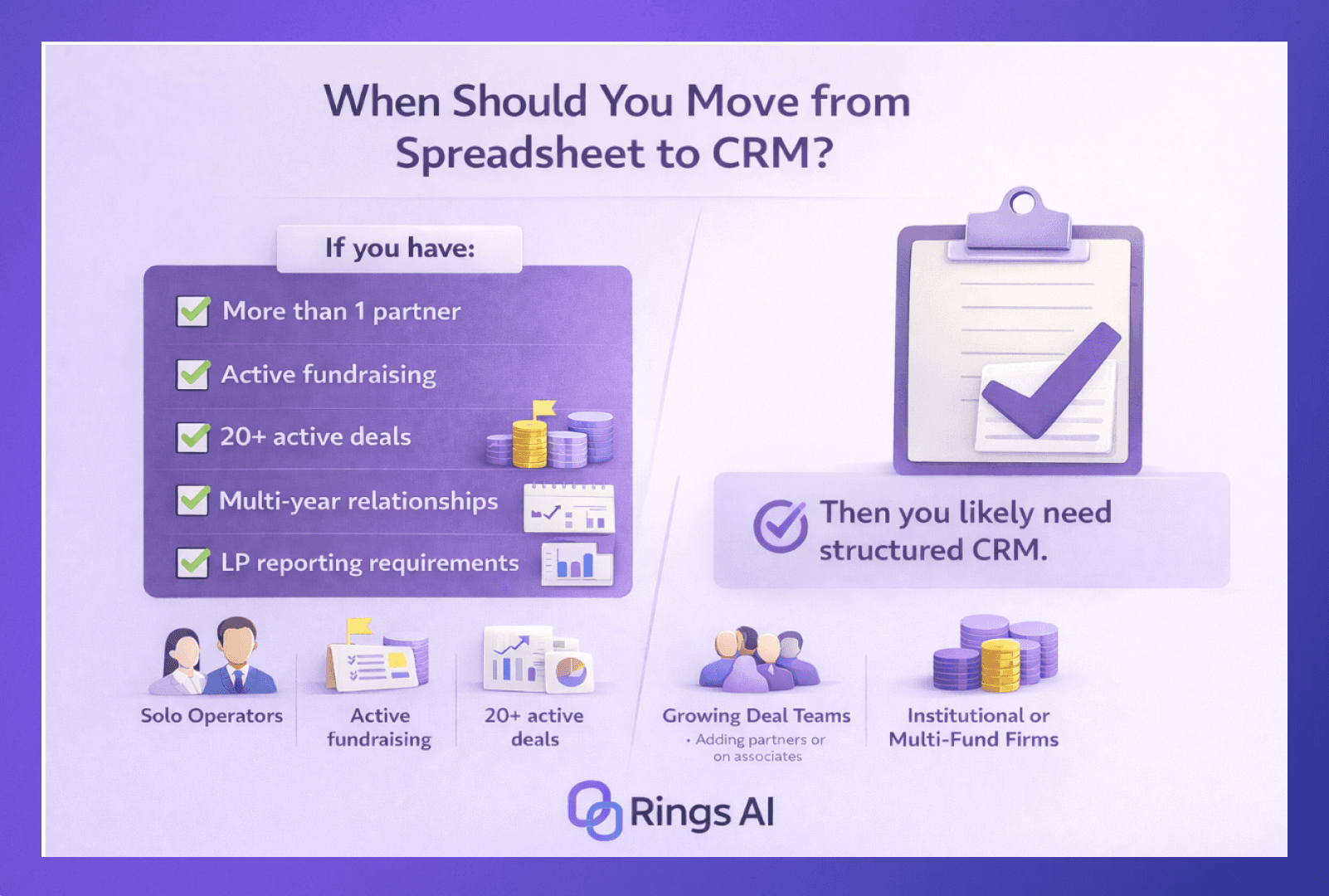
For Solo Operators
If you are managing a small pipeline independently, a well-maintained spreadsheet may be sufficient. The simplicity can be efficient when relationship depth and reporting complexity are limited. The constraint appears once conversations span years or fundraising overlaps with active deal management.
For Emerging Managers
If you are launching your first fund or transitioning from angel investing into institutional capital, spreadsheets often feel practical in the early days. The inflection point comes quickly once LP conversations formalize and deal flow increases. What begins as a lightweight tracker can become difficult to maintain when fundraising, diligence, and portfolio oversight overlap.
For Growing Deal Teams
As additional partners, associates, and operating leads engage with the same relationships, shared visibility becomes critical. Version control, manual updates, and disconnected inbox history begin to introduce friction. At this stage, structure often becomes more valuable than flexibility.
For Institutional Investors
Firms managing multiple funds, active LP communication, and portfolio oversight across long timelines require durable institutional memory. Decisions frequently reference prior diligence, board discussions, and historical theses. Systems designed to centralize relationship intelligence offer structural advantages over flat tracking documents.
In early phases, spreadsheets can support speed. Over time, long-cycle investing tends to reward systems that preserve context and scale with complexity.
Why Rings AI Is Built for Deal Teams
Most teams do not move from a spreadsheet to a CRM because they want more features; they move because complexity outpaces manual tracking. When deals overlap, LP conversations run in parallel, and multiple partners engage the same founder at different points in time. Traditional sales-focused CRMs often introduce structure, but not always the relationship depth investment teams require.
Rings AI was built specifically for investors who operate across long timelines and recurring relationships. Instead of organizing work around short-term opportunities, it structures data at the person and company level so context compounds over time.
Key capabilities include:
Automatic email and meeting capture connected to people and companies
Firm-wide visibility into relationship strength and interaction history
Centralized notes and files linked across deals and stakeholders
AI-powered search and summaries across historical conversations
Unified deal and fundraising workflows inside the same system
If your deal workflow depends on preserved context and shared visibility, see how Rings AI supports long-cycle execution. Book a demo.
Learn more about deal sourcing.