
Private equity firms operate in an environment where decisions depend on the quality of their data. Investor conversations, portfolio company performance, deal pipeline activity, diligence materials, and relationship history all influence whether a firm can source better deals, move faster, and create value after acquisition.
The problem is that most firms still manage this information across spreadsheets, disconnected CRMs, email inboxes, shared drives, and individual team members’ notes.
As firms grow, that fragmentation creates blind spots. Teams lose track of who knows whom, which deals are active, where diligence stands, and which portfolio companies need attention.
Strong private equity data management solves that problem. It creates a single system where deal, investor, and portfolio information is accurate, accessible, and easy to act on.
What is Private Equity Data Management?
Private equity data management is the process of collecting, organizing, updating, and using all the information that matters across the investment lifecycle. That includes deal pipeline data, investor and LP relationships, meeting notes, portfolio company information, diligence materials, and internal communications.
The goal is not simply to store information. It is to make sure the right people can access the right information at the right time.
When a partner prepares for a meeting with a founder, they should immediately be able to see:
Previous conversations
Shared contacts
Relevant portfolio companies
Past deals in that sector
Notes from colleagues
Company news and recent updates
That context shapes the quality of the conversation and, ultimately, the future relationship. When teams go into meetings prepared, they ask better questions, build more credibility, and identify opportunities faster.
Private equity firms increasingly need a centralized extended relationship management (XRM) platform rather than a traditional CRM. A standard CRM can track contacts and deals, but it often struggles to manage the layered, multi-party relationships that drive private equity.
Why Data Management is Essential in Private Equity
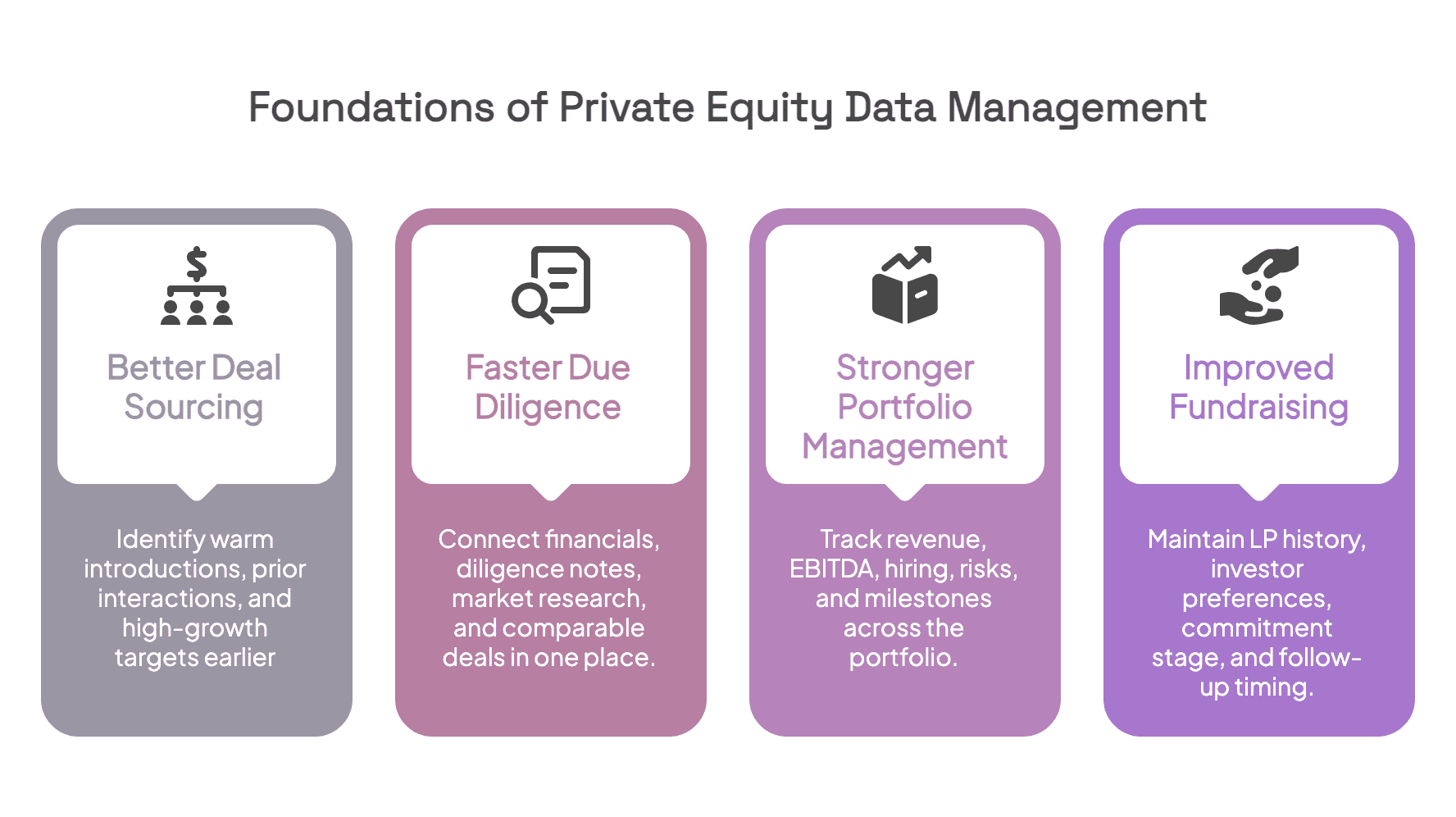
Private equity firms compete on access, speed, and judgment. Data management improves all three. This ultimately results in:
Better deal sourcing
The best private equity deals rarely come through cold outreach. Firms source stronger opportunities by building direct relationships with founders, bankers, advisors, and portfolio executives long before a company formally enters a process.
A strong data management system makes those relationships visible by showing who in the firm knows a founder, whether the company has been evaluated before, and where warm introductions exist.
The strongest firms also combine relationship intelligence with industry expertise and thematic targeting. By using technology and big data to identify high-growth companies early, firms can focus on the opportunities most likely to fit their investment strategy.
Faster due diligence
Effective private equity due diligence depends on how quickly a firm can access and connect the information behind a potential investment. Teams need immediate visibility into financial models, management meeting notes, legal documents, market research, internal opinions, and comparable deals evaluated in the past.
When that information is centralized, firms can identify risks earlier, test assumptions more thoroughly, and move through the diligence process with greater speed and confidence.
Stronger portfolio management
After a deal closes, private equity firms need a clear view of performance across every portfolio company. The strongest firms track not only revenue growth and EBITDA, but also hiring plans, operational improvements, board discussions, key risks, and strategic milestones.
A well-managed data system allows firms to compare companies, identify issues early, and support portfolio executives more effectively.
Improved fundraising
Successful fundraising depends on maintaining a clear record of LP conversations, investor preferences, meeting history, commitment stage, follow-up timing, and warm introduction paths.
When those details are not tracked consistently, firms risk missing follow-ups or approaching investors without context.
Common Data Management Challenges in Private Equity
Despite the importance of data, many private equity firms continue to face the same operational challenges.
Information lives in too many places: Critical information is often spread across spreadsheets, inboxes, shared drives, and legacy CRMs. As a result, teams work from incomplete or conflicting information and lose valuable context over time.
Manual data entry creates errors: Traditional CRMs rely heavily on manual updates, which means meetings go unlogged, notes remain incomplete, and records quickly become outdated. Eventually, teams stop trusting the system and return to their own spreadsheets and inboxes.
Relationships are hard to track: Most systems capture direct contacts but fail to show second-degree connections, shared relationships, and warm introduction paths. That is a major limitation in private equity, where access often depends on who knows whom.
No single source of truth: When different teams maintain their own version of the data, firms lose alignment. Duplicate outreach, missed follow-ups, and unclear ownership become common, slowing down execution across the firm.
Best Practices for Private Equity Data Management
The strongest firms treat data management as part of their operating model, not an administrative task. Here are the best practices that keep data accurate, accessible, and actionable.
1. Build a centralized data repository
Every firm needs a single system where relationship, deal, investor, and portfolio data live. That repository should include companies, contacts, deals, LP relationships, notes, documents, and activity history in one place.
A centralized repository reduces duplication and makes sure everyone works from the same information.
2. Standardize data entry
Firms should create a consistent structure for entering and organizing information. For example:
Use the same naming format for companies and contacts
Define standard deal stages
Create templates for meeting notes
Standardize portfolio reporting metrics
Without standardization, data quickly becomes difficult to search and compare.
3. Automate wherever possible
Manual data entry is one of the biggest reasons private equity data becomes incomplete or outdated. The most effective systems automatically capture emails, calendar activity, meeting notes, contact updates, company information, and relevant news.
Automation makes data more accurate and more useful.
Many firms are moving away from spreadsheet-style tools because they require too much manual maintenance and offer limited relationship intelligence. Platforms such as Airtable may work for basic operational tracking, but they often struggle when firms need deeper relationship mapping and investor intelligence.
4. Prioritize relationship mapping
Private equity firms should track more than who they know. They should understand how those relationships connect across the firm and the broader market.
That means identifying:
Which colleagues know a contact best
Which founders are connected to current portfolio companies
Which LPs overlap across funds
Which advisors can make introductions
Relationship mapping gives firms a competitive advantage by helping them find the warmest path into every opportunity.
5. Keep data fresh
Even the best system loses value if the information is outdated. Firms should regularly review stale contacts, inactive deals, missing meeting notes, and outdated investor records.
The strongest platforms automatically surface changes such as new funding rounds, executive hires, company news, and leadership transitions, so teams are always working with current information.
6. Make data accessible across the firm
Investment professionals, operating partners, investor relations teams, and leadership should all be able to access the information relevant to them. However, access should still be controlled based on role and confidentiality.
A good data management platform balances transparency with security.
The Best Tools for Private Equity Data Management
There are several categories of tools that private equity firms use:
Spreadsheet and database tools
Some firms rely on spreadsheets or platforms such as Airtable because they are flexible, easy to implement, and familiar to teams used to spreadsheet-style workflows.
However, as firms grow, these tools become harder to maintain. They create silos, require constant manual updates, and do not provide the relationship intelligence private equity firms need. For a closer look, see our detailed review of Airtable.
Traditional CRM tools
Traditional CRMs, such as Salesforce and HubSpot, can track contacts and deal stages, but they are often designed for sales teams rather than private equity firms.
They typically require heavy customization and still struggle with relationship mapping, investor tracking, and portfolio visibility. If you are evaluating whether a CRM is the right fit compared with spreadsheets, you may also want to read our guide on CRM vs Spreadsheet.
XRM platforms
Private equity firms are increasingly using an extended relationship management (XRM) platform rather than a traditional CRM. XRM platforms are designed to manage the complex, multi-party relationships that exist across founders, investors, bankers, advisors, LPs, and portfolio companies.
They combine deal tracking with relationship intelligence, portfolio visibility, and AI-driven prospecting, giving firms a clearer view of the people and companies that drive investment decisions.
Why Rings AI is the Best Tool for Private Equity Data Management
Rings AI is built specifically for firms that depend on relationships, deal flow, and network visibility. Unlike generic CRMs, Rings does not simply store contacts. It gives firms a complete view of how they are connected to founders, investors, bankers, advisors, LPs, and portfolio companies.
Rings automatically captures activity from email, calendar, and LinkedIn to build up-to-date relationship profiles.
What sets Rings apart is the depth of its relationship intelligence. Rings maps connections across the entire firm, surfaces the strongest paths into an opportunity, and enriches more than 100M+ data points every day to keep contact and company information.
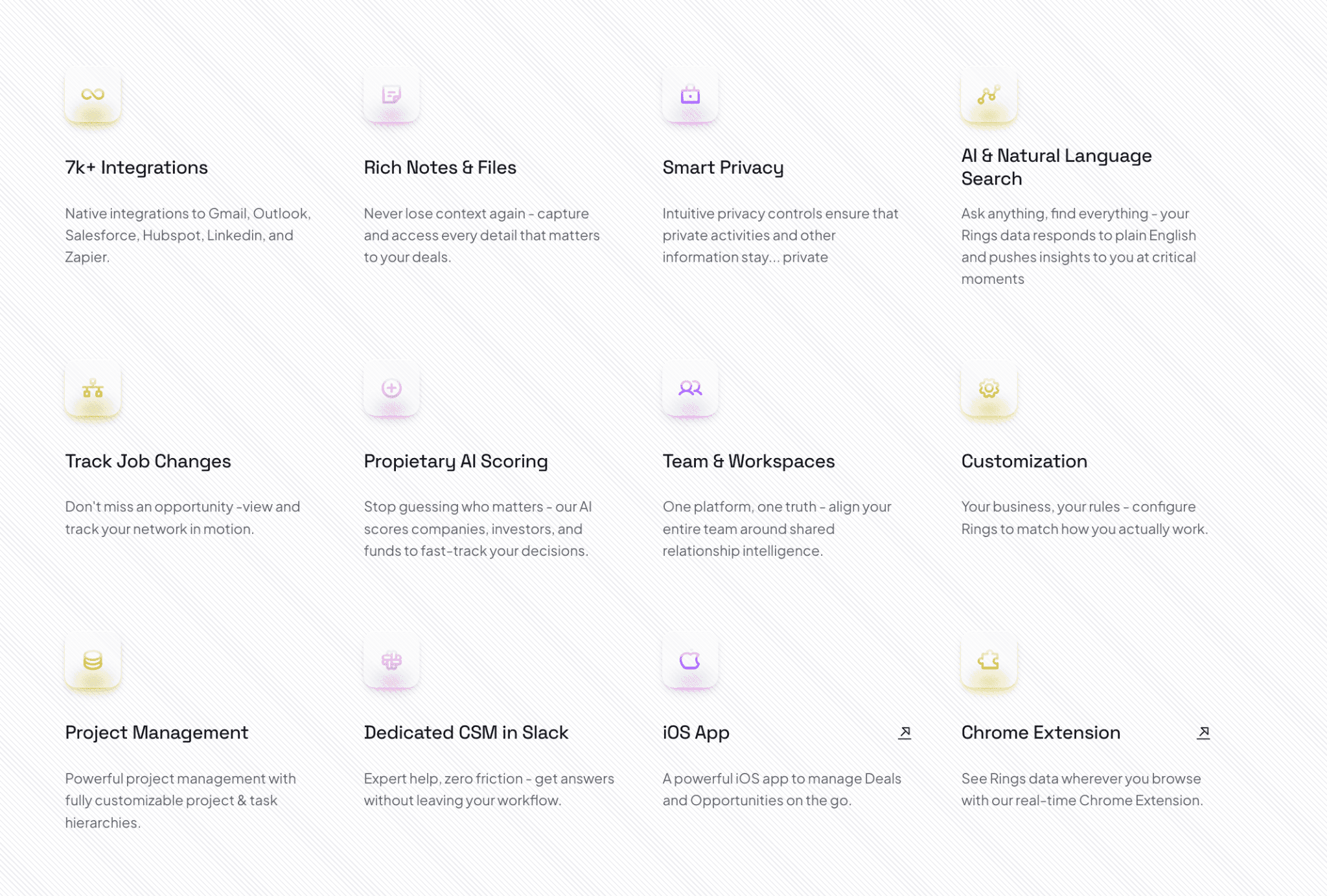
Comprehensive list of Rings AI’s private equity data management capabilities
Most importantly, Rings gives private equity firms a true single source of truth. Everyone works from the same data, with the same relationship history and deal context.
Turn Data Into a Competitive Advantage
Private equity firms cannot afford to manage critical information through disconnected spreadsheets, outdated CRMs, and scattered notes.
The firms that win are the ones that manage data deliberately. They centralize information, automate updates, map relationships, and make it easy for teams to act on what they know.
Traditional tools may help with basic contact tracking, but they are not designed for the complexity of private equity data management.
Book a demo with Rings AI to see how it can improve every stage of your investment process with solid data management.