
Imagine you’re launching your startup into a crowded market. You’ve got a strong product, a scrappy team, and a short list of dream customers or investors. But trying to reach them feels like navigating a city you’ve never visited; every street looks the same, every turn could be a dead end, and the GPS only shows obvious landmarks and main roads, not the secret shortcuts.
That’s where relationship mapping comes in.
Instead of just following the usual path to new connections, relationship mapping gives you a live, interactive visual of who actually knows whom, including the warm introductions, unseen partnerships, and best routes that lead you to your next deal, customer, or investor.
Let’s see how relationship mapping works, how it can help startups and businesses scale, share practical examples, and show how Rings AI can help you transform raw connection data into actionable relationship intelligence.
What is Relationship Mapping
Relationship mapping is the practice of visually representing the people and organizations connected to an account, deal, or market, along with how they influence each other. Instead of just showing a stagnant list of contacts in a CRM, a relationship map reveals decision makers, blockers, champions, and connectors in a single view.
What Benefits Do Relationship Mapping Provides
Relationship mapping turns relationship data into a strategic asset instead of a static database. It helps teams see not only who is connected, but also how strong each relationship is, who trusts whom, and where influence really sits.
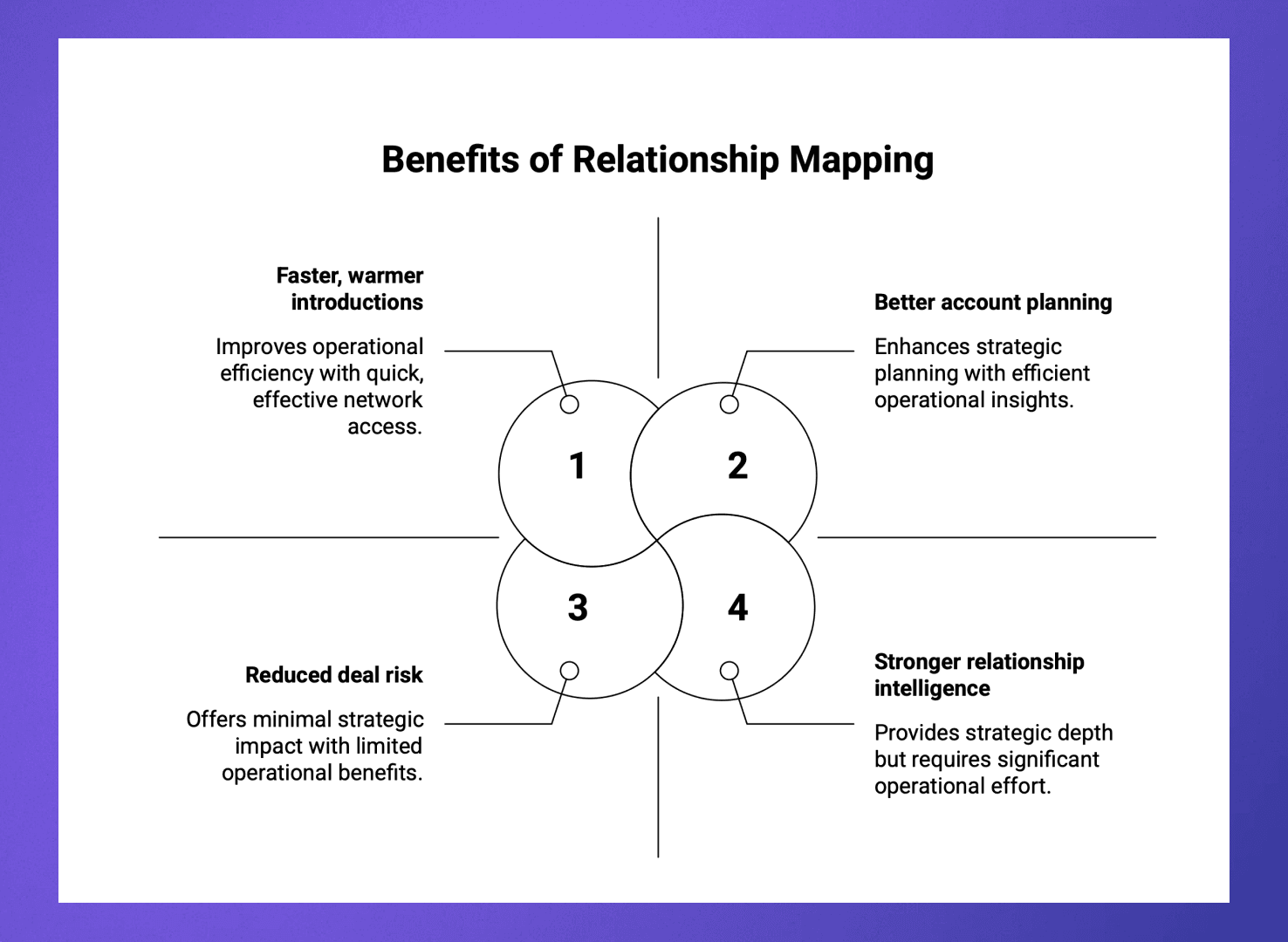
Some of the biggest benefits of relationship mapping include:
Better account planning: Teams can see decision makers, influencers, and internal champions in one place, then design targeted engagement plans.
Stronger relationship intelligence: Combining mapping with behavioral data (emails, meetings, interactions) surfaces relationship strength and momentum, not just org chart lines.
Faster, warmer introductions: By visualizing shared connections across a company’s network, teams uncover indirect paths into target accounts that would be hard to spot manually.
Reduced deal risk: Maps highlight single-threaded deals, at-risk relationships, and isolated champions long before problems show up in the forecast.
When this visibility is shared across teams and systems, relationship mapping becomes a powerful layer of business intelligence, not just a visual exercise.
How Relationship Mapping Works
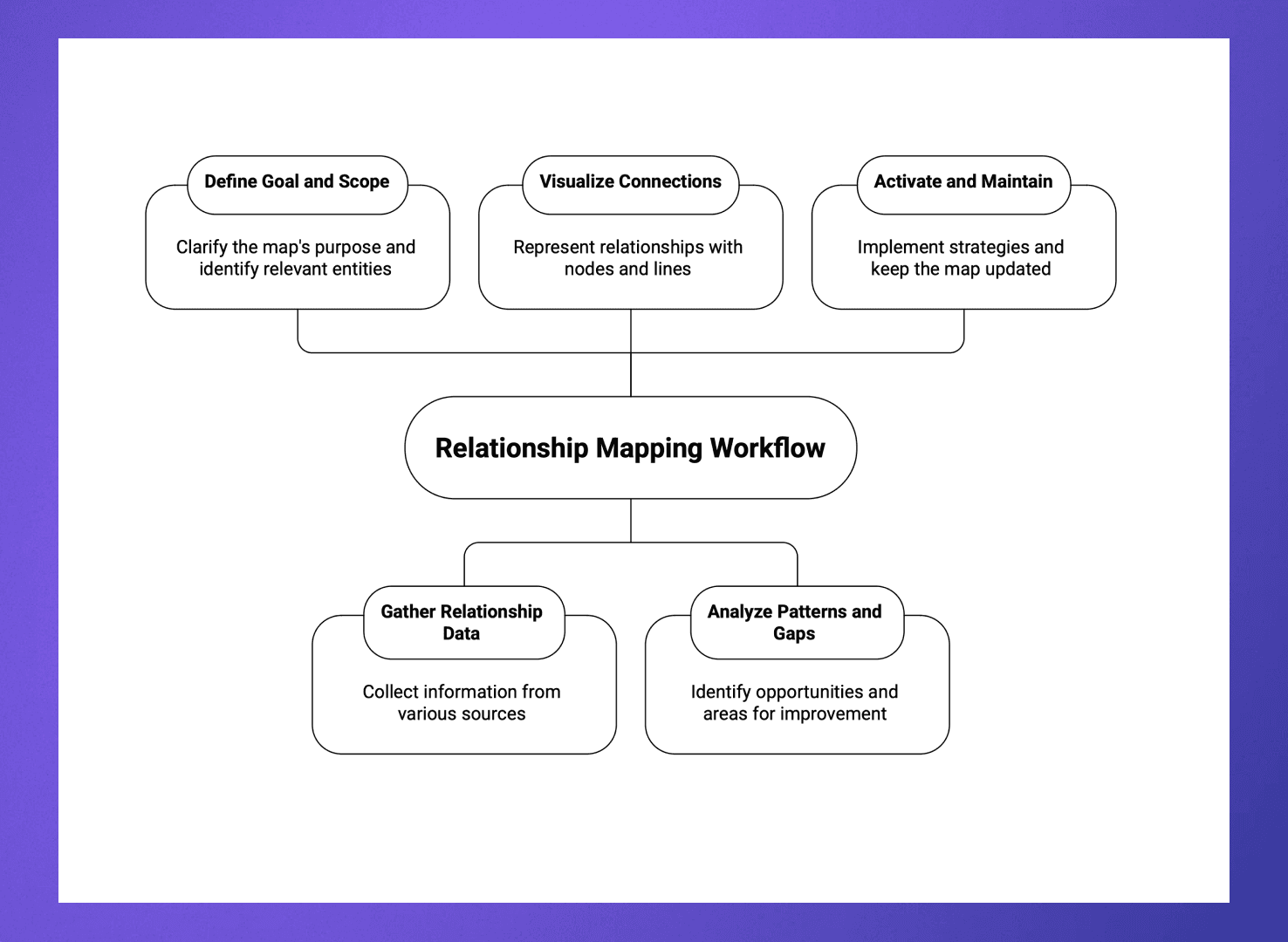
At a high level, relationship mapping follows a repeatable workflow that combines human insight with automated data capture. It typically involves five steps:
Define the goal and scope: Teams begin by clarifying the question the map should answer, such as “Who can influence this deal?” or “Where are our warmest paths into these target accounts?” and identifying which people and organizations to include.
Gather relationship data: Relationship information comes from CRM records, email/calendar data, social connections, board memberships, and the lived experience of sales, partners, and executives. Advanced platforms automatically ingest these signals, so teams do not rely only on memory or manual notes.
Visualize connections and attributes: The people and organizations become nodes on the map, while lines represent relationships, annotated with strength, trust level, and type.
Analyze patterns and gaps : Teams look for opportunities, missing champions, or underused warm paths that could accelerate outreach. This analysis informs account plans, fundraising strategies, and stakeholder engagement tactics.
Activate and maintain the map : The final step is turning the map into concrete steps of who should reach out, to whom, and in what order. Tools like Rings AI make this easy by weaving relationship insights right into your daily workflows, so your map is always up to date.
How Relationship Mapping Can Help Your Business
Relationship mapping shines when it comes to making business decisions. You use relationship mapping for:
Finding customers: Early‑stage startups can map founders’ existing networks; past colleagues, alumni, advisors, angel investors to systematically identify warm paths into their ideal customer profile. Relationship maps help prioritize who to approach first, who should introduce you, and which connections are strong enough to pursue.
Fundraising and investor targeting: Founders can use relationship mapping to see which angels, seed funds, or investors are a few steps away via existing investors, portfolio founders, or executives.
Customer expansion and land‑and‑expand motions: Growth‑stage startups can map internal champions, adjacent departments, and executive sponsors to identify where to cross‑sell or upsell.
Advanced Techniques: From Mapping To Intelligence
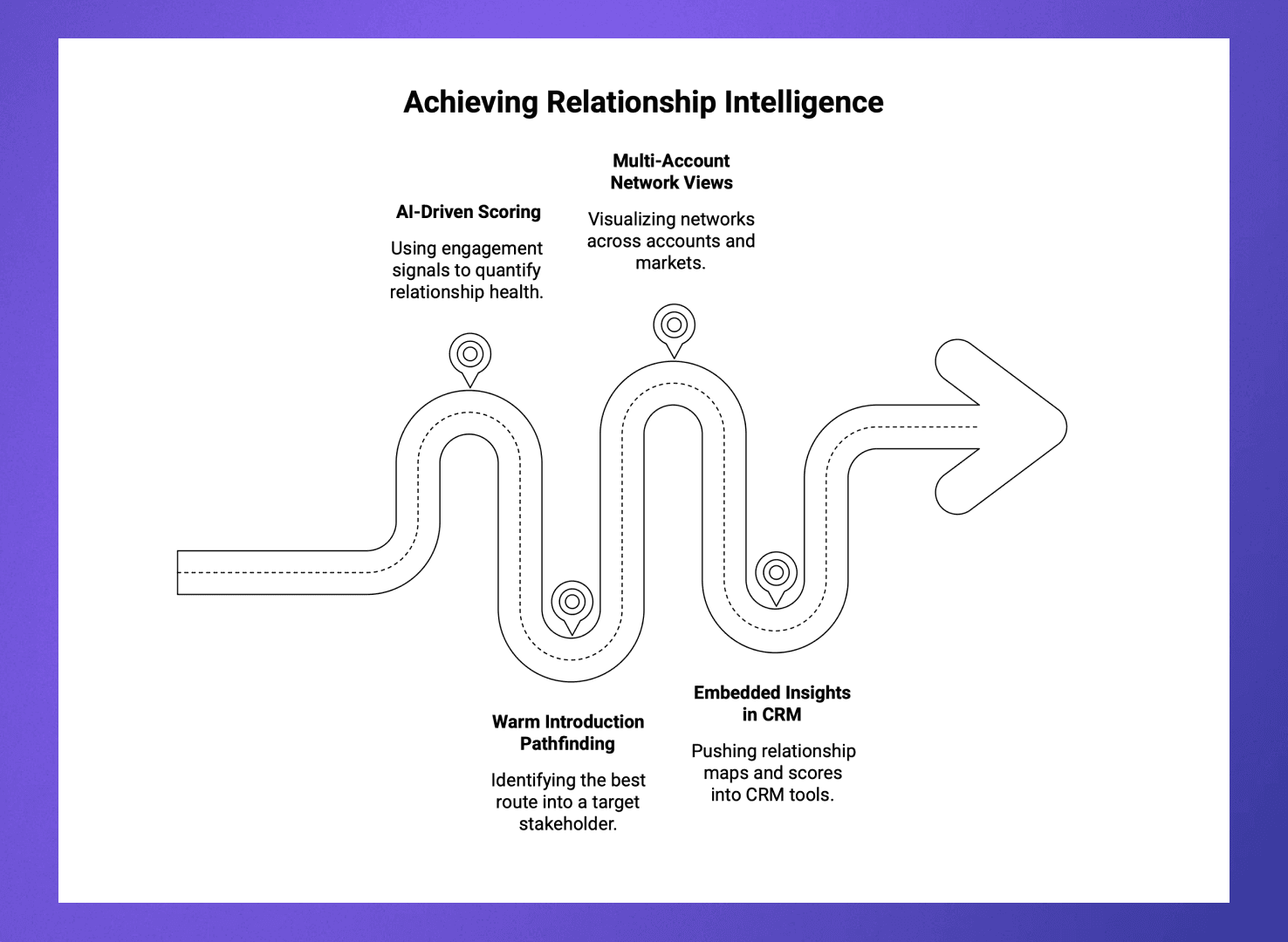
Leading teams go beyond basic diagrams. Relationship mapping acts as a backbone for relationship intelligence and revenue strategy. Some advanced capabilities include:
AI-driven relationship scoring: Using engagement signals like email frequency, meeting cadence, and responsiveness to quantify relationship health, helping teams prioritize outreach.
Warm introduction pathfinding: Automatically identifying the best internal or external route into a target stakeholder based on shared connections and relationship strength.
Multi-account network views: Visualizing networks across accounts, portfolios, and markets to reveal patterns, clusters, and cross-sell opportunities.
Embedded insights in CRM: Pushing relationship maps, scores, and recommended next steps directly into tools like Salesforce and HubSpot so teams act where they already work.
How Rings AI Enhances Relationship Mapping
Rings AI is built specifically to centralize and activate relationship intelligence across your company, not just log interactions. By connecting to email, calendar, notes, files, and CRMs, Rings AI automatically captures relationship signals and turns them into shared maps, scores, and warm-intro paths.
Here’s a closer look at the key benefits of Rings AI:
Automated relationship discovery: Rings AI uncovers shared connections across your company, showing who knows whom and how strong each relationship is, no manual input needed.
Centralized relationship insights: Teams get one clear view of relationship history, deal context, and introduction paths across all accounts.
Privacy-first collaboration: Built-in privacy controls let teams share insights as needed while keeping sensitive information protected.
CRM augmentation, not replacement: Rings AI adds relationship intelligence to tools like Salesforce and HubSpot, turning them from static databases into dynamic platforms for relationship growth.
Improve Relationship Mapping With Rings AI
Relationship mapping isn’t just another tool; it’s the key to revealing the fastest paths to dream customers or investors. Picture your team huddled around a live relationship map: Scattered contacts from emails, calendars, and CRMs have transformed into a crystal-clear visual network of opportunities.
Enter Rings AI, the relationship intelligence platform trusted by high-growth teams to automate relationship mapping. With privacy controls for secure collaboration, seamless CRM integrations, and real-time market data, Rings AI elevates your business intelligence without replacing your stack.
Ready to map your way to faster deals? Start your free Rings AI trial today.
Rings AI gives deal teams full visibility into relationship context, deal flow, and pipeline activity. Book a demo to see how Rings AI can strengthen your deal management process.
Learn more about CRM for venture capital firms.