
Private equity due diligence is the process of thoroughly evaluating a potential investment before committing capital. It's where deals get validated (or killed!).
For PE firms, due diligence is more than just a checkbox exercise. It's the difference between a portfolio company that generates strong returns and one that drains resources for years. The stakes are high: a single missed liability, overlooked operational issue, or flawed financial assumption can turn a promising deal into a costly mistake.
This guide breaks down how PE teams approach due diligence. We'll cover what areas to look at, how to build your due diligence team, and tools that can help you.
What Private Equity Due Diligence Actually Covers
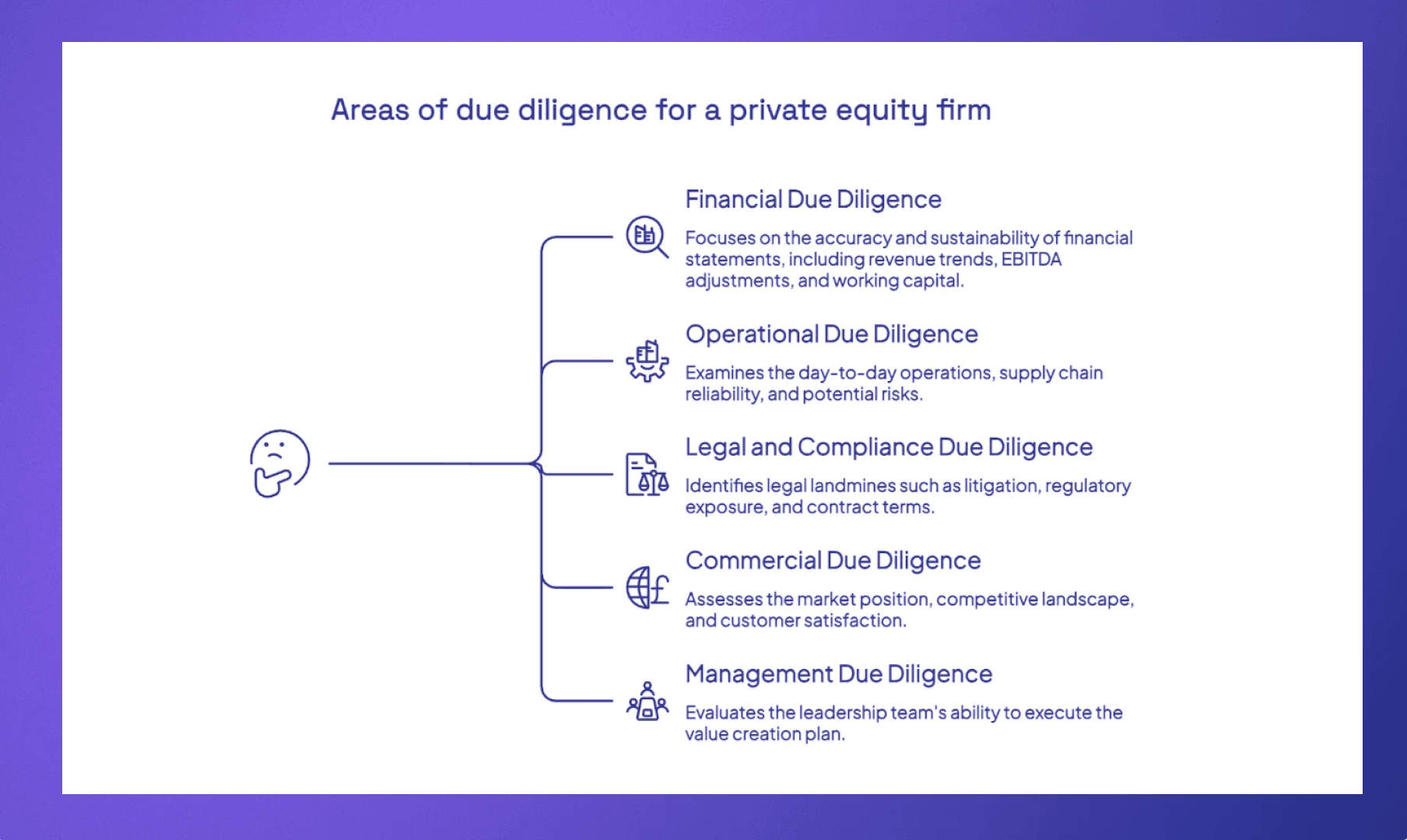
Due diligence is not just one thing. It's several workstreams running in parallel. Each looks at the target company from a different angle. The goal is to build a complete picture before you commit capital.
Here's what most PE teams focus on.
Financial Due Diligence
This is usually the most intensive workstream.
The core questions: Are the financials accurate? Are revenue and margins sustainable? What's the quality of earnings once you strip out one-time items and accounting adjustments?
Teams typically dig into:
Historical revenue trends and customer concentration
EBITDA adjustments and add-backs
Working capital patterns and cash conversion
Debt structure and off-balance-sheet liabilities
Quality of earnings gets a lot of attention here. Sellers often present adjusted EBITDA that adds back "non-recurring" expenses, but some of those expenses have a way of recurring every year. A good diligence team will scrub each add-back and push back on anything that looks like it's inflating the number.
Customer concentration is another red flag to watch. If 40% of revenue comes from one client, you're not just buying a business; you're betting on that relationship staying intact post-close. The same goes for revenue that's lumpy or heavily back-loaded toward year-end.
The goal is to confirm the numbers and find what's been left out or framed too optimistically. What looks like a clean P&L often has a few surprises buried in the footnotes.
Operational Due Diligence
Financials tell you what happened. Operations tell you whether it can keep happening.
This is where you look at supply chain reliability, vendor dependencies, production capacity, and how the business actually runs day-to-day. For service businesses, it's more about delivery model, utilisation rates, and key person risk.
A few things that often surface here: over-reliance on a single supplier, systems held together by spreadsheets, or processes that only work because one person has been doing them for 15 years. None of these is necessarily a deal-breaker, but they need to be priced in.
Legal and Compliance Due Diligence
This is about finding landmines before you step on them, such as pending litigation, regulatory exposure, IP ownership disputes, etc. You even check contract terms that don't transfer on a change of control, or employment issues that could turn into liabilities.
Some of it requires reading between the lines. A company might not have any active lawsuits, but if it's quietly settled three employee disputes in the past two years, that's a pattern worth understanding.
Change of control provisions are easy to miss and painful to discover late. Key customer contracts, software licenses, or lease agreements might have clauses that let the other party walk (or renegotiate) when ownership changes. If those aren't flagged early, you could close the deal and immediately lose a critical vendor relationship or customer account.
Legal diligence is often the least glamorous part of the process, until it uncovers something that kills the deal. The goal is to surface anything that could create liability or require negotiation before close.
Commercial Due Diligence
Commercial diligence zooms out from the company itself and looks at its market position. The financials might look great, but if the market is shrinking or a competitor is about to eat their lunch, that changes everything.
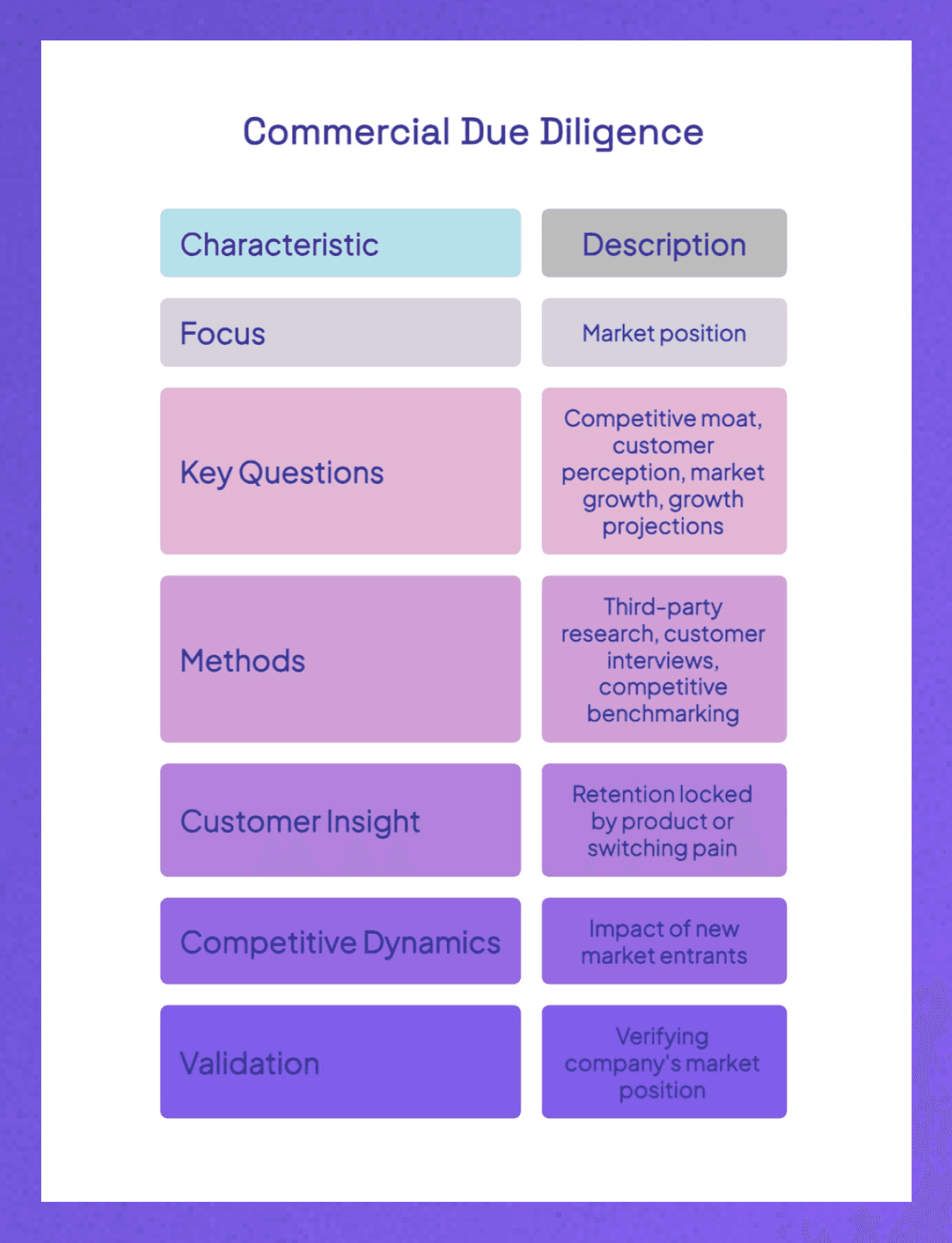
How defensible is the competitive moat?
What do customers actually think, and would they stay post-acquisition?
Is the market growing, flat, or contracting?
How realistic are management's growth projections?
This often involves third-party market research, customer interviews, and competitive benchmarking. Customer calls are especially telling. Management will always say retention is strong. But when you talk to actual customers, you'll find out whether they're locked in because the product is great or just because switching is painful.
Competitive dynamics matter too.
A company might be the market leader today, but if two well-funded players just entered the space, that lead could evaporate faster than the projections assume. Commercial diligence is where you validate whether the company's story about its own position actually holds up, or whether it's built on assumptions that won't survive contact with the market.
Management Due Diligence
At the end of the day, you're not just buying a business. You're backing a team.
Management diligence is about figuring out whether the current leadership can execute the value creation plan, or whether you'll need to make changes. It includes background checks, reference calls, and a close read on how the team operates under pressure.
A few things to watch for:
How does the team talk about failure? If leadership only tells a clean success story, they're either hiding something or lack the self-awareness to learn from mistakes.
What's the layer below the C-suite like? A strong CEO with a weak bench is a risk, especially if your value creation plan depends on execution.
Can functional leaders speak confidently without looking at the CEO for approval? If not, that's a signal.
Some of this is formal. Some of it is pattern recognition from conversations and site visits. The best diligence teams treat every interaction with management as a data point: how they handle tough questions, how they talk about their team, whether they know the details or defer to others.
Building Your Due Diligence Team
Due diligence isn't a solo effort. It's a coordinated push across multiple workstreams, each requiring different expertise. Getting the team structure right upfront saves time and avoids gaps.
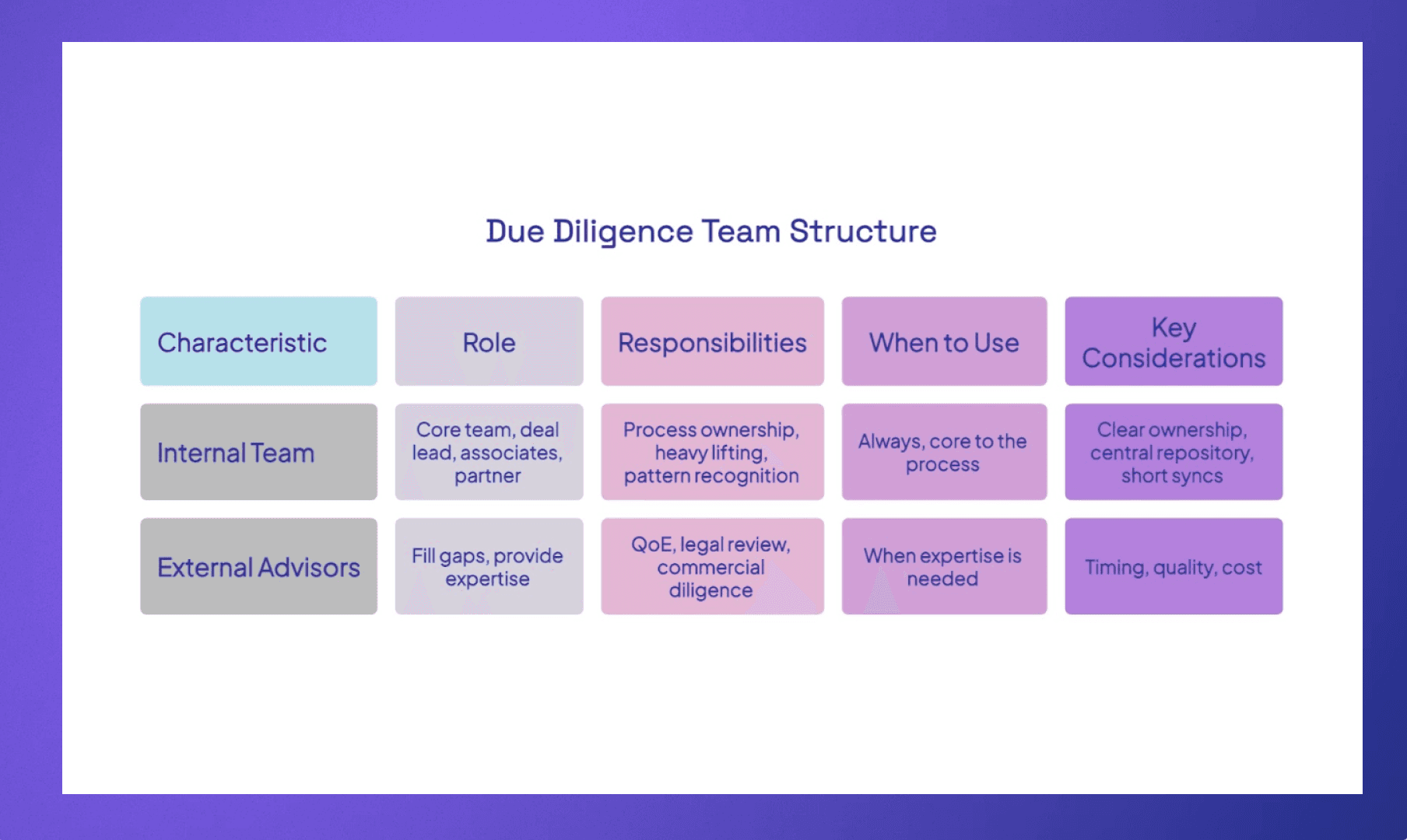
Internal Team: Who Owns What
Most PE firms run diligence with a small core team, typically a deal lead, an associate or two, and a partner who's involved at key decision points.
The deal lead owns the process. They're coordinating timelines, managing external advisors, and making sure nothing falls through the cracks. Associates do the heavy lifting, such as building models, reviewing documents, and drafting sections of the investment committee (IC) memo.
A few things that help:
Assign clear owners for each workstream (financial, legal, commercial, etc.) from day one
Set up a single place for notes, documents, and findings
Schedule regular syncs, but keep them short. Long status meetings eat into actual diligence time.
The partner's role is pattern recognition. They've seen dozens of deals, know what red flags look like, and can push the team to dig deeper when something feels off.
External Advisors: When to Bring Them In
No PE team does everything in-house. External advisors fill gaps, especially for legal, accounting, and specialised commercial work.
Quality of earnings (QoE) reports typically come from an accounting firm. They'll scrub the financials, validate EBITDA adjustments, and flag anything that doesn't tie out. For most deals, this is non-negotiable.
Legal counsel handles contract review, regulatory exposure, and deal documentation. They're also your first call when something unexpected surfaces, for example, an IP dispute, a customer contract with tricky change-of-control language, or an employment issue that needs a closer look.
Commercial or market diligence sometimes goes to a consulting firm, especially for industries where you don't have in-house expertise. Customer calls, competitive benchmarking, and market sizing often benefit from a third party who can move fast and bring an outside perspective.
The key is knowing when to bring them in. Too early and you're burning the budget before you know if the deal is real. Too late, and you're scrambling to get answers before IC.
Keeping Everyone Aligned
The biggest risk with multiple workstreams is fragmentation. Legal finds something that affects the financial model, but it doesn't get flagged until the memo is half-written. Or commercial diligence surfaces a customer concern that should've changed how you approached management calls.
What helps:
A shared tracker for deal tracking that shows where each workstream stands, what's been completed, and what's still open
A quick daily or every-other-day sync during peak diligence weeks
One person responsible for connecting dots across workstreams, not just running their own
Manage the Relationship Side of Due Diligence with Rings AI
Due diligence isn't just documents and data rooms. You're also evaluating people. That means running reference checks, vetting management teams, and finding experts who can validate if what you're interpreting is correct or not.
That relationship work often gets scattered across inboxes and notes. Rings AI CRM keeps it organised. Learn more about XRM vs CRM.
With Rings AI, your deal team can:
See who already has connections to the target company, such as, former executives, board members, and customers
Capture every conversation and meeting automatically
Search your team's collective notes and emails in plain English
Surface warm intro paths instead of starting cold, strengthening ongoing deal sourcing efforts
The relationships you build during diligence don't disappear after close. They become part of your firm's long-term network, and Rings AI makes sure that context stays accessible for future deals.
Book a demo to keep your deal team aligned and your relationship intel in one place.