

The funds that close are not always the ones with the best numbers. They are the ones that market themselves well, and that is a skill you can build.
Fund marketing is the work of getting the right Limited Partners (LPs) to know you, trust you, and commit. You don't need a fancy deck or a louder pitch. The goal is to reach LPs who actually back funds like yours, tell a story they remember, and stay in front of them until the timing lines up. Done well, it can shorten your raise and get you better-fit partners. Done badly, it can burn months chasing money that was never going to come.
This guide walks through how. You will learn which LPs to target and what each type actually cares about, how to build a fund story that stands out, and where to find and reach LPs. We'll cover the SEC rules you have to stay inside while you market. Whether you’re raising your first fund or your fourth, the goal is to turn LP interest into signed commitments.
Know Your LPs Before You Pitch
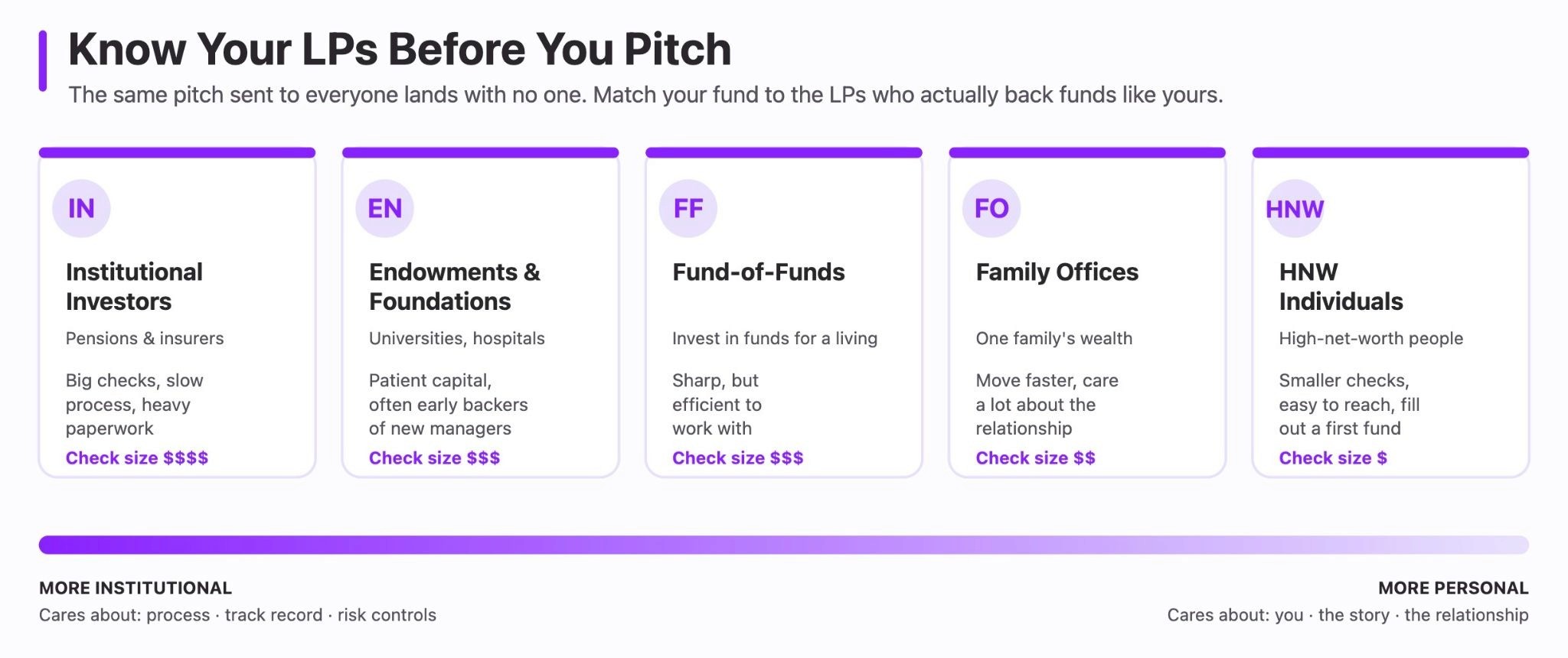
The biggest reason a pitch falls flat is sending the same one to everyone. A family office, a pension fund, and a fund-of-funds are not after the same thing, and a deck that tries to please all of them lands with none. Before you market anything, get clear on who your money is actually going to come from and what they care about.
The Main Types of LPs
These are the buckets most fund managers raise from. Each behaves differently, so know which ones you’re realistically targeting:
Institutional investors (pensions, insurance companies): big checks, slow process, lots of paperwork
Endowments and foundations (universities, hospitals): patient capital, often early backers of new managers
Fund-of-funds: invest in funds for a living, so they are sharp but efficient to work with
Family offices: manage one wealthy family's money, move faster, and care a lot about the relationship
High-net-worth individuals (HNWIs): smaller checks, easier to reach, useful for filling out a first fund
What Each Type of LP Actually Looks For
The bigger and more institutional the LP, the more they care about process, track record, and risk controls. The smaller and more personal the LP, the more they care about you and the story.
A pension fund wants to see clean numbers, a repeatable strategy, and infrastructure that will not embarrass them. A family office can fall in love with a thesis and write a check in weeks. First-time managers usually have the most luck with family offices, HNWIs, and the occasional endowment, because the giant institutions rarely back a fund without a track record.
Match your fund's size and stage to LPs who actually back funds like yours. Chasing pensions for a $20M first fund wastes everyone's time.
Define Your Ideal LP Profile
Instead of casting a wide net, define your target LP the same way you would define a customer. Run through these four questions:
Check size: What range fits your fund size and how many LPs does that imply?
Type: Which buckets above are realistic for a fund at your stage?
Fit: Who already invests in your sector, stage, or thesis?
Access: Who can you actually reach through your network or a warm intro?
Write the answers down as a one-line profile you can screen against:
For example, “Family offices and endowments writing $1M to $3M, already active in early-stage tech, reachable through founders or fellow GPs.”
Now every name you chase either fits that profile or it does not, which keeps your outreach focused instead of scattered.
Build a Fund Narrative That Stands Out
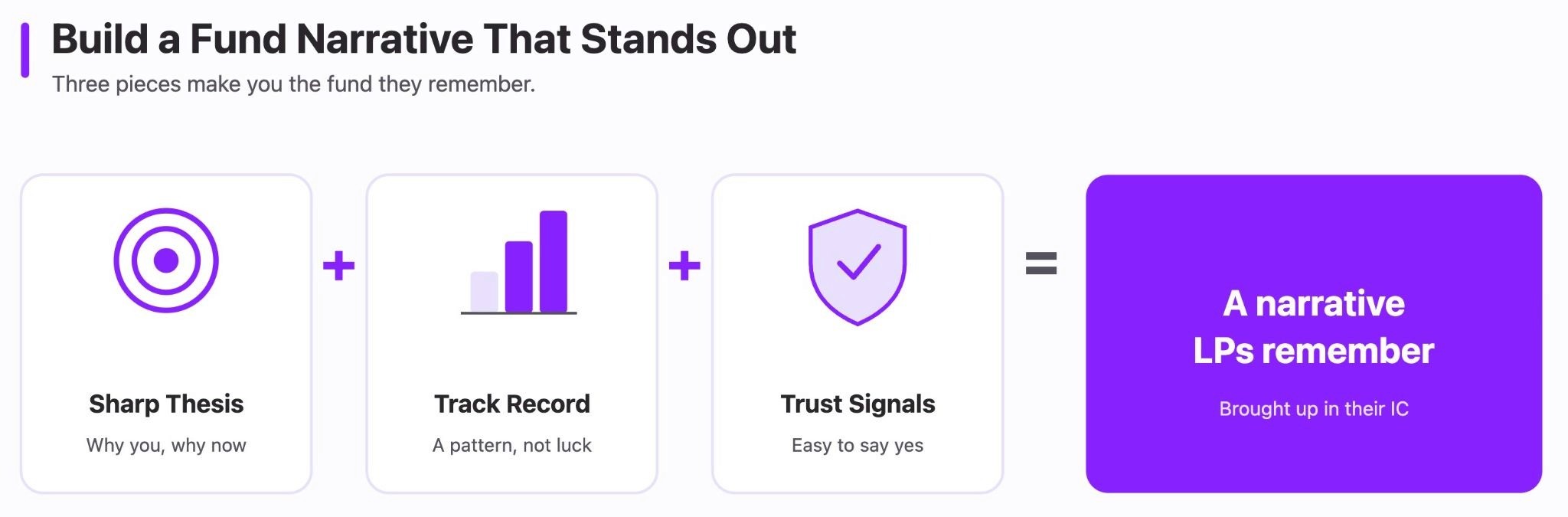
By the time an LP reads your deck, they have already seen a stack of funds that sound the same: strong team, big market, great deals coming. Your narrative is what makes you the one they remember and bring up in their investment committee. This section covers the three pieces that do that work: a sharp thesis, a track record story that feels repeatable, and trust signals that make you easy to say yes to.
Define a Differentiated Investment Thesis
Your thesis answers one question in plain terms: why should this fund exist right now, and why you? A good test is whether it actually rules things out. If your thesis could describe 50 other funds, it is too vague.
Here’s a simple formula to pressure-test yours:
We invest in [stage + sector] where we win because of [your specific edge], and that matters now because of [market shift].
Compare the two:
Weak: “We invest in promising early-stage startups across tech.”
Strong: “We write first checks into climate hardware startups in the Midwest, where our partners spent a decade running manufacturing plants, just as federal infrastructure money is pushing this stuff into the real economy.”
The second one tells an LP what you do, why you win the deal, and why the timing is right. Your edge usually comes from one of three places, and you should be able to name yours out loud: a market insight others have not caught onto, a sourcing advantage that gets you into deals early, or a hands-on skill that founders actively want.
Tell Your Track Record Story
Numbers get you the meeting. The story behind them is what builds belief. Whether you have a formal track record or are raising a first fund, walk an LP through it in this order:
Lead with your best, most relevant proof. Established managers show net IRR, TVPI, and DPI against benchmarks for the same vintage. First-time managers build a deal-by-deal track record of investments they sourced or led as an angel or at a prior firm.
Tie the wins back to your thesis. If you claim a sourcing edge, show that your best deals came through that exact channel. LPs are looking for a pattern, not a lucky streak.
Be honest about the misses. Every portfolio has them, and LPs will find them anyway. Explaining what went wrong and what you changed builds more trust than pretending it was all upside.
The point is to make your results look like something you can do again, not something that happened to you once.
Establish Credibility and Trust Signals
LPs are signing up for a relationship that lasts years, so they are really asking one thing: “Can I trust this person with locked-up money?” Trust signals answer that question before you have to.
Think of it as a checklist you want to be able to tick off:
An anchor LP or respected name already in (one institution's yes lowers the risk for the next)
Founder references, especially founders who would take your call before anyone else's
A team background that fits the thesis (operating experience, prior fund roles, real exits)
Clean institutional setup (a solid fund admin, auditor, legal counsel, and clear terms)
Your thesis, your deck, and the way you talk in a meeting all need to say the same thing. When the story holds up everywhere an LP looks, it stops feeling like a pitch and starts feeling like proof.
Where to Find and Reach LPs
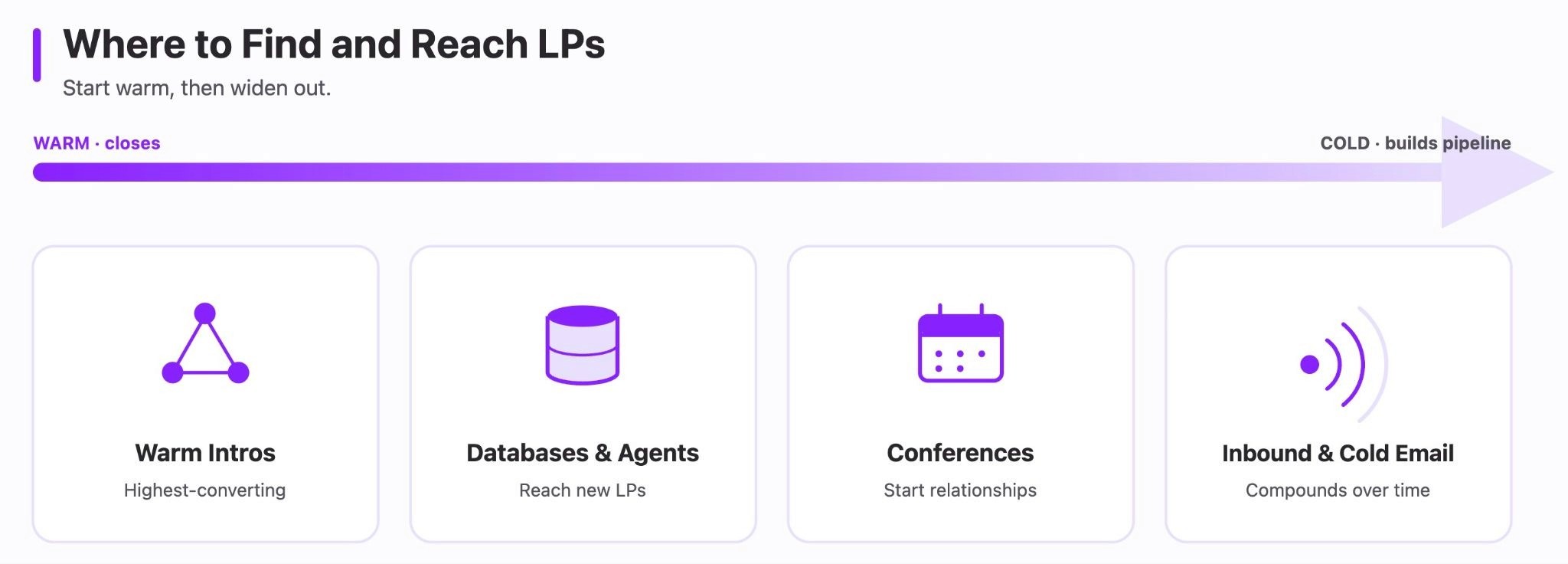
LPs are not all in one place, so the goal is to spread across a few channels and lean hardest on the ones that actually convert. A useful way to think about it: warm channels close, cold channels build pipelines. Start warm, then widen out.
Start With Warm Introductions
This is your highest-converting channel by far, so work it before anything else. A warm intro from someone an LP trusts gets you taken seriously in a way cold outreach never will.
Map your network in three buckets: existing LPs who can refer peers, founders you have backed who know investors, and other GPs who raise from similar LPs. Then ask for specific intros, not vague ones.
A good ask sounds like “Would you introduce me to the two family offices you mentioned?” not “Let me know if anyone comes to mind.”
LP Databases and Placement Agents
When your network runs dry, paid tools and intermediaries help you reach LPs you do not already know.
LP databases let you filter LPs by check size, strategy, and past commitments so you’re not guessing.
Placement agents raise capital on your behalf for a fee. They’re usually worth it for larger or institutional raises but are often too pricey for a small first fund.
Capital introduction teams at your prime broker or bank can connect you to allocators at no direct cost.
Conferences and Industry Events
Events work when you treat them as a head start on relationships, not a place to close. Nobody commits at a conference. They commit months later because you met there.
A simple play that works:
Pick events where your target LPs actually show up, not just GP-heavy ones.
Line up meetings before you arrive instead of hoping to bump into people.
Follow up within 48 hours while you are still fresh in their mind.
Build Inbound and Stay Top of Mind
The slow-burn channels keep your name circulating so LPs come to you, or at least remember you when you reach out. Writing about your thesis, posting on LinkedIn, and sending sharp quarterly investor updates all compound over time.
Cold email still works too, as long as it is short, specific, and shows you know who you are writing to. The funds that raise fastest usually combine a few of these channels instead of betting on just one.
Stay Compliant While You Market
How you market a private fund in the U.S. is governed by securities law, and getting it wrong can sink a raise or trigger penalties. Most of it comes down to one question: who are you allowed to talk to, and what are you allowed to say publicly? Below are the rules that matter most.
Note: This is a plain-English overview, not legal advice, so run your materials past a securities attorney before you send them.
General Solicitation: 506(b) vs. 506(c)
Almost every U.S. private fund raises under Regulation D, and you have to pick one of two paths. The difference decides whether you can market in public at all.
Rule 506(b): no public marketing
You cannot advertise the fund or post about the raise publicly.
You can only raise from people you already have a real, prior relationship with.
Investors can self-certify that they are accredited.
Rule 506(c): public marketing allowed
You can advertise openly, post on LinkedIn, speak about the raise, the works.
But every single investor must be accredited, with no exceptions.
You have to verify it with documents (tax returns, W-2s, a CPA or broker letter), not just take their word.
The trade-off is simple: 506(b) keeps you quiet but flexible, 506(c) lets you go loud but adds a verification burden.
The SEC Marketing Rule and Advertising Limits
If you are a registered investment adviser, the SEC Marketing Rule sets what you can and cannot put in an ad, including decks, websites, and emails. It took full effect in late 2022 and is strict about performance and proof.
A few things it requires:
Show net returns, not just gross. If you show gross performance, you must show net right alongside it, with equal prominence.
No cherry-picking. You cannot show only your winners. Performance has to be presented fairly across standard time periods.
Testimonials and endorsements need disclosure. If a happy LP or a paid promoter vouches for you, you must disclose the arrangement and any compensation.
The theme across all of it is that anything that could mislead an investor about your results is off the table.
Run Your Raise From One Place with Rings AI
Everything in this guide comes down to the same thing: knowing your LPs, reaching the right ones, and staying in front of them until they commit. That is relationship work, and most CRMs were never built for it. They treat an LP as a deal to close and forget, when an LP is someone you will talk to across this fund and the next three. Rings AI is built the other way around.
Here’s what that looks like while you raise:
See your whole team's path to every LP. Rings maps your team's network from email and LinkedIn and scores how well each person actually knows a contact, so you find the warmest intro instead of guessing.
Keep every LP's full history in one place. Emails, meetings, notes, and files live at the person and firm level, not buried in a closed deal, so you can pick up a relationship exactly where you left it.
Run the raise itself, not just the contacts. Fundraising and deal modules are built for how investors work, so your pipeline of LPs, commitments, and follow-ups lives in the same system as everything else.
Walk into every LP meeting prepared. Rings' Copilot pulls recent emails, notes, market data, and web research into a meeting-prep dossier, the kind of work that can eat 30 minutes before every call.
Every firm raises a little differently, so the best way to see if Rings fits how you work is to look at it. Book a demo and we will walk through it with your fund in mind.