


Investing is an ongoing process of evaluating options and making informed trade-offs. What anchors this process is being able to clearly explain why a particular opportunity is worth backing.
An investment thesis puts that answer into writing. It outlines the reasoning behind an investment decision by connecting the market, the opportunity, and the return you expect to generate. For venture capital and private equity firms, it becomes a shared reference point for evaluating deals and maintaining consistency across decisions.
This guide walks through how to write your own investment thesis in a way that’s practical, adaptable, and usable in real deal flow.
What Is an Investment Thesis?
An investment thesis is a document that explains how you plan to invest a fund and generate returns for your investors. Markets offer many possible paths, and a thesis clarifies which ones you intend to pursue.
For venture capital and private equity firms, a thesis goes beyond individual deals. It defines areas of focus, highlights repeatable patterns, and sets boundaries around what should be prioritized or passed on.
At its core, a strong investment thesis answers three questions:
What are you investing in?
Why does this opportunity create value?
Under what conditions does the investment succeed or fail?
How investment decisions are made and documented often depends on the systems behind them. Understanding the different types of CRM platforms provides useful context for how firms support deal evaluation and follow-through.
What Goes Into a Strong Investment Thesis
There are many components to a compelling investment thesis. While the specifics vary by fund, the most effective theses include:
Market focus: The industries, stages, geographies, and market dynamics the fund is targeting. Clear focus helps filter opportunities early and avoid misaligned deals.
Value creation logic: How the fund expects to generate returns. This may include growth, operational improvement, consolidation, pricing power, or other levers.
Investment criteria: The repeatable patterns you look for across opportunities, such as company size, revenue quality, unit economics, leadership, or competitive position.
Risks and assumptions: The key assumptions underpinning the thesis and the risks that would cause it to break if they materialize.
Time horizon and exit path: How long capital is expected to be deployed and what a successful outcome looks like, whether through an acquisition, IPO, recapitalization, or secondary sale.
A Practical Framework for Writing an Investment Thesis
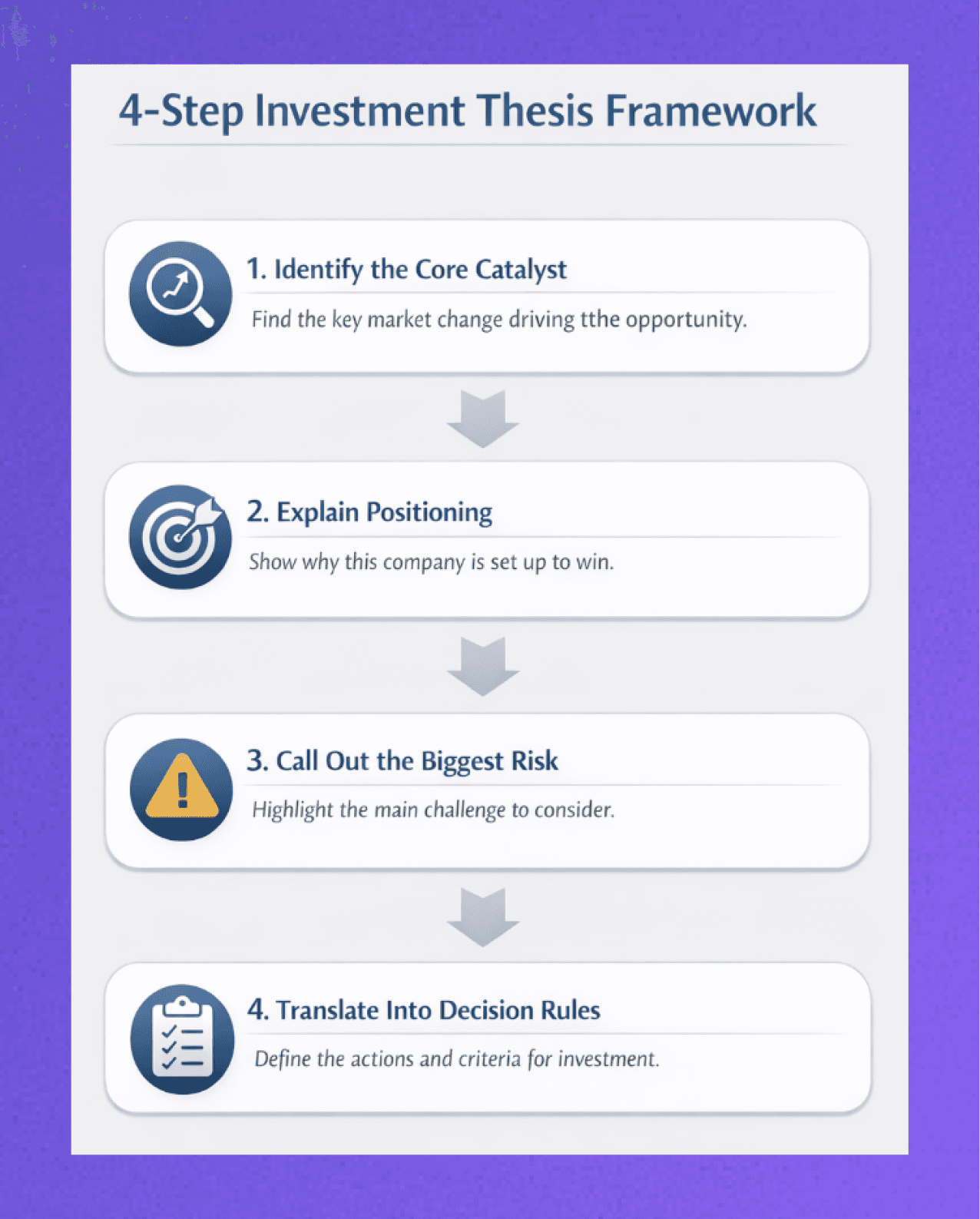
Contrary to popular belief, an investment thesis doesn't need to be long to be effective. A good thesis focuses on the single most important driver behind an investment decision and builds outward from there.
Four guiding principles help keep an investment thesis focused and useful.
Step 1: Identify the core catalyst
Every investment thesis begins by identifying what is changing, and why that change matters. This change, or catalyst, is the underlying force that creates the opportunity in the first place.
The catalyst could be a shift in technology, regulation, customer behavior, industry structure, or cost dynamics.
The key is to be specific. Rather than describing a broad trend, articulate the force that actually creates the opportunity.
For example, a thesis might be driven by
New regulatory requirements that increase complexity and demand for specialized solutions
A change in buying behavior that favors usage-based pricing over fixed contracts
Industry fragmentation creates room for consolidation or scale advantages
Your thesis should clearly state what the catalyst is and why it creates a window for value creation.
For instance, increasing regulatory complexity in financial services is driving demand for specialized B2B software that enables compliance without adding headcount. That belief might translate into a strategy like:
“I focus on B2B software companies at Series A–C selling into regulated industries, where complexity creates defensibility.”
That single sentence already eliminates thousands of deals that would otherwise waste time.
Step 2: Explain how the investment is positioned
Once the catalyst is clear, the next step is to explain why this specific opportunity is positioned to benefit from it.
This is where many theses fall apart. Being in the right market is not enough. You need to articulate how the company, team, or platform actually converts the broader trend into measurable results.
This often comes down to factors like:
Market size and the scale of the opportunity
The company’s current position within that market
Product differentiation
Distribution or relationship advantages
Operating model or cost structure
Timing relative to competitors
The goal is to connect the external change to the internal mechanics of the business, as part of your wider analysis and projections.
For example, if regulatory complexity is increasing demand for compliance-first B2B software, the thesis should explain why this company is set up to capture that demand.
That might mean it sells directly to compliance teams that control budgets, has a product designed specifically for regulated workflows, or already has footholds in institutions where expansion can happen without restarting the sales cycle.
The emphasis shifts from the market itself to execution: how the company turns a known catalyst into durable growth.
In other words, why does this investment make sense when allocating capital toward this opportunity?
Step 3: Call out the biggest risk
A strong investment thesis includes explicit disconfirming signals, or risks.
These risks can come from two sources:
External risks, which are outside the company’s control, such as regulatory changes, competitive pressure, or shifts in customer behavior that slow adoption.
Internal risks, which are execution-related, such as scaling the team, driving adoption, or sustaining margins.
Rather than listing every possible downside, focus on the top three risks that would most clearly break the thesis if it plays out. This keeps the thinking honest and sharpens diligence.
Being explicit about the main risks also makes it easier to track whether the thesis is strengthening or weakening over time.
Step 4: Translate the thesis into decision rules
A thesis is only useful if it informs action and expected return. This starts with being clear about your level of conviction in that investment.
Conviction isn’t just about certainty. It reflects how much evidence you have today and how much uncertainty you’re willing to underwrite. This step helps frame position sizing, fund pacing, and follow-on decisions.
Ask yourself:
How central is this thesis to the fund’s strategy?
What would increase or decrease conviction over time?
What signals would confirm or challenge the original view?
Stating your conviction level makes the thesis more actionable and easier to evaluate as new information emerges.
How to Clearly Articulate Your Fund Thesis to LPs
An investment thesis can range from a short verbal explanation used in early conversations to a more detailed version embedded in a pitch deck or investment committee (IC) materials.
At a minimum, you should be able to articulate your fund thesis in one or two clear sentences.
Fund thesis summary example
Below is an example of a concise fund-level investment thesis for a hypothetical venture fund:
“Atlas Ridge Capital is raising a $40 million early-stage fund to invest in B2B software companies serving regulated industries in North America. The fund leverages the partners’ deep operating experience and long-standing relationships with compliance and risk leaders to source proprietary opportunities and support expansion within enterprise accounts.”
This format works because it quickly answers the questions LPs care about:
Where you invest
Why you’re positioned to win
What gives you an edge
From there, the thesis can be expanded with more detail as conversations with LPs evolve. Many firms rely on CRM for investor relations to keep context and notes centralized rather than scattered across tools.
Real-world examples of investment thesis in practice
Some investors share versions publicly when announcing a new fund or outlining long-term conviction. These public summaries are typically concise.
For example, early-stage firms like 2048 Ventures have outlined their fund thesis in concise LinkedIn posts. It clearly states where they invest, the types of founders they back, and the networks they leverage.

Other firms share their thesis through longer-form writing. For instance, NFX published a clear investment thesis explaining why they invested in OnMe, a company rethinking how gift cards are discovered and used.
It explains the underlying market shift, the behavior change driving it, and why NFX believes this model creates durable value.

Best Practices for Writing an Effective Investment Thesis
A strong investment thesis is as much about discipline as it is about insight. These best practices help ensure your investment thesis holds up as you evaluate and compare opportunities.
1. Keep it focused
An investment thesis doesn’t need to cover everything. The strongest ones center on a single core driver, supported by a set of three to four key variables. Anything more tends to dilute the signal and slow decision-making.
2. Identify and define repeatable patterns
Clear patterns make opportunities easier to evaluate and compare. These may include retention signals, proven go-to-market dynamics, or how deals align with your team’s sourcing strengths.
Relationship-first CRMs designed for venture capitalists surface warm paths and shared connections, making it easier to validate patterns and prioritize the right opportunities.
3. Write it early
An investment thesis is most valuable when written early, before conviction hardens. It forces clarity on why the deal matters and what would change your view, reducing bias and post-hoc justification.
4. Use it as a communication tool
A well-written investment thesis should be easy to explain to partners, IC members, and even LPs. If the logic can’t be communicated clearly, it’s often a sign that the thinking itself needs refinement.
How Relationship Intelligence With Ring AI Strengthens Your Thesis
A strong investment thesis brings clarity to where you invest, why you invest, and what must be true for returns to follow. But turning that clarity into action depends on access, timing, and relationships.
This is where relationship intelligence becomes a force multiplier.
Rings AI is an extended CRM (XRM) built to help venture capital and private equity firms operationalize their thesis by making relationship intelligence visible. It surfaces warm paths, maps shared connections, and tracks engagement signals across your network, so decisions aren’t driven by memory or fragmented data.
With better visibility into relationships, teams can validate assumptions, prioritize the right opportunities, and apply decision rules more consistently as deal flow evolves.
If your investment thesis defines what you believe in, Rings AI helps you execute on it with context and discipline. Book a demo to see Rings AI in action.