
Meetings shape many important business decisions. Whether you're discussing a potential partnership or exploring an investment opportunity, the quality of your preparation often determines the outcome. Learn more about deal sourcing.
Yet many professionals walk into meetings relying on instinct or last-minute preparation. They skim a few emails, glance at a LinkedIn profile, and hope the conversation will unfold naturally.
In practice, effective meetings rarely happen by accident. They are the result of thoughtful preparation and a clear structure for the conversation.
This guide will share how to prepare for a meeting like an experienced dealmaker.
Why Meeting Preparation is Important
Imagine securing a meeting with a potential investor and walking in without a clear agenda or preparation. The opportunity can easily slip away.
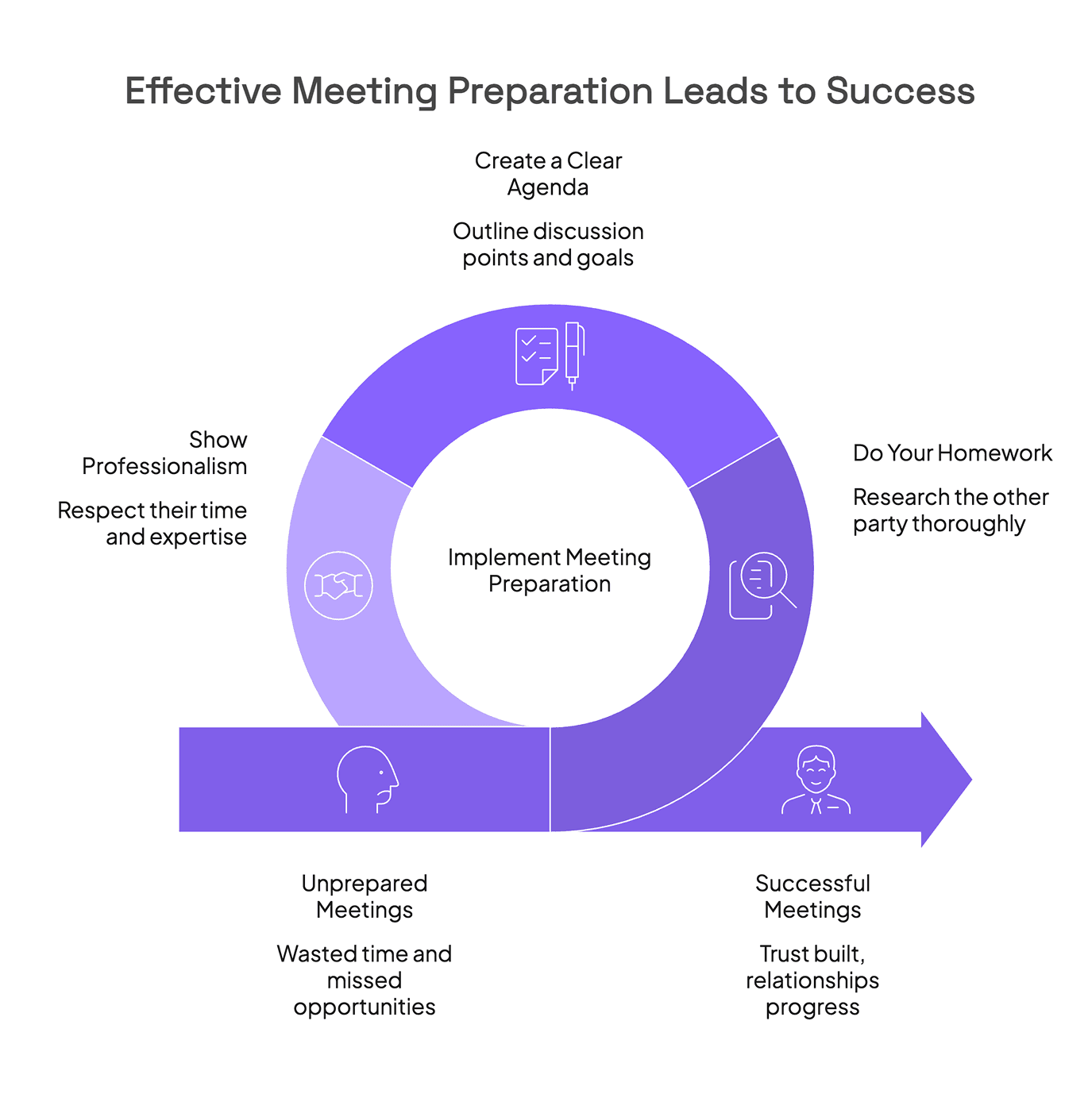
When the other side sees that you’ve done your homework, it signals professionalism and respect for their time. It also shows that you’re serious about the conversation and the potential relationship.
And this matters more than most teams realize. Research from the London School of Economics (LSE) found that more than 35% of meetings are considered unproductive, costing U.S. professionals an estimated $259 billion each year.
In deal-driven environments, such as sales, venture capital, private equity, and partnerships, meetings often determine whether a relationship progresses or stalls. Decisions rarely happen in a single conversation, but each meeting plays a role in building trust and understanding.
Without preparation, you risk missing key opportunities to guide the discussion.
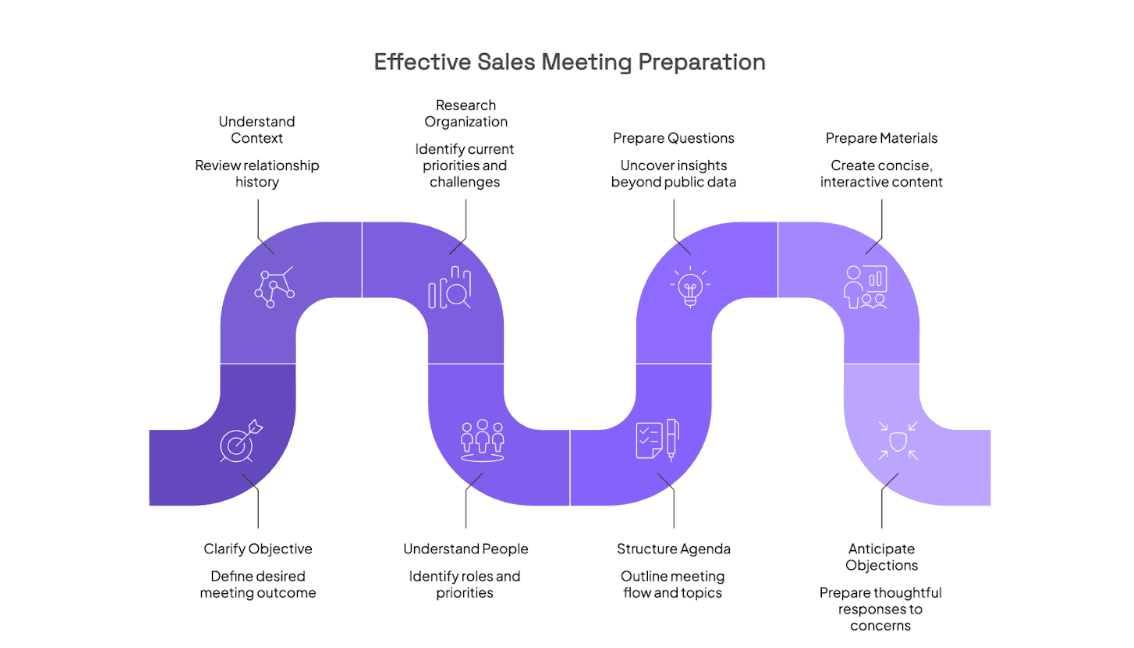
9 Clear Steps for Sales Meeting Preparation
Let’s understand the key steps involved in preparing for a sales meeting.
Step 1: Clarify the objective of the meeting
Before preparing anything else, start by answering a simple question:
What should happen by the end of this meeting?
Many meetings fail because the objective is vague. People join with different expectations, and the discussion becomes unfocused. According to Zoom, 37% of leaders say they spend time in meetings that lack a clear outcome or fail to address a real problem.
A clearer objective might look like this:
Confirm whether the company is a good fit for your solution
Understand the client’s internal decision process
Introduce a potential investment opportunity
Move the deal to the next stage
The goal does not need to be closing a deal immediately. In many cases, the objective is simply to gather information or build alignment.
Defining the objective helps you design the conversation around outcomes rather than just exchanging information.
Step 2: Understand the relationship context
Before researching the company, take a moment to understand how this meeting came about.
For deal-driven teams, that review often extends beyond conversations into the contracts that formalized past work. Knowing where a relationship stands contractually, including renewal dates, outstanding obligations, and past terms, can meaningfully shape how you enter a meeting. Contract lifecycle management (CLM) software gives teams visibility into that layer of the relationship before the conversation even starts.
Some meetings happen after several previous interactions, while others may be the first time you are speaking with someone. Understanding that context helps you approach the conversation more thoughtfully.
If this is a follow-up meeting, review the history of the relationship. This may include:
Earlier conversations
Email exchanges
Introductions from mutual contacts
Previous deals or collaborations
Looking back at these interactions helps you avoid repeating the same questions and allows the conversation to build on what has already been discussed.
If this is a first-time meeting, it still helps to understand the connection path. Ask yourself questions like: Who introduced us? What prompted the meeting? What opportunity or topic led to this conversation?
For professionals managing large networks, keeping track of relationship history manually can become difficult. Many teams rely on relationship management platforms (XRM) to automatically capture interactions across email, calendars, and other communication channels.
Having this context readily available makes meeting preparation faster and helps ensure conversations start from the right place.
Step 3: Research the organization’s current situation
Once you understand the relationship context, the next step is learning about the organization itself.
The goal isn’t to memorize every detail about the company. Instead, focus on identifying signals that reveal what matters to them right now.
Useful signals include:
Recent funding announcements
Product launches or updates
Market expansion
New leadership hires
Strategic partnerships
These signals often provide clues about the company’s current priorities and challenges.
For example, if a company recently raised funding, the conversation may focus on scaling operations or entering new markets. If leadership has recently changed, the discussion may involve shifts in strategy or new business priorities.
Step 4: Understand the people in the meeting
Meetings are rarely just about companies. They are about the individuals representing those companies.
Different participants bring different priorities to the discussion. Knowing their roles helps you tailor the conversation accordingly.
Start by identifying:
Their job titles and responsibilities
Their role in the decision-making process
Their professional background and experience
Their relationship to the opportunity being discussed
For example, an executive may focus on strategic outcomes and long-term impact, while an operations or product leader may be more interested in implementation details.
In deal-driven environments, it’s common for multiple stakeholders to influence a decision. Recognizing who is involved and how they relate to each other helps you guide the discussion more effectively.
Network mapping software helps bring visibility to these relationships by showing who knows whom across your network, how introductions happened, and connections already exist.
Step 5: Structure the meeting agenda
An agenda helps participants understand how the conversation will flow and prevents important topics from being overlooked. Yet many meetings still happen without one.
According to the Flowtrace State of Meetings Report 2025, only 37% of workplace meetings actively use an agenda.
Even a simple agenda helps keep the meeting focused and ensures key topics are covered.
A typical meeting flow might include:
Opening and introductions: Briefly establish context and confirm the purpose of the meeting.
Understanding the other side’s priorities: Discuss the current challenges, goals, or opportunities.
Exploring solutions or partnership opportunities: Discuss how your ideas, product, or partnership might fit their needs.
Clarifying next steps: Clarify what happens after the meeting.
Step 6: Prepare questions that reveal insight
One of the most valuable preparation steps is thinking through the questions you want to ask. Strong questions help uncover information that cannot be found in public sources.
For example, you might ask:
What are the biggest challenges your team is dealing with right now?
How are you currently approaching this problem?
What would success look like for your organization over the next year?
What factors influence how decisions are made internally?
When you ask thoughtful questions, the conversation becomes more collaborative rather than one-sided. It encourages deeper discussion and helps reveal priorities that may not appear in public materials.
Step 7: Prepare supporting materials
In many meetings, especially sales or partnership discussions, you may need supporting materials. These might include:
A short presentation
A product demo
A case study
Market insights or research
If you plan to share a proposal after the meeting, make sure it clearly explains the problem, the proposed solution, and the expected outcomes.
A well-written sales proposal continues the conversation even after the meeting ends, helping stakeholders understand the value of the collaboration.
The key is to keep materials concise. It ensures the discussion remains interactive rather than presentation-heavy.
Step 8: Anticipate questions and objections
Experienced sales professionals rarely walk into a meeting unprepared for potential concerns. Before the meeting, think about what the other side might question.
Some common questions may include:
How will this solution integrate with our current systems or processes?
What level of effort or resources will implementation require?
What timeline should we realistically expect?
How does this compare with alternative solutions?
Today, many sales teams use Gen AI tools to anticipate possible objections and prepare responses in advance.
Preparing thoughtful responses allows you to address concerns calmly and confidently rather than reacting defensively in the moment.
Step 9: Define the next step before the meeting ends
A productive meeting should always lead to a clear next step. Without this, conversations often fade without progress.
Possible next steps might include:
Scheduling a follow-up meeting
Sharing additional information or documentation
Introducing other stakeholders who should be involved
Reviewing a proposal or conducting a product demo
The important part is clarity. Everyone should leave the meeting knowing what will happen next and who is responsible. This keeps momentum moving forward.
How Relationship Intelligence Improves Meeting Preparation
One challenge dealmakers or sales professionals face today is gathering information quickly before important meetings.
Contacts, past conversations, and introductions are often scattered across email, calendars, LinkedIn, and spreadsheets.
Relationship intelligence platforms like Rings AI help solve this by organizing relationship data in one place. They automatically surface key context before meetings, including shared connections, previous interactions, and recent company updates.
This makes preparation faster and ensures you enter meetings with the right information at the right time.
For teams that rely on relationships to source deals, build partnerships, or manage complex networks, that visibility can make meeting preparation far more effective.
Prepare Smarter for Every Meeting with Rings AI
Preparing for a meeting shouldn’t require complex planning or hours of research.
Most effective meeting preparation follows a simple structure. When that information lives in one place, it becomes easier to prepare for meetings and approach conversations with confidence.
Rings AI, an extended relationship management platform, simplifies this process. With features like automated relationship tracking, shared connection visibility, and deal intelligence, Rings helps teams prepare faster and focus on the opportunities that matter most.
When these elements come together, meetings become significantly more productive.
Book a demo with Rings AI to see how it can support your sales and dealmaking workflows.
Rings AI gives deal teams full visibility into relationship context, deal flow, and pipeline activity. Book a demo to see how Rings AI can strengthen your deal management process.