

Institutional investing has changed. Competitive advantage now depends on speed, signal quality, and structured intelligence, not just access to information.
Harmonic is positioned as an AI-native startup discovery platform built for venture capital, growth equity, and innovation teams. Instead of relying solely on funding announcements and founder submissions, Harmonic uses machine learning to classify startups, map markets, and detect emerging signals earlier.
But does it deliver enough depth to justify the investment? And how does it fit into a modern investment stack in 2026?
This review examines Harmonic’s capabilities, pricing structure, strengths, limitations, and where it fits strategically.
What is Harmonic?
Harmonic is an early-stage startup intelligence platform designed to help investors systematically discover and analyze private companies before they become widely visible to competitors. It aggregates and structures startup data using AI classification to interpret early signals rather than relying solely on self-reported information. The platform analyzes large volumes of public digital signals to:
Classify startups by sector and sub-sector
Map founders and leadership teams
Detect growth signals
Surface emerging categories
Unlike traditional company databases, Harmonic emphasizes early visibility and signal-driven market analysis.
Harmonic is not a CRM. It does not focus on relationship tracking, pipeline management, or portfolio administration. Its primary value is sourcing and research efficiency. For venture capital or private equity firms that rely on thematic investing or proactive sourcing, that distinction matters.
Key Harmonic Features
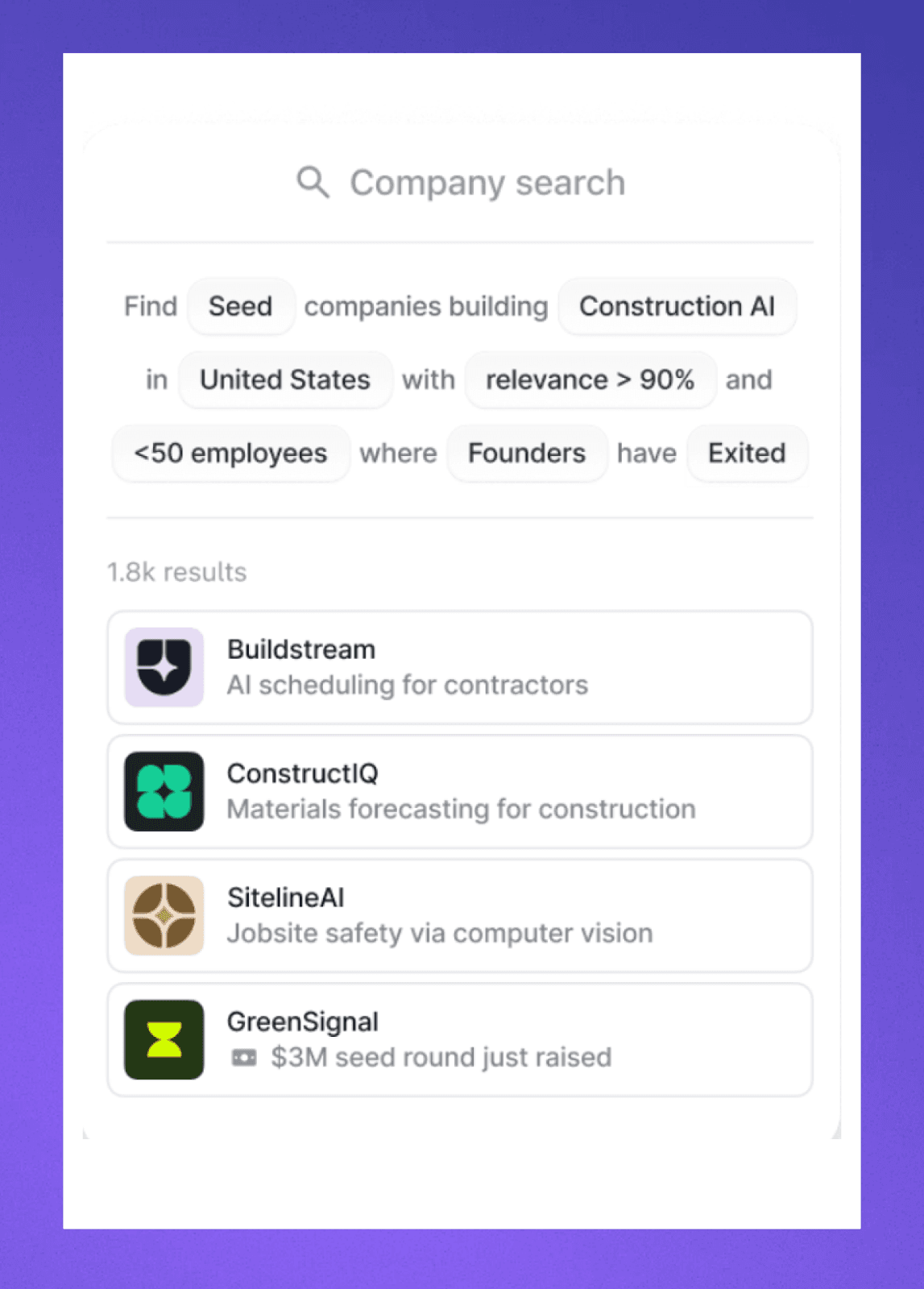
Harmonic’s functionality centers around discovery, classification, and ecosystem intelligence. The platform is built to answer one question clearly: What companies should we be looking at right now?
Key features include:
AI-driven startup classification: Uses machine learning to classify startups based on a wide range of public data sources, including legal filings, registries, and digital activity, allowing categorization beyond self-reported labels.
Advanced search and filtering: Offers multi-dimensional filters across sector, geography, funding stage, founder background, hiring velocity, and headcount to build highly targeted sourcing lists.
Founder and team intelligence: Aggregates structured founder and executive profiles, including education, career history, prior startups, and exits for faster early-stage evaluation.
Growth signal detection: Surface real-time indicators like rapid hiring, leadership changes, and product expansion to highlight companies gaining momentum.
Market Mapping and Ecosystem Visibility: Enables exploration of companies within specific verticals to support thesis building and competitive landscape research.
Lists and internal collaboration: Enables teams to organize and track curated company lists for research, watchlists, and investment committee preparation.
Harmonic Pricing Breakdown for 2026
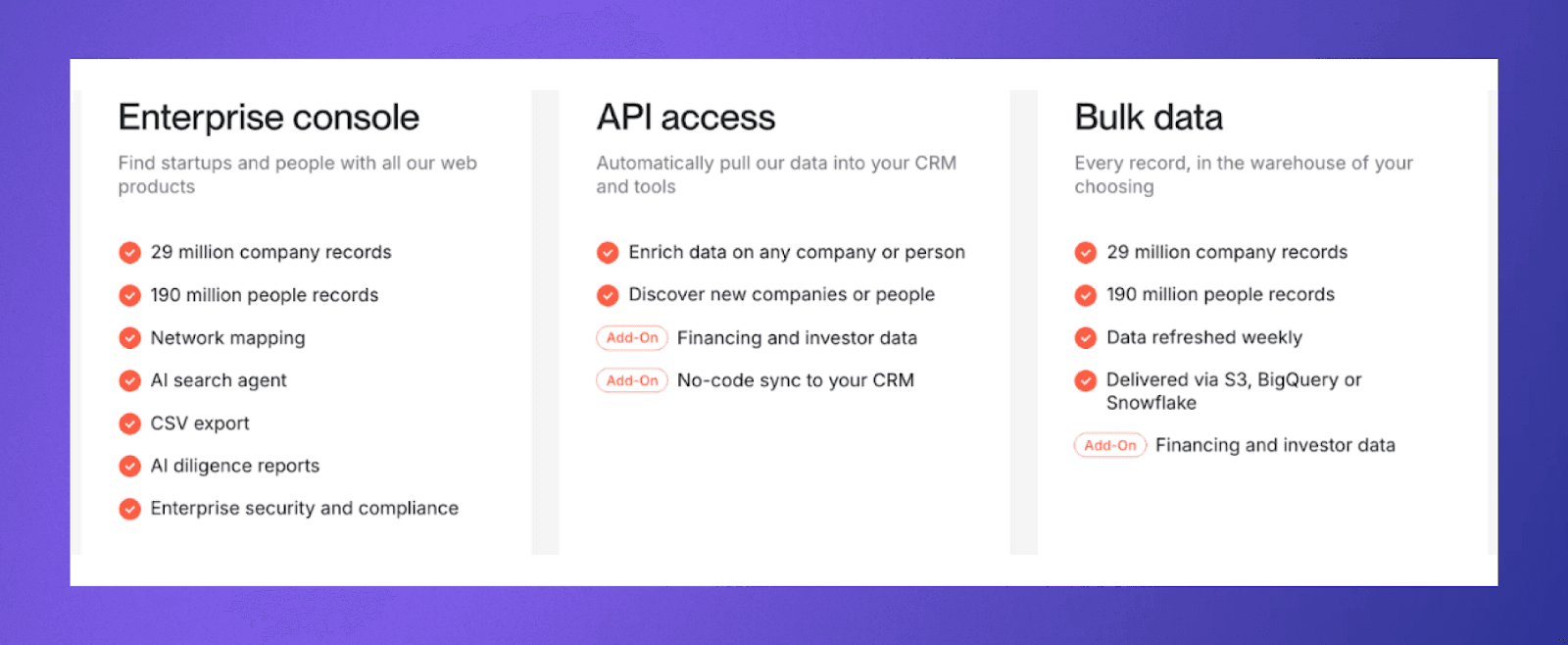
Harmonic offers three core plans, with pricing available upon request. While exact costs are not publicly listed, the platform clearly separates access by delivery method and depth of data usage.
Enterprise Console: Gives you full access via Harmonic’s web platform; includes 29M company records, 190M people records, network mapping, AI search agent, CSV export, AI diligence reports, and enterprise security features.
API Access: Designed for syncing Harmonic data into your CRM and internal tools; includes company/person enrichment and programmatic discovery. Add-ons: Financing & investor data, no-code CRM sync.
Bulk Data: Provides full dataset delivery into your data warehouse; includes 29M company records, 190M people records, weekly refreshes, and delivery via S3, BigQuery, or Snowflake. Add-on: Financing & investor data.
Harmonic Pros and Cons
Harmonic is widely used by venture and growth investors for proactive startup discovery. But while it excels at surfacing companies early, it has limitations when it comes to relationship intelligence and workflow depth.
Let’s look at Harmonic’s strengths and limitations.
Harmonic pros
Harmonic AI provides unusually broad startup coverage, giving investors confidence that they are not missing companies outside traditional databases or inbound pipelines.
The platform significantly reduces early-stage research time by consolidating scattered web signals into structured, searchable intelligence.
It supports thesis-driven investing by making it easier to explore and pressure-test emerging categories before they become mainstream.
Scout, Harmonic’s AI screening agent, helps narrow large result sets into a manageable shortlist aligned with your investment focus.
Console, API, and bulk data access options make the platform adaptable for both individual investors and data teams integrating startup intelligence into internal systems.
Harmonic cons
Harmonic AI does not function as a full CRM, so teams still need a separate system to manage relationships, deal flow, and pipeline execution.
Relationship intelligence is primarily visibility-based and lacks deeper connection strength scoring and engagement tracking, found in dedicated extended relationship management (XRM) platforms like Rings AI.
Despite advanced filters and Scout, effective screening still depends on clear thesis calibration, and reviewing broad result sets can strain lean teams without dedicated sourcing capacity.
Built for institutional investors, the platform’s breadth of data and filtering capabilities can create a steeper learning curve for new users.
Extend Harmonic Discovery into Deal Advantage with Rings AI
Harmonic helps investors see more of the market, structure their sourcing process, and surface emerging companies earlier. But discovery is only one side of competitive investing. As funds move from sourcing to execution, the challenge shifts from “What companies exist?” to “How do we win this deal?”
That’s where relationship intelligence becomes critical.
While Harmonic includes network mapping, its architecture remains discovery-centric. It surfaces connections, but it does not deeply prioritize relationship strength, optimal introduction paths, or engagement intensity that determine access in competitive rounds.
For teams moving from visibility to execution, exploring Harmonic AI alternatives can surface platforms built for relationship-driven deal advantage.
These platforms often add capabilities such as:
Automated prospect intelligence: Automatically reveal overlapping relationships and strongest introduction paths in one unified view, reducing manual filtering and exploration.
Priority-based outreach: Identify the right person to contact based on real engagement signals, communication history, and relationship strength. This enables faster, network-driven execution beyond simple connection visibility.
Integrated fundraising & portfolio context: View round-by-round fundraising history and investor portfolio data alongside your firm’s private relationship graph; auto-matched in one workspace so teams can move from insight to action without switching tools.
Rings AI is built for this execution layer, turning discovery into structured relationship leverage.
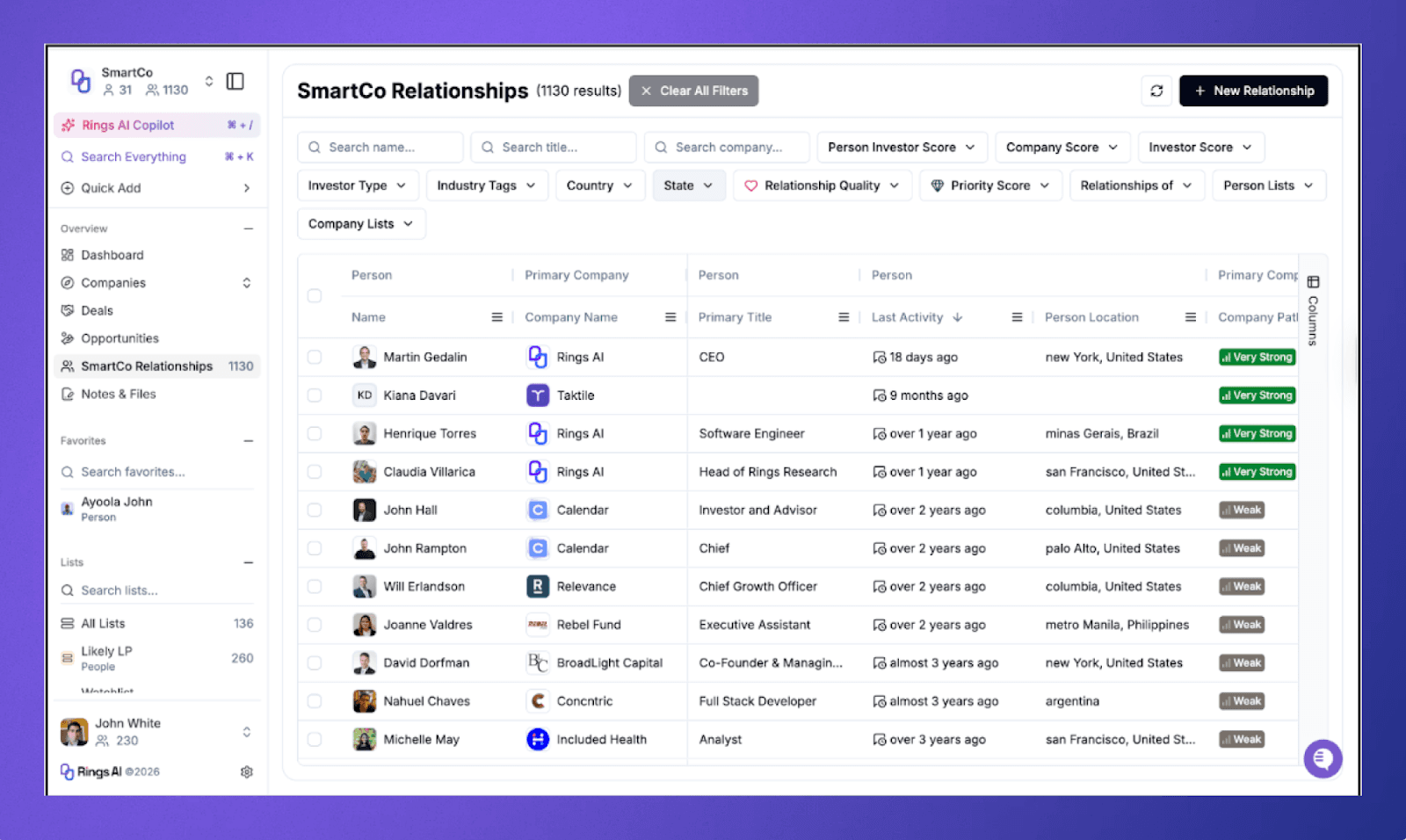
Rings AI provides unified relationship visibility with priority and strength scoring in one workspace.
Strengthen Your Deal Flow with Rings AI XRM
Harmonic is strong for startup discovery and research. But when firms need to operationalize relationships across partners, founders, LPs, and portfolio companies, discovery alone isn’t enough.
Rings AI is a relationship-first XRM built for teams managing complex, multi-party networks and long deal cycles. It centralizes network visualization, warm introduction mapping, deal management, notes, files, and workflows in one system. Instead of stitching together multiple tools, firms run their entire relationship and deal workflow inside Rings.
For venture capital and private equity firms, competitive advantage depends on structured visibility into their network and the ability to execute with precision.
Book a Rings AI demo today to see how relationship intelligence strengthens your deal execution.