
Pipeline management is how teams track work in progress, understand where decisions stand, and prioritize what matters next. Done well, it gives teams a clear view of active conversations, stalled opportunities, and upcoming decisions without relying on memory or guesswork.
Most pipelines fall apart because they only show movement, not context. Deals change pace. Conversations pause. Relationships resurface months later. Traditional CRMs lose that history as timelines stretch and people change roles.
Rings AI is built to solve this. It supports flexible pipeline views while keeping relationship context tied to people and companies, so teams always understand what’s happening and why. Book a demo to see how Rings AI supports real pipeline management without losing context.
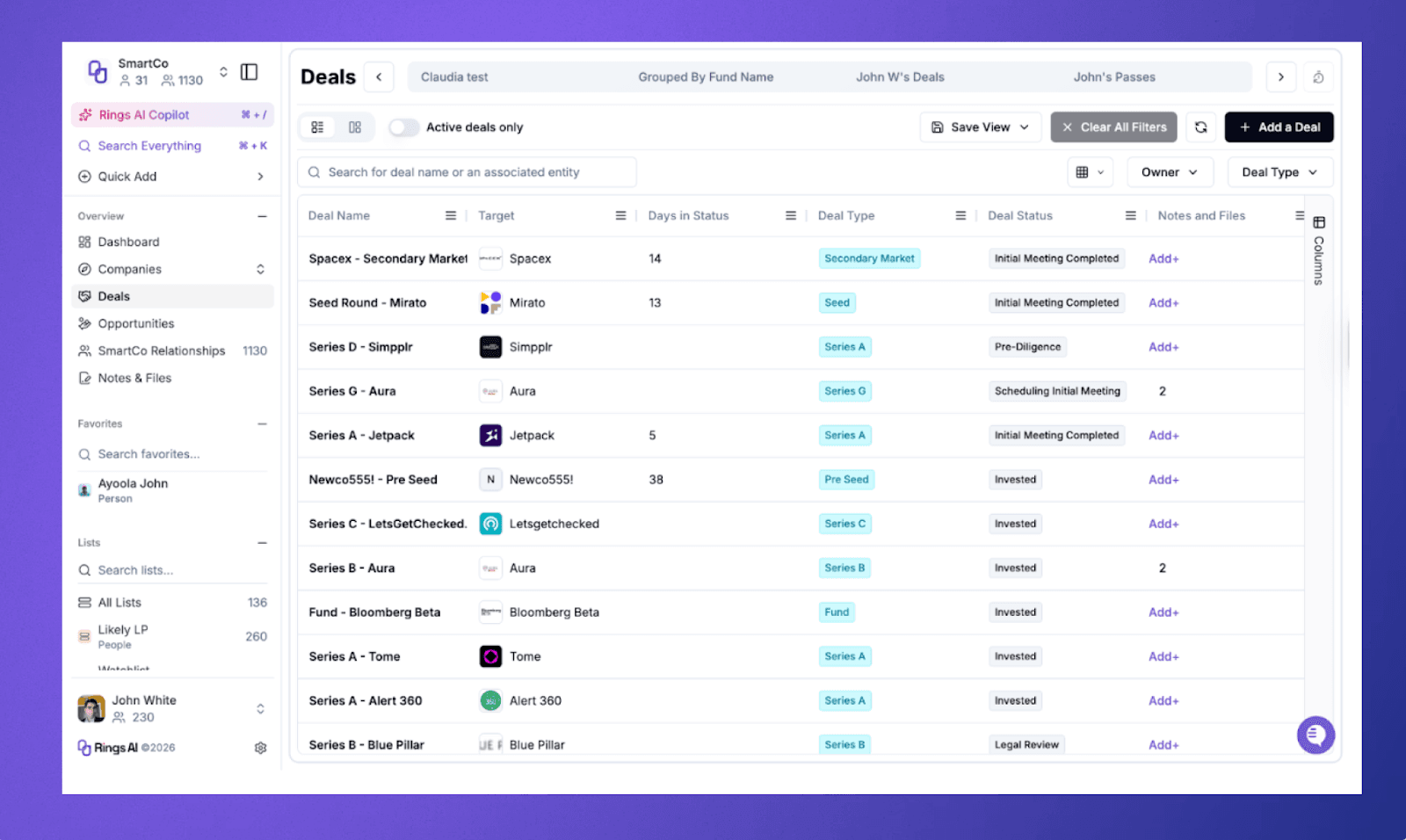
Pipeline view showing deal status, time in stage, and attached context in one place.
What is Pipeline Management
Pipeline management is not about pushing deals forward. It is about maintaining clarity as work evolves.
In practice, effective pipeline management helps teams:
See what is active, paused, or dormant, without forcing artificial stages
Understand why something is in the pipeline, not just where it sits
Keep decision context attached to people and companies, not buried in closed deals
Revisit opportunities months later without restarting conversations
For relationship-driven teams, this means the pipeline must reflect reality rather than an idealized flow.
Common expectations teams have from pipeline management:
Clear ownership and next steps
A reliable view of current priorities
Visibility into long-running conversations
Confidence that nothing important is silently dropped
Where most pipelines break down is accuracy. Linear stages assume steady progress. Real work does not move that way. This is why many teams lose trust in their pipeline over time and fall back on inboxes and spreadsheets instead.
Traditional pipeline tools fall short in long-cycle environments, especially in comparison to private equity CRM platforms built for real-deal tracking, and pipeline-first CRMs struggle to preserve context.
In environments like private equity and long-cycle dealmaking, pipeline management only works when it supports non-linear timelines, relationship continuity, and shared understanding.
Learn more about CRM for venture capital firms and deal flow management.
5 Step Pipeline Management Process in Long-Cycle Teams
Pipeline management breaks down when teams assume steady forward motion. In long-cycle environments, the process needs to support pauses, reversals, and revisits without losing clarity.
In practice, the pipeline process looks like this:
Intake
New opportunities enter the pipeline through introductions, inbound conversations, or referrals. What matters here is capturing who introduced whom and why the opportunity exists, not just creating a new record. This is where relationship context starts to matter.
Qualification
Teams assess relevance and timing. Many opportunities are valid but not actionable yet. A good pipeline keeps these visible without forcing premature stage progression. This is a common failure point in pipeline-first CRMs, especially in private equity workflows.
Active Progress
When work moves forward, the pipeline should show real engagement, not just stage changes. Conversations, meetings, and decisions need to stay connected to the people involved so progress is understandable later.
Pause
Most pipelines ignore this step. Conversations stall for good reasons: market timing, internal priorities, or external constraints. Effective pipeline management keeps paused work searchable and explainable, rather than letting it disappear.
Decision or Exit
Decisions are made, or opportunities are closed out. What matters is not the outcome, but whether the reasoning is preserved. This is where teams often lose institutional memory and end up re-evaluating the same opportunity months later.
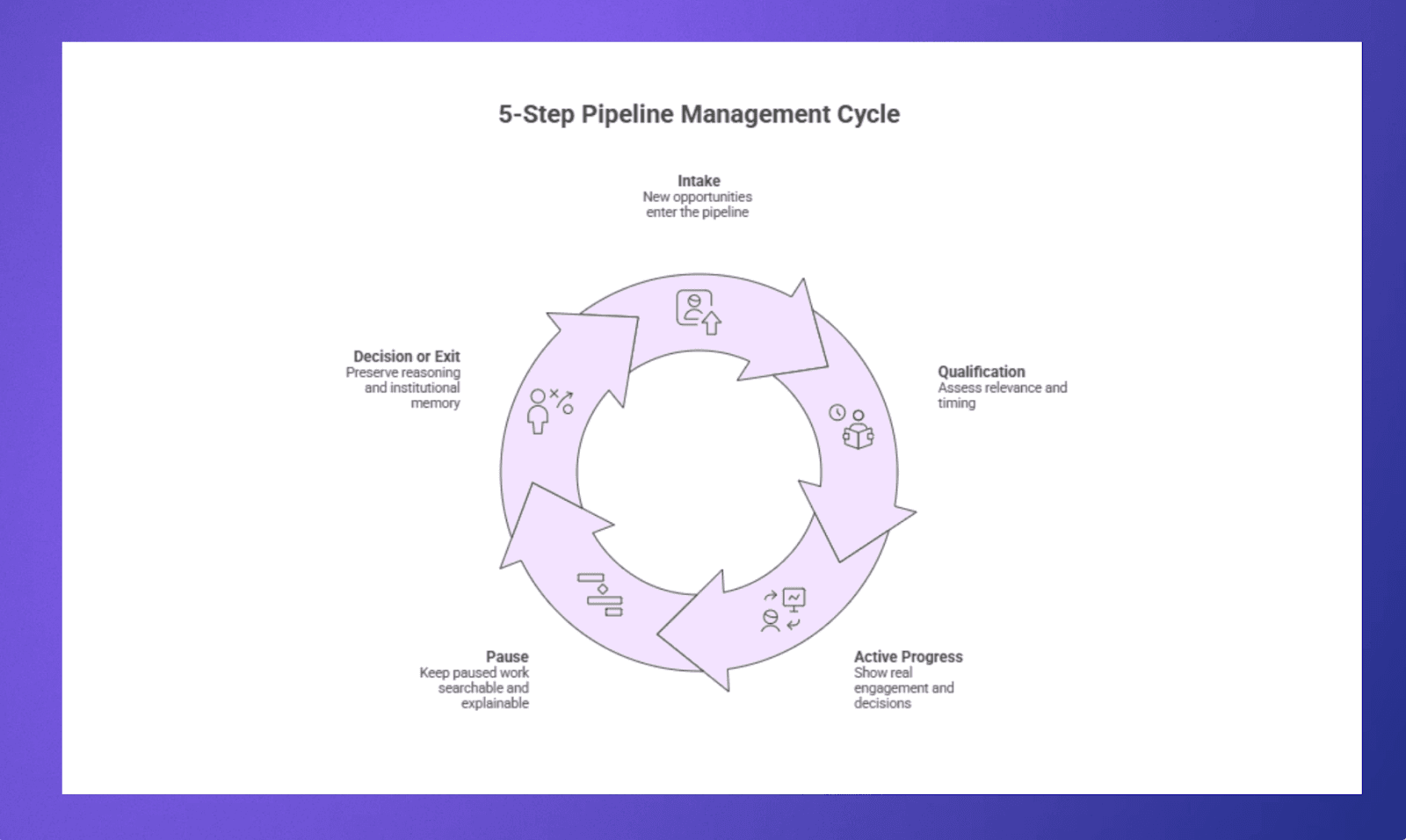
For relationship-driven teams, pipeline management works only when each step preserves context and keeps past decisions visible. Otherwise, the pipeline becomes a status board instead of a decision tool.
5 Key Benefits of Effective Pipeline Management
When pipeline management works, teams start making deliberate decisions.
Effective pipeline management gives teams:
Clear visibility into real work
Teams can see which conversations are active, paused, or dormant without relying on side notes or memory. This is especially important when multiple team members touch the same opportunity over time.
Stronger decision context
Pipelines that preserve history make it easier to understand why something moved forward, stalled, or exited. This reduces repeated diligence and prevents teams from reopening the same questions later.
Better prioritization
When context is visible, teams can focus on opportunities that are truly actionable instead of chasing movement for reporting’s sake. This is a common gap in pipeline-first CRMs.
Smoother handoffs across the team
Pipeline clarity improves collaboration. New team members or partners can step into ongoing work without restarting conversations or missing critical background.
More accurate reviews and planning
Pipelines that reflect reality support better internal reviews. Teams spend less time reconciling numbers and more time discussing actual next steps.
Gartner has found that pipeline accuracy and decision quality improve when systems emphasize context and ownership rather than rigid stage progression.
For long-cycle teams, the benefit of pipeline management is not speed. It is confidence. When teams trust what they see, pipelines become tools for decision-making instead of status reporting.
Where Traditional Pipeline Management CRMs Fall Short
Traditional pipeline management breaks when it tries to impose certainty on inherently uncertain work.
Most pipeline tools are built around a few assumptions that do not hold in long-cycle, relationship-driven environments:
Linear progression is expected - Opportunities are forced to move forward or close. When conversations pause, pipelines either stall or become cluttered with outdated records. This leads teams to ignore the pipeline altogether.
Context is tied to stages, not relationships - Notes, emails, and decisions are often buried inside deal records. When stages change or deals close, the reasoning disappears. Over time, pipelines show status without explanation.
Pauses are treated as failure - Traditional pipelines do not handle “not now” well. Legitimate timing issues get lumped in with true dead ends, making it harder to identify which opportunities are worth revisiting.
Reporting replaces understanding - Many systems prioritize forecast views and dashboards over decision clarity. Teams spend time reconciling numbers instead of discussing why work is stalled or what would move it forward.
Forrester has noted that pipeline tools underperform when they emphasize control and forecasting over collaboration and shared context
When teams stop trusting the pipeline, they fall back on inboxes, spreadsheets, and individual memory. At that point, the pipeline becomes a reporting artifact rather than a working tool.
This is the gap modern pipeline management needs to address.
How Rings AI Supports Pipeline Management in Real Work
Rings AI supports pipeline management by treating it as a view into ongoing work, not a rigid system teams must conform to.
Instead of forcing linear stages, Rings allows teams to shape pipeline views around how work actually progresses over time. Pipelines remain flexible, while context stays intact.
Rings AI supports effective pipeline management by:
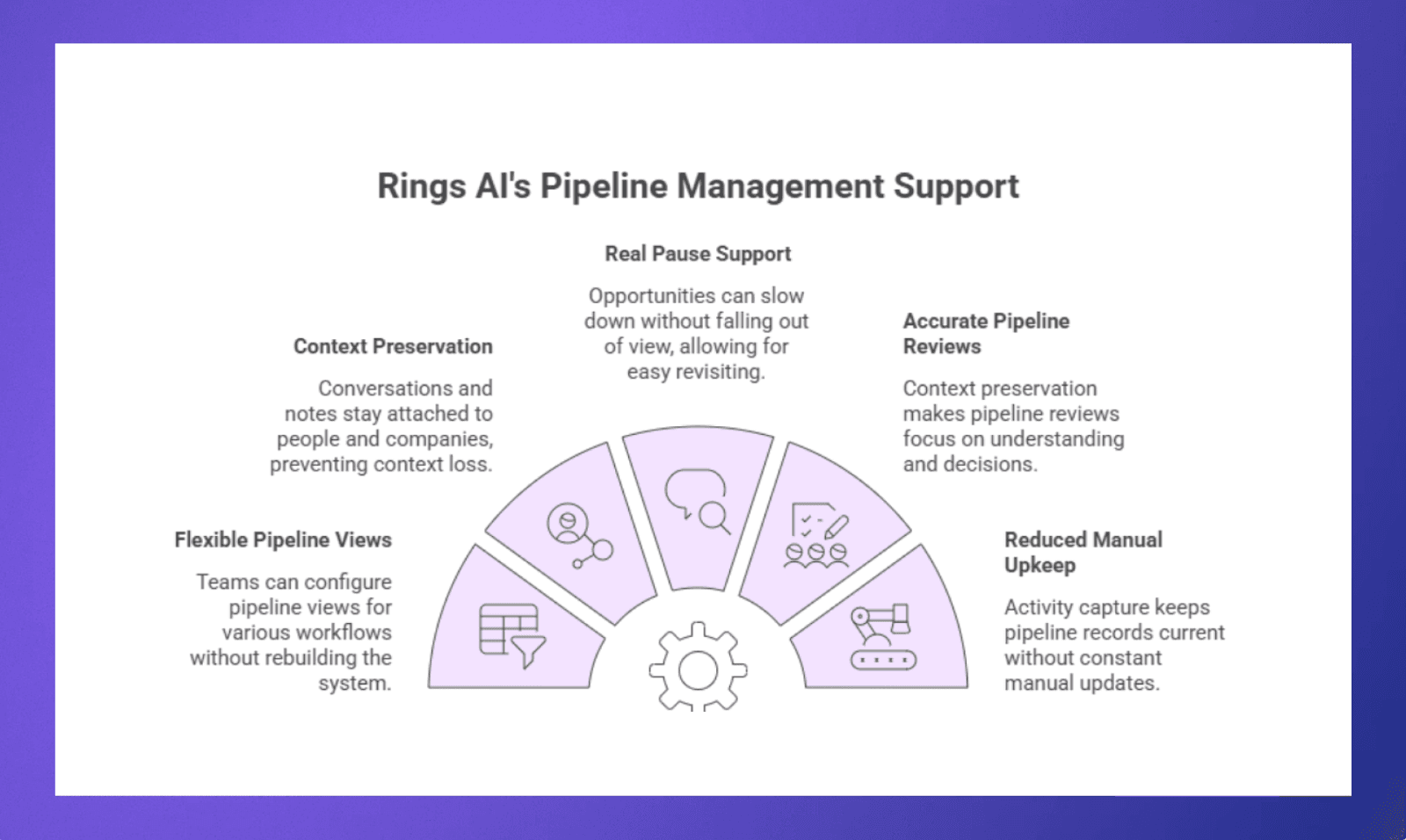
Keeping pipeline views flexible - Teams can configure pipeline views for deals, fundraising, intros, or other workflows without rebuilding the system. This supports long timelines and uneven progress while keeping the pipeline usable.
Preserving context at the person and company level - Conversations, notes, emails, and decisions stay attached to people and companies rather than disappearing inside closed deals. This prevents context loss as opportunities pause or resurface. Rings AI approach to this is central to how it handles relationship management beyond traditional CRM objects.
Supporting real pauses without losing visibility - Opportunities can slow down without falling out of view. Teams can revisit past work with full context instead of reopening diligence from scratch.
Making pipeline reviews easier and more accurate - Because context is preserved, pipeline reviews focus on understanding and decisions rather than reconciling data.
Reducing manual upkeep - Activity capture from email and meetings keeps pipeline records current without requiring constant manual updates. This allows teams to trust what they see without adding process.
External research supports this approach. Gartner has noted that CRM systems deliver more value when they adapt to existing workflows instead of enforcing rigid process models.
For relationship-driven teams, pipeline management works best when the system reflects reality. Rings AI is designed to do exactly that.
Use Pipeline Management That Reflects Real Work With Rings AI
Pipeline management should help teams understand what is happening and why. When context stays visible, and work can pause without disappearing, pipelines become decision tools instead of reporting artifacts.
Rings AI is built for long-cycle, relationship-driven teams that need pipeline clarity without a rigid process.
Book a demo to see how Rings AI supports pipeline management without losing context.