
Customer relationships are the backbone of most businesses. But managing them well is harder than it sounds. Emails get buried, context gets lost, and teams end up working from different versions of the same information. CRM SaaS platforms exist to solve that. They bring contacts, conversations, deals, and data into one place.
But not all CRMs are built the same. A platform designed for a sales team at a tech startup looks very different from one built for a venture capital firm managing hundreds of relationships over the years. Choosing the wrong one means paying for features you don't need while missing the ones you do.
This guide covers what CRM SaaS actually is, the core benefits, and a breakdown of the leading platforms so you can figure out which one fits how your business actually works.
What is CRM SaaS?
CRM SaaS (Customer Relationship Management Software as a Service) is cloud-based software that helps businesses manage their interactions and relationships with customers, prospects, and partners.
Rather than installing software on local computers, users access it through a web browser or app. This means businesses pay a recurring subscription (usually monthly or annually per seat) instead of a large upfront license fee.
A CRM tracks things like contact information, communication history, deals in progress, notes, and tasks. Traditional CRMs were built around sales pipelines and treating people as leads to close. They'd track things like contact information, communication history, deals in progress, notes, and tasks.
More modern CRMs, like Rings AI, are rethinking that model for relationship-led industries where the same people are interacted with repeatedly over years, rather than as one-time transactions.
Some well-known CRM SaaS products include Salesforce, HubSpot, and Pipedrive, which have been around for decades. There are newer players also like Affinity, Attio, and Rings AI, which cater to investors and relationship-heavy businesses.
Benefits of CRM SaaS
CRM SaaS helps businesses manage relationships, close deals, and stay organized, all from one cloud-based platform. That benefits a business in several different ways:
1. Centralized Relationship Management
Instead of scattered spreadsheets, emails, and sticky notes, a CRM brings every contact, conversation, and deal into one place. Teams can see the full history of a relationship at a glance — who spoke to whom, what was discussed, and what needs to happen next. No more duplicated outreach or lost notes when a team member changes roles. Everyone works from the same source of truth, making collaboration seamless and ensuring no relationship ever falls through the cracks.
2. Time Savings Through Automation
Modern CRMs eliminate the busywork that eats into a team's day. A few things that get automated:
Email and calendar activity captured without lifting a finger
Meeting prep generated from your existing notes and history
Notifications surfaced at the right moment, not buried in a feed
The result is a few hours back every week. And for lean, high-performing teams in VC or PE, that compounds fast.
3. AI-Powered Insights
Because a CRM holds so much relationship data, it becomes the perfect foundation for AI. Modern platforms can summarize your history with a contact, prep you for an upcoming meeting, or surface warm introduction paths across your team's network.
The key difference from generic AI tools is context. A CRM-native AI has access to your emails, notes, deals, and market data simultaneously. This kind of intelligence would otherwise take 30+ minutes of manual research before every single call.
4. Cost Consolidation
A well-built CRM replaces a surprising number of standalone tools, such as note-taking apps, contact databases, market research platforms, and email tracking software. One subscription instead of five or six, and far less time spent switching between them and reconciling conflicting information. For smaller firms, the operational simplicity alone is worth it, and for larger teams, the savings across a full tech stack add up quickly.
Top 4 CRM SaaS Platforms
Depending on your industry, team size, and how your business generates value, the right CRM for your business can look very different. Here are some of the leading options worth knowing.
1. Rings AI
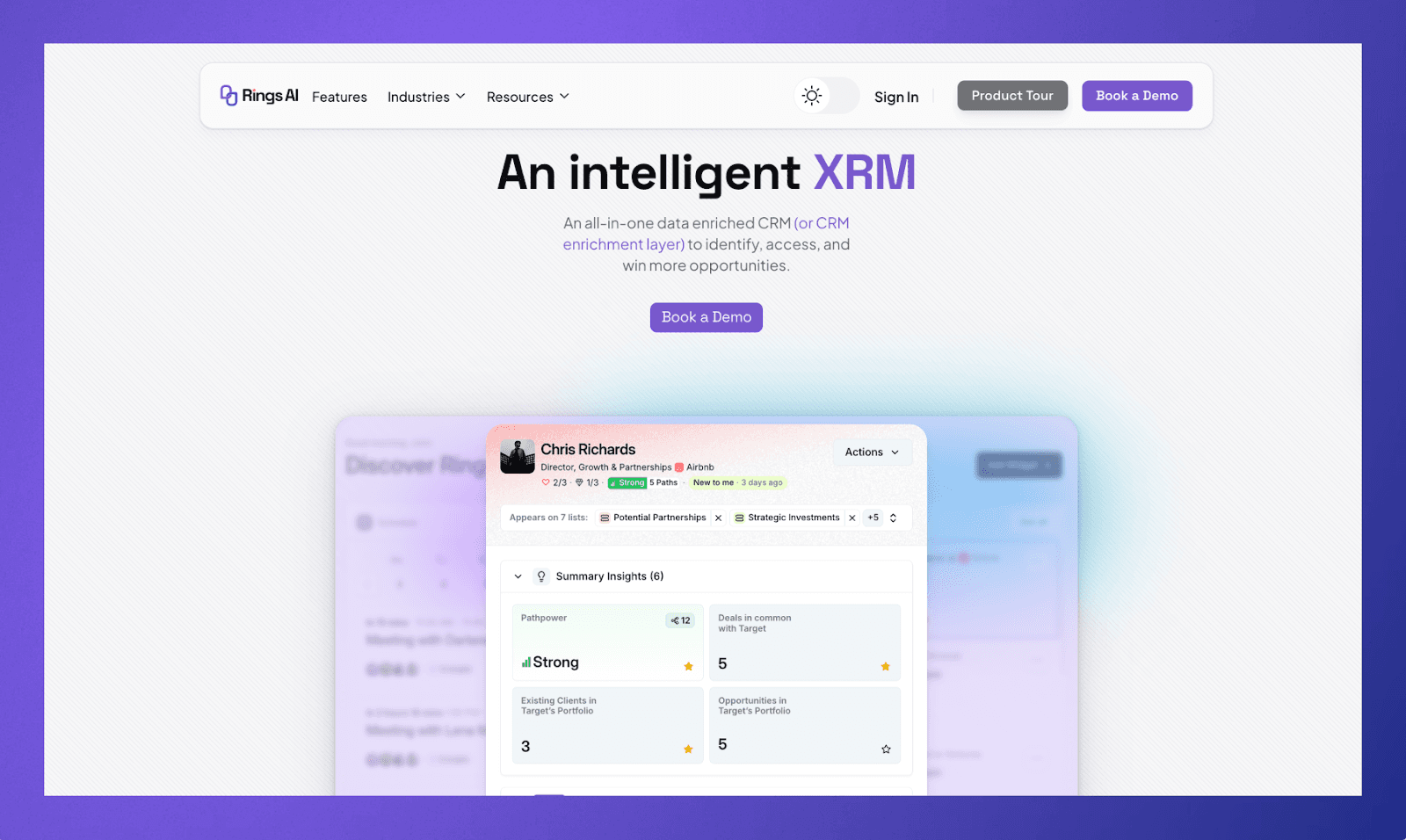
Rings AI is a CRM built specifically for investors (venture capital, private equity, and dealmaking finance). It was designed from the ground up to solve the problems that generic CRMs consistently fail at: managing recurring relationships, tracking deals round by round, and giving an entire team visibility into their collective network.
What sets Rings apart is how much context it brings into one place. Emails, meetings, notes, market data, fundraising history, and AI is all under one roof. Because of this, its AI actually works, producing meeting prep and relationship summaries that would otherwise take 30 minutes of manual research.
Key Features:
Team Network Mapping: Analyzes every employee's emails and LinkedIn to score relationship strength and surface warm intro paths across the whole firm
Automated Activity Capture: Emails and calendar meetings sync automatically, so your CRM stays up to date without manual input
AI Copilot: Ask questions about your notes, get caught up on a relationship, or generate a full meeting prep dossier using email, notes, and web data
Fundraising & Deal Management: Purpose-built modules for LP tracking and round-by-round deal management, built the way investors actually work
100M+ Data Points: Daily-updated market data from Crunchbase and dozens of partners, seamlessly matched against your private relationship data
Rich Notes & File Management: Fully searchable, AI-readable notes and files in one place, with sync to your favorite note-taking and storage tools
2. Attio
Attio is a cloud-based CRM built around flexibility and customization. Teams can configure objects, fields, pipelines, and workflows to match how they actually operate, rather than adapting to a fixed structure. It's widely used by startups and growing sales teams.
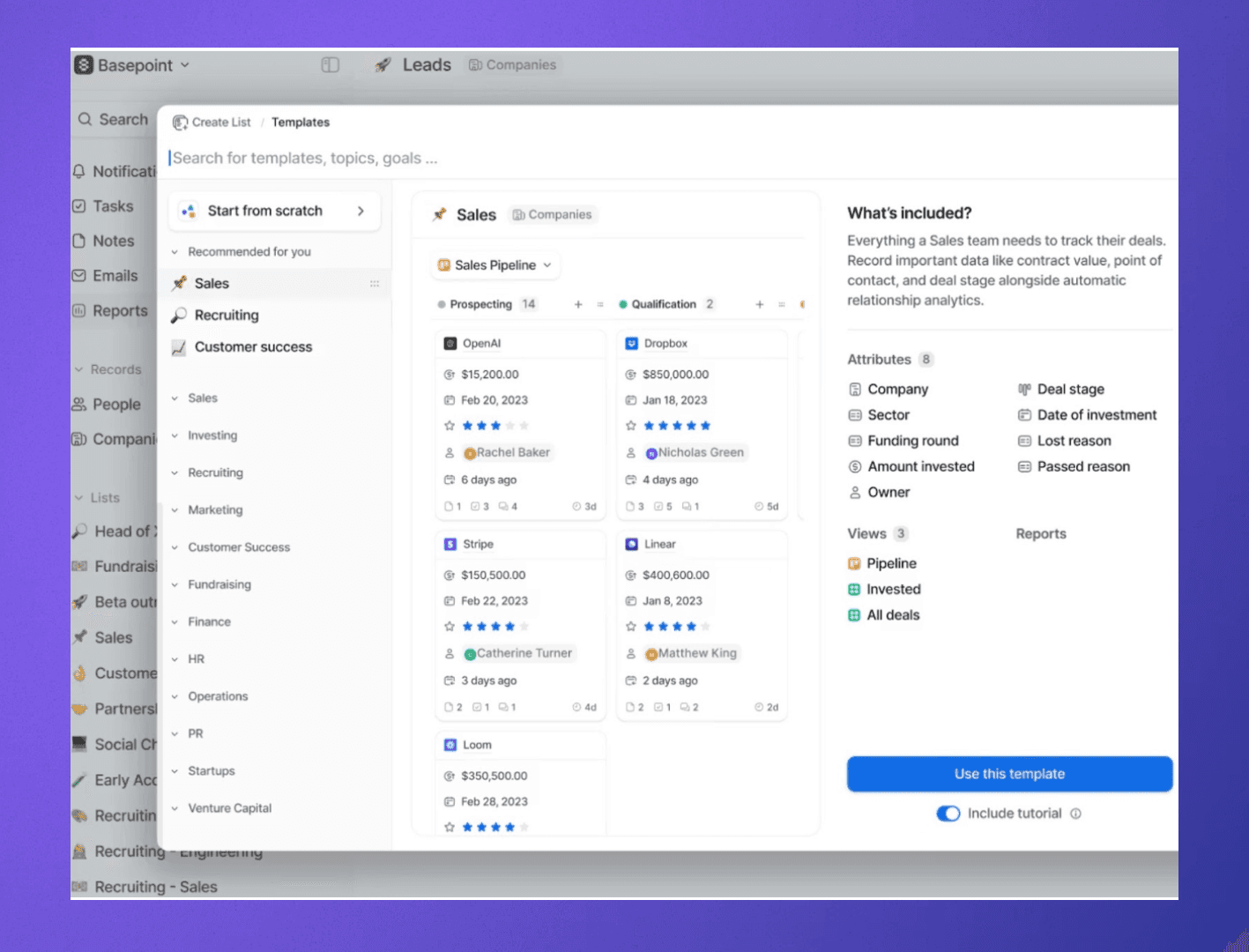
The platform covers core CRM functionality: email and calendar sync, contact enrichment, pipeline management, and automations. It offers a free tier and transparent per-seat pricing for paid plans.
Key Features:
Custom Objects & Fields: Build data structures that reflect your business's specific needs
Email & Calendar Sync: Automatic activity capture with contact enrichment out of the box
Data-Powered Automations: Trigger workflows based on data changes across your pipeline
Real-Time Reporting: Live dashboards across deals, contacts, and team activity
Integrations: Connects with Gmail, Slack, Zapier, Outreach, Mailchimp, and thousands more
Attio doesn't offer access to deal data, investor portfolios, or company prospecting. Relationship mapping is also limited, which matters for teams whose work is built around the depth of their network. Portfolio and enterprise opportunity management aren't well served by the platform either.
Some reporting and analytics features are gated behind higher-tier plans, and onboarding is entirely self-serve with no guided setup available.
3. Folk
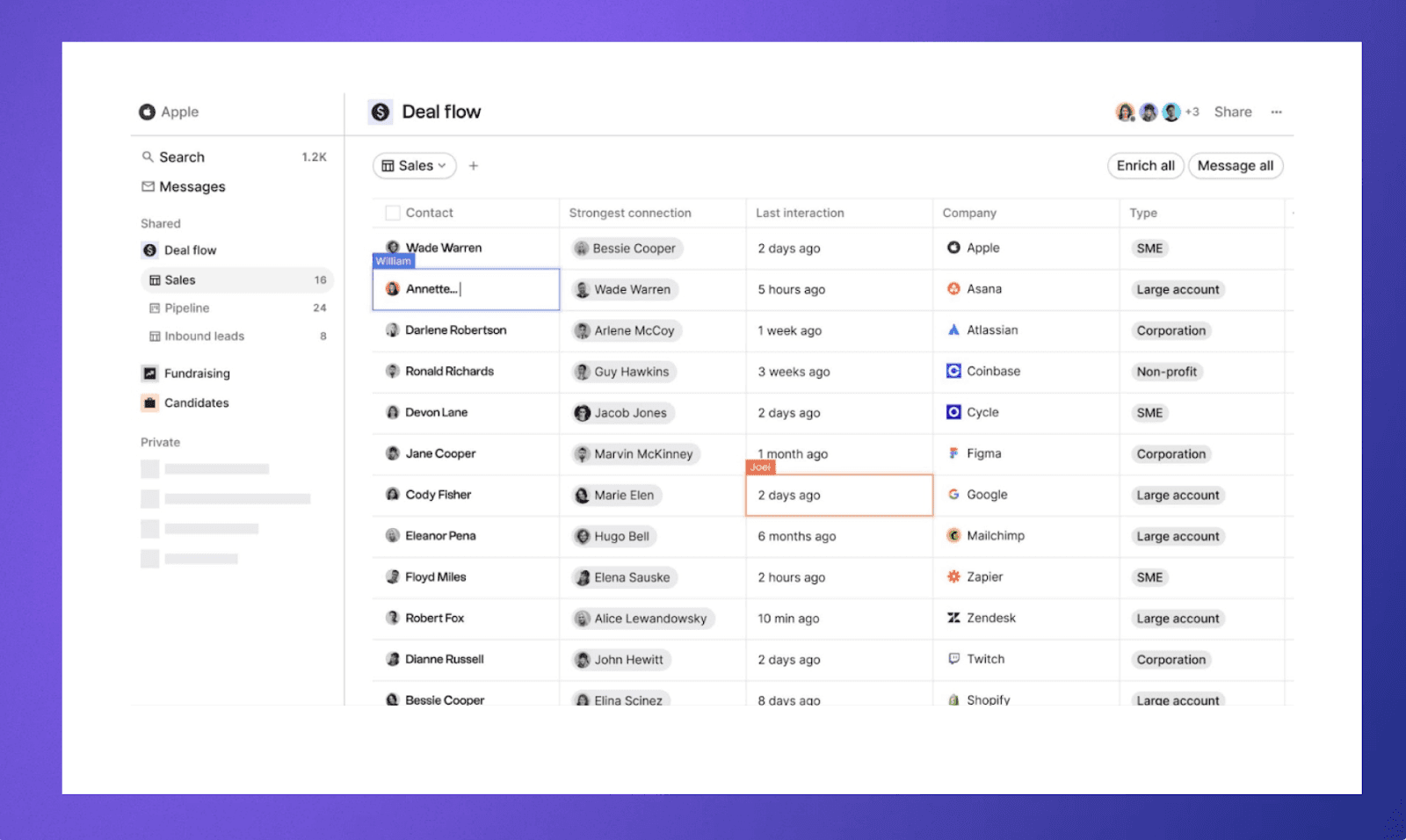
Folk is a CRM focused on contact management and outreach, built around simplicity and ease of use. Its main draw is combining relationship context with AI-assisted automation. The platform centers on a few core workflows: capturing contacts quickly, enriching their data automatically, and running personalized outreach at scale. It also offers pipeline management and integrations with over 6,000 tools.
Key Features:
Contact Import: Pull contacts directly from LinkedIn into your CRM via a Chrome extension, with details filled in automatically
Data Enrichment: Find emails, phone numbers, and other contact information in one click without manual research
Outreach Tools: Send bulk emails, build automated follow-up sequences, and use AI to write more personalized messages at scale
AI Assistants: Automate repetitive tasks like research, follow-ups, and record updates in the background
Pipeline Management: Track deals across shared pipelines with team permissions and basic sales reporting
Integrations: Connects to email, calendar, social platforms, and thousands of other tools
There's no mobile app, which is a practical limitation for anyone who needs to access contacts or conversations outside of a desktop. Folk isn't built for complexity. It supports a single pipeline, lacks meaningful segmentation and filtering, and doesn't offer the kind of reporting or analytics that growing teams typically need.
4. HubSpot
HubSpot is a general-purpose CRM platform covering contact management, sales pipelines, marketing, and customer service in one system. It's designed to scale with a business over time. Teams can start on the free plan and move to paid tiers as their needs grow, without migrating data.
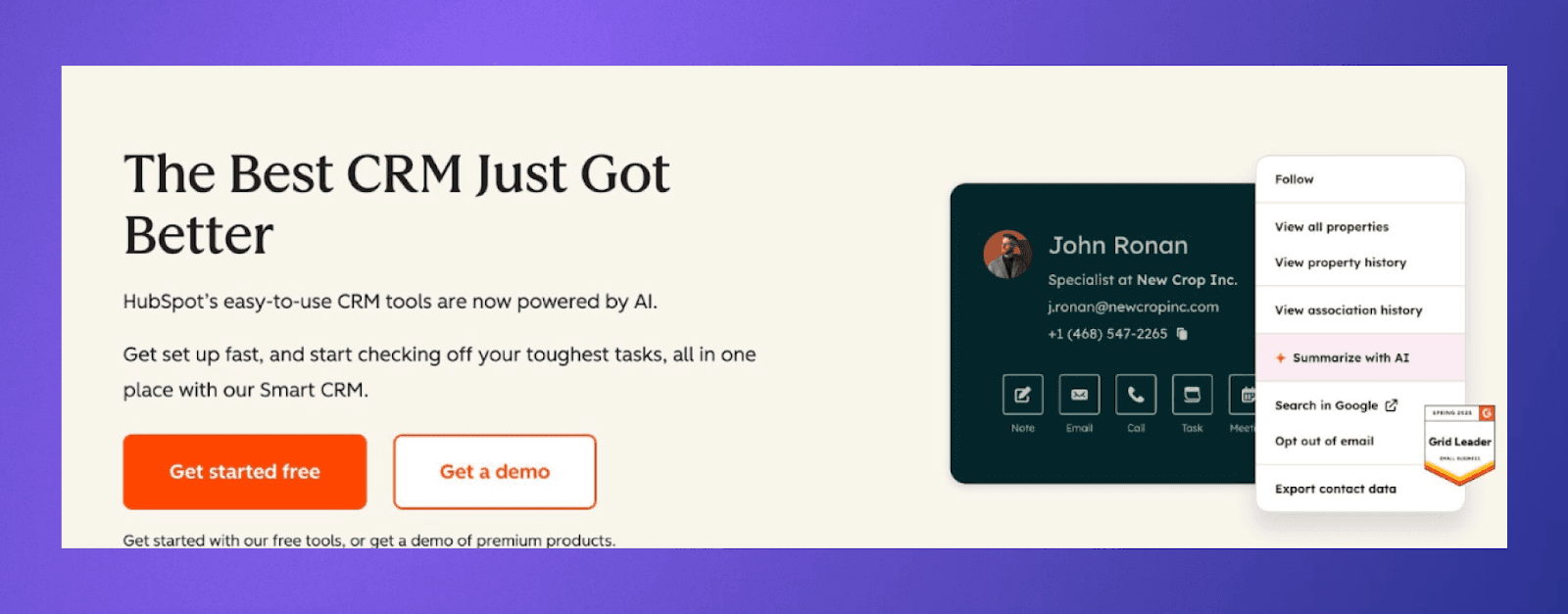
HubSpot, a CRM SaaS
The platform is broadly used across startups and small-to-mid-sized businesses. It offers a permanently free tier, which is a meaningful differentiator for teams early in their evaluation process.
Key Features:
Contact & Deal Management: Centralized records with full communication history, activity logging, and pipeline tracking
Breeze AI Assistant: Summarizes CRM records, researches companies, and helps prep for sales calls
Email Tools: Tracking, templates, sequences, and a shared team inbox connected to contact data
Reporting: Unified dashboards across sales, marketing, and service activity
Integrations: Connects to over 2,000 apps, including Gmail, Slack, Shopify, and Zapier
Free Tier: A functional free plan with no expiration; paid plans start at $15/seat/month
HubSpot is built primarily for sales and marketing teams at growth-stage companies. It doesn't offer relationship mapping, investor-specific workflows, or market data. It is a poor fit for firms in private capital where the nature of relationship management is fundamentally different from a standard sales process.
Which CRM Is Right for You?
If you're in venture capital, private equity, or dealmaking finance, the right CRM isn't just a nice-to-have. It's how you find deals, stay close to your network, and move faster than the firm sitting across the table. A generic tool can manage contacts. It can't tell you who on your team has the warmest path to a founder, summarize three years of relationship history before a meeting, or track a deal the way an investment round actually works.
That's the gap Rings AI was built to fill. I was designed from the ground up for how these firms actually operate. The relationship data, the deal workflows, the fundraising modules, and the AI all work together because they were built to.
Book a demo to see how Rings AI can transform how your firm manages relationships and closes deals.
Rings AI is a relationship intelligence CRM designed for teams that manage complex, long-term relationships. Book a demo to see how Rings AI can work for your team.