
Not every CRM is built around traditional sales pipelines. Many modern teams need a system that can organize complex relationships, custom workflows, and evolving data structures rather than just track deals.
Attio is one of the newer CRM platforms designed with that flexibility in mind. Instead of forcing teams into predefined templates, it allows them to build a CRM around their own processes.
But how well does Attio perform as a CRM in practice?
In this Attio review, we’ll look at its key features, pricing, pros and cons, and the best alternatives to consider before making a decision.
What is Attio?
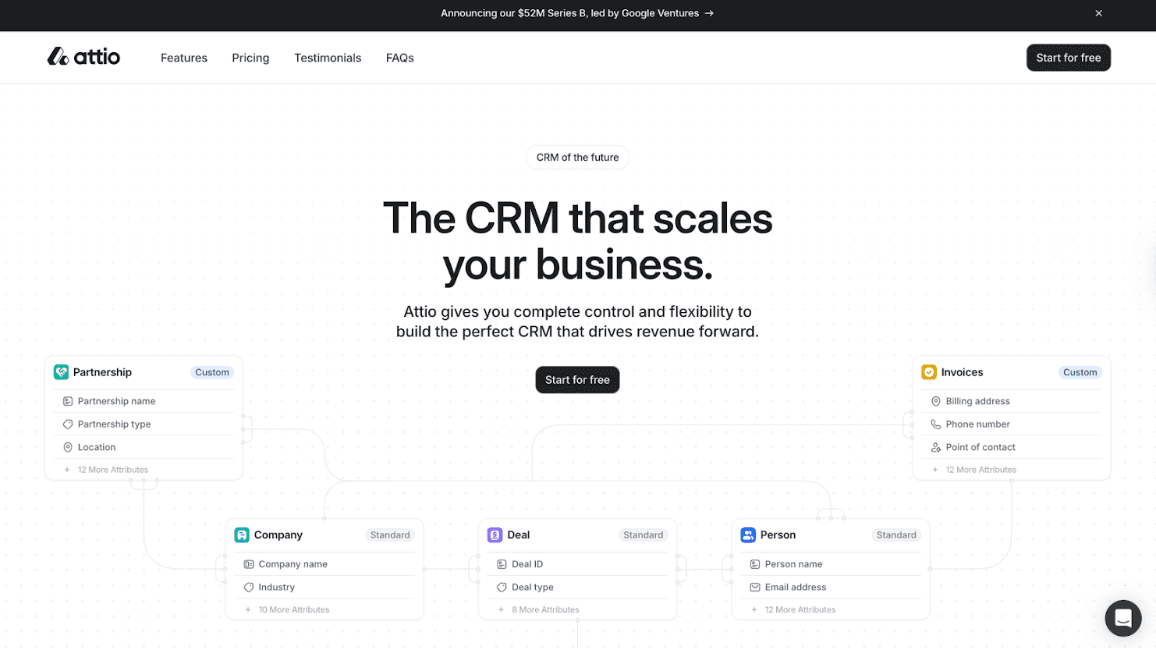
Attio is a modern, customizable CRM designed to help teams manage relationships, track opportunities, and organize business data in flexible workflows.
Unlike traditional CRMs that force companies into rigid sales pipelines, Attio takes a data-centric approach. It allows teams to build their own objects, workflows, and data structures to track anything from deals and partnerships to investors and recruiting pipelines.
At its core, Attio functions as both a CRM and a collaborative database. Teams can create custom collections for contacts, companies, deals, or other entities and connect them through relationships that mirror real-world business interactions.
Key Attio Features
Attio combines CRM functionality with a flexible data platform, allowing teams to manage contacts, deals, and other network-based workflows in one system.
Here are some of the key features that define the Attio platform.
Flexible data model: Attio allows users to create custom objects and collections that represent different types of data, such as contacts, companies, deals, investors, or projects.
Relationship linking: Connect related records, such as people, companies, and deals, so teams can view interactions and business relationships in one place.
Email and calendar sync: Integrate Gmail and Google Calendar to automatically log emails and meetings on relevant contact or company records.
Call intelligence: Automatically captures and analyzes sales calls, helping teams review conversations, extract insights, and keep records of key discussions linked to contacts or deals.
Reporting and analytics: Provides dashboards and reports that help teams track pipeline activity, monitor performance, and understand trends across deals, contacts, and workflows.
Kanban and table views: Manage deals or workflows using visual boards or structured tables, depending on how your team prefers to work.
AI-powered automation: Attio includes AI-powered agents that help automate tasks such as updating records, summarizing interactions, or triggering workflows based on activity.
Real-time collaboration: Allow team members to comment, tag colleagues, and work together on records within the CRM.
Integrations: Connect Attio with other business tools, such as Slack, email providers, and productivity platforms, to streamline workflows.
Attio Pricing Breakdown for 2026
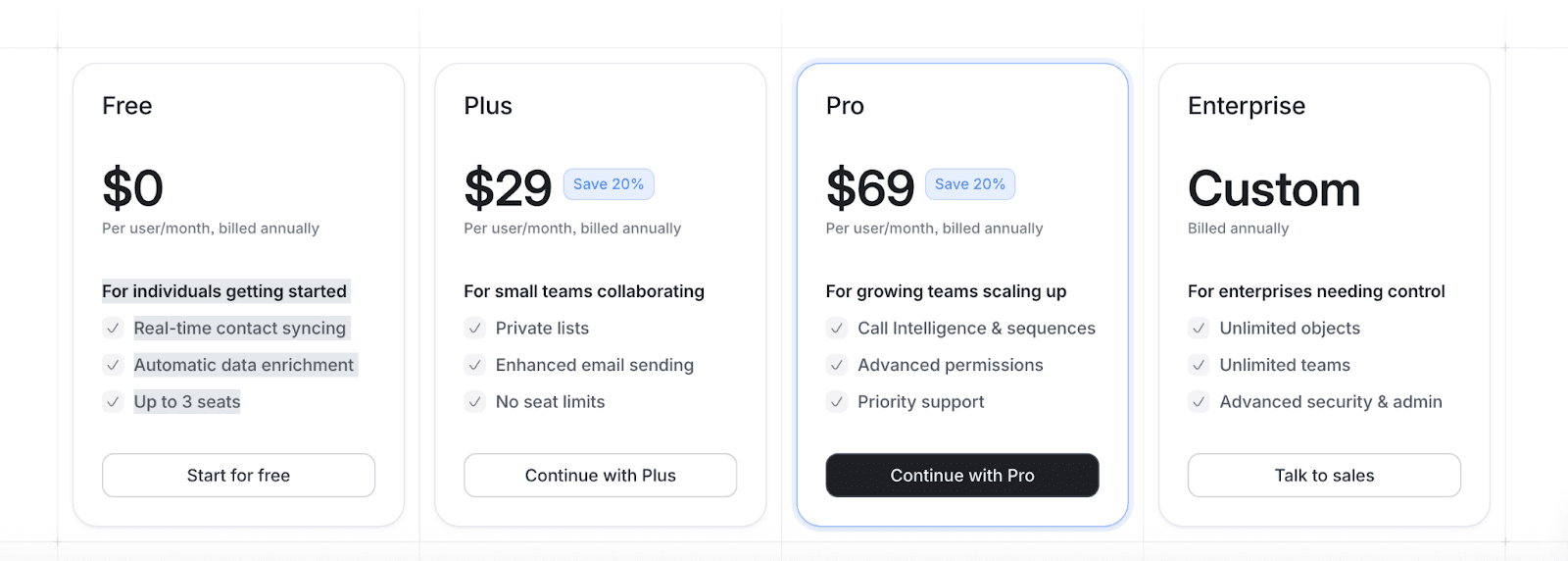
Attio offers multiple pricing plans designed to support individuals, small teams, and growing organizations.
Free: Designed for individuals getting started. Includes real-time contact syncing, automatic data enrichment, and support for up to three seats.
Plus: Starts at $29 per user per month. Removes seat limits and includes enhanced email sending, AI agents, and additional collaboration features.
Pro: Starts at $69 per user per month. Adds advanced capabilities, such as email sequences, call intelligence, and priority support.
Enterprise: Custom pricing for larger organizations. Includes unlimited teams and objects, along with advanced security, permissions, and enterprise-level controls.
All pricing listed above is billed annually.
Attio Pros and Cons
Attio has gained attention as a modern CRM, but it may not be the perfect fit for every organization. Here’s a balanced look at the platform’s strengths and limitations.
Attio pros
Attio allows teams to build their own data models and workflows, making it adaptable to many use cases beyond traditional sales pipelines.
Real-time collaboration, comments, and shared workflows allow multiple teams to work together on relationship management.
The ability to create custom objects, fields, and views allows teams to manage deals, partnerships, hiring pipelines, or investor relationships in a single system.
Many early-stage companies and venture capital teams prefer Attio because it offers the flexibility of a database combined with CRM capabilities.
Attio offers a robust API that allows teams to connect external tools and build custom workflows on top of the CRM.
Attio cons
Because Attio allows deep customization, new users may need time to design the right data structures and workflows for their needs.
Compared with traditional CRMs like Salesforce or HubSpot, Attio’s reporting and analytics capabilities are still developing.
Attio focuses more on flexible relationship management rather than enterprise sales automation, which may limit its suitability for very large sales teams.
While Attio helps organize contacts and deals, it lacks deeper relationship intelligence features, such as automated network mapping or multi-degree relationship discovery.
Records are typically attached to a single person or company, which can make it harder to represent complex processes involving multiple stakeholders across different organizations.
Best Attio Alternatives to Consider
Depending on your needs, such as deeper relationship intelligence or broader marketing tools, other platforms may be a better option.
Here are three Attio alternatives worth considering.
1. Rings AI
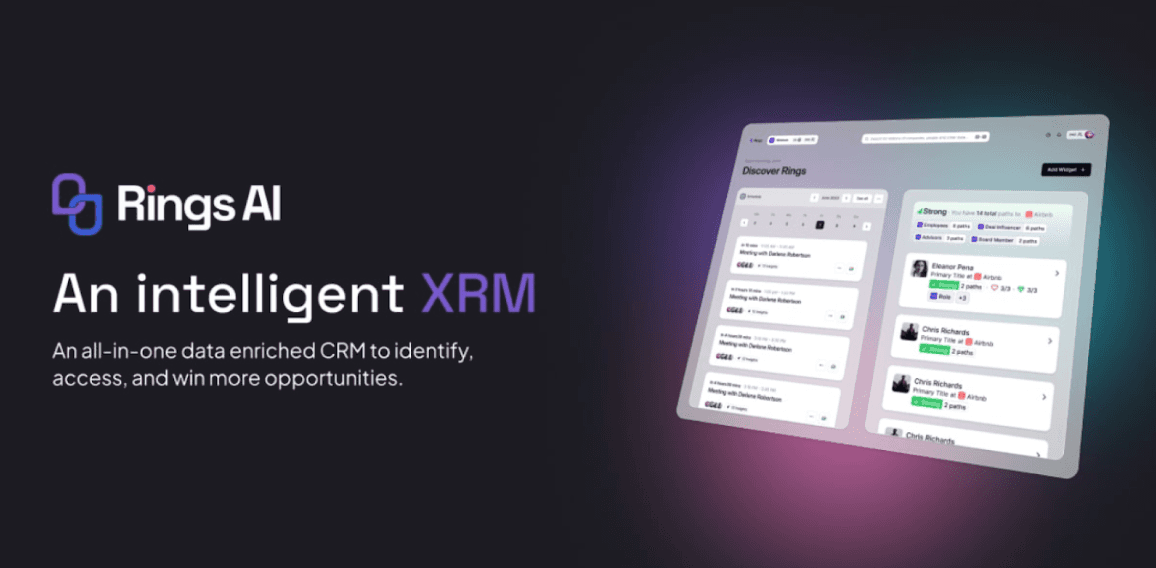
Rings AI is a relationship intelligence platform designed for teams that rely heavily on networks and deal flow, such as venture capital, private equity, and other relationship-driven businesses. It focuses primarily on tracking contacts and deals. Rings AI helps teams understand how relationships connect across companies, investors, and stakeholders.
The platform automatically captures interactions from email and calendar activity and surfaces insights that help teams identify warm introductions and hidden opportunities.
For organizations managing complex deal networks, Rings AI uses a proprietary association data model that lets teams create custom objects and link each record to multiple people and companies. This makes it easier to represent multi-stakeholder relationships commonly found in investment and partnership-driven deal processes.
Rings AI follows an annual, per-user pricing model, making it comparable to platforms like Attio in terms of overall cost. In many cases, teams with larger seat counts may find it even more cost-effective.
One notable difference is how AI functionality is handled. Unlike Attio, which relies on usage credits for AI features, Rings AI includes its AI capabilities within the standard pricing rather than charging separately based on usage.
2. Affinity
Affinity is a relationship intelligence CRM built specifically for investment-driven teams, such as venture capital firms, private equity funds, and investment banks.
The platform automatically captures relationship data from email and calendar interactions, helping teams track communication history and identify strong connections within their networks. It also offers features like deal flow tracking, relationship analytics, and automated data enrichment.
It is generally best suited for small investment teams managing an existing contact base, as it cannot prospect outside your network. The insights are limited to known contacts and companies, unlike Rings AI.
Affinity pricing typically starts at around $2,000 per user per year.
3. HubSpot CRM
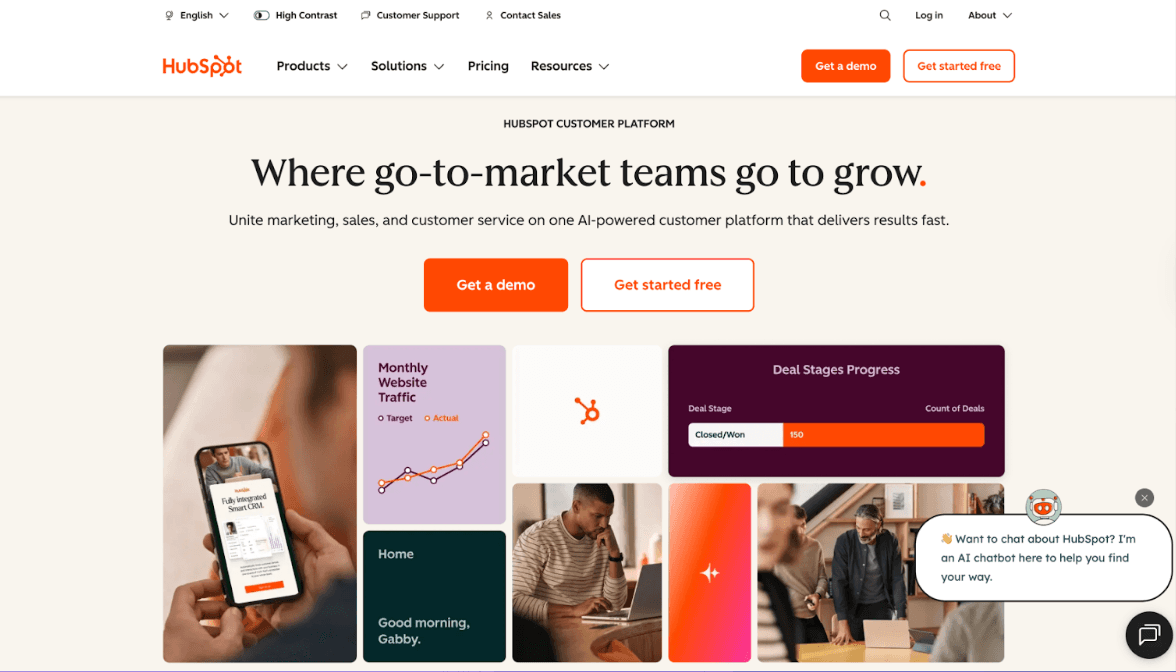
For businesses looking for an all-in-one platform that combines CRM with marketing and service tools, HubSpot can be a strong alternative to Attio.
The platform includes contact management, pipeline tracking, automation tools, and detailed reporting dashboards. Its free CRM plan makes it accessible for startups and small teams, while paid tiers provide more advanced automation and analytics capabilities.
Its paid plan starts at $9 per seat per month, but can become expensive quickly as additional tools and features are added.
If you want a broader comparison, check out our guide on the best Attio alternatives to see how other platforms compare in features and pricing.
When Attio May Not Be Enough for Your Team
Attio is a strong choice for teams that want a flexible CRM to organize contacts, deals, and workflows. However, as networks grow and deal cycles become more complex, some teams need deeper visibility into how their relationships actually connect.
This is especially true for organizations that rely heavily on introductions, partnerships, and investor networks. In these cases, simply storing contact data is often not enough. Teams need tools that help them understand how opportunities move across their broader network.
Platforms like Rings AI focus on relationship intelligence that provides an additional layer of insight, helping teams identify warm paths, track network activity, and prioritize the most promising opportunities.
If your team relies heavily on relationships to win deals or source investments, this deeper visibility can make a meaningful difference.
Book a demo to see how Rings AI helps teams uncover hidden opportunities and manage complex business networks more effectively.