
Sales pipelines rely on consistent visibility into prospects, relationships, and deal progress. Yet in many organizations, this information is spread across inboxes, spreadsheets, meeting notes, and messaging apps.
When data lives in disconnected systems, teams struggle to track conversations, share context internally, and forecast revenue accurately. Deals stall not because of a lack of interest, but because important information gets lost along the way.
A CRM database solves this problem by creating a centralized system where customer and prospect data is structured, accessible, and continuously updated. Instead of relying on fragmented records, sales teams gain a unified view of their pipeline and relationships.
In this guide, we’ll explain what a CRM database is, how it works, and why it plays a critical role in building a predictable sales pipeline.
What is a CRM Database?
A CRM database is a structured repository that stores and organizes information about prospects, customers, and business relationships.
CRM stands for customer relationship management, and the database serves as the operational foundation for managing sales interactions and pipeline activity.
Instead of storing information across emails, spreadsheets, and personal notes, a CRM database connects multiple data points into one system. Typical records stored in a CRM database include:
Contact profiles (names, roles, emails, phone numbers)
Company or account information
Sales activities, such as calls, meetings, and emails
Deal records and pipeline stages
Market signals, such as funding announcements or leadership changes
Notes, documents, and internal collaboration
Relationship connections between stakeholders
When these records are connected, teams gain a clearer picture of who they’re working with, how relationships are evolving, and what activity is happening around an account.
It’s also important to distinguish between raw CRM entries and actionable insights. Our guide on the difference between data and information explains how structured systems like a CRM database help convert scattered data into meaningful context for decision-making.
Why a CRM Database Matters for Sales Teams
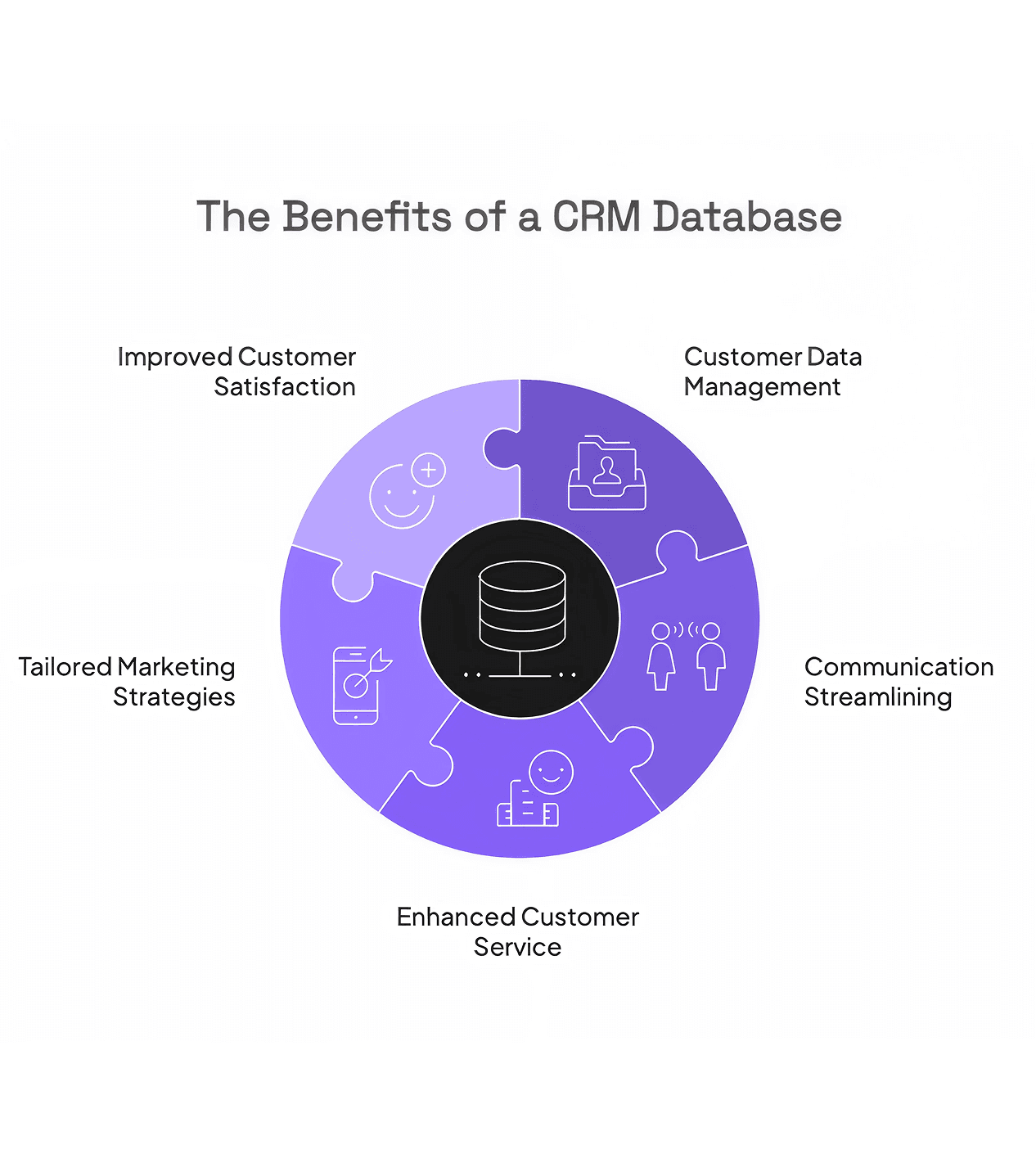
At first glance, a CRM database might seem like a simple storage system for contact records. But its real value lies in how it supports sales strategy, collaboration, and decision-making.
Modern pipelines involve multiple touchpoints across marketing, sales, partnerships, and leadership. Without a central system to track those interactions, opportunities are easily missed.
Research consistently shows that organizations with strong data visibility outperform those that rely on fragmented systems.
Personalization at scale: McKinsey’s research shows companies that personalize outreach using customer data can generate 10–15% revenue growth. A CRM database enables this by consolidating interaction history, engagement signals, and account details in one place.
Faster growth through analytics: Companies that deploy advanced customer analytics grow 1.5× faster than competitors. These insights rely on a well-structured CRM database that allows teams to analyze deal patterns, engagement history, and pipeline trends.
More precise targeting: When sales and marketing teams have access to accurate account data, such as industry signals, stakeholder roles, engagement activity, and market developments, they can focus on the opportunities most likely to convert instead of pursuing every lead equally.
CRM Database vs. Spreadsheet: Which One Should You Choose?
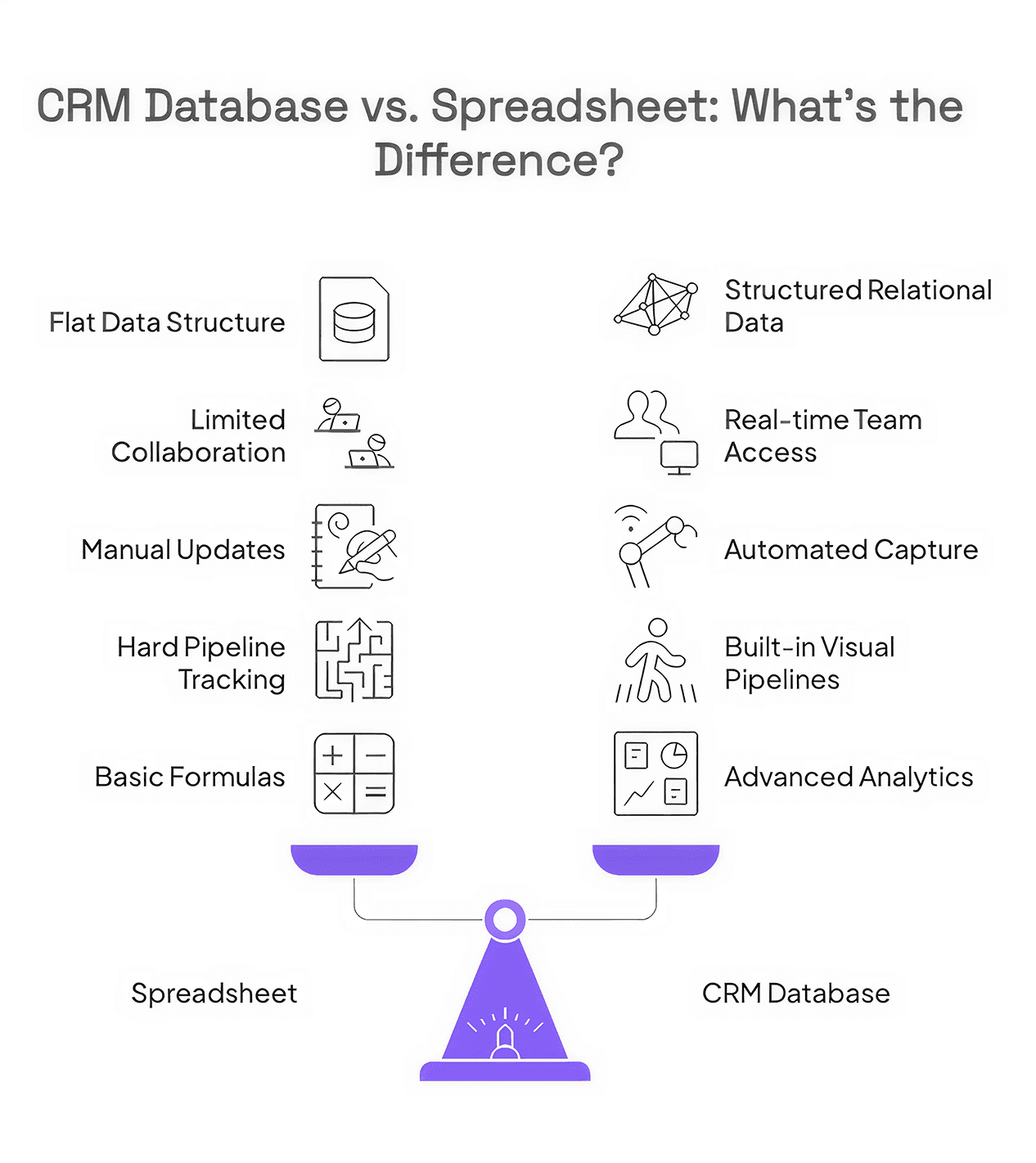
While the benefits of a CRM database are clear in theory, many teams still rely on spreadsheets in the early stages of growth.
However, as pipelines grow and deals involve multiple stakeholders, spreadsheets quickly become difficult to manage. Updates rely on manual entry, collaboration becomes fragmented, and maintaining an accurate view of the pipeline becomes increasingly challenging.
While spreadsheets are useful for storing basic information, they lack the structure needed to manage complex relationships and evolving deal pipelines.
CRM databases address this by connecting contacts, companies, deals, and activities within a single system. This structured approach allows teams to track interactions, maintain relationship context, and monitor pipeline progress more effectively.
The difference between a spreadsheet and a database becomes even clearer as sales operations scale.
How a CRM Database Works
A CRM database organizes information around several interconnected records that together create a clear view of relationships, deal activity, and pipeline progress. These components help teams track interactions, manage opportunities, and maintain context across the sales process.
1. Contact records
A contact record stores details about the individuals your team interacts with. This includes basic information like job title and email address, but it also captures relationship context, such as:
Past meetings and conversations
Email exchanges
Notes from calls or demos
Internal discussions about the contact
Over time, this builds a timeline of engagement that helps sales teams understand how relationships evolve. When a colleague joins a conversation or a deal changes owners, the full history remains available.
2. Company (account) records
Most B2B deals involve multiple stakeholders within the same organization. A CRM database groups individual contacts under a company or account profile, making it easier to understand the broader relationship with that organization.
A company record typically includes:
Industry and company size
Key decision-makers
Current deals and past transactions
Strategic notes about the account
This structure allows teams to move beyond isolated conversations and view the entire account landscape when managing opportunities.
3. Relationship mapping
In industries like venture capital, private equity, and partnerships, deals involve multiple organizations and interconnected stakeholders.
Data-enriched CRM systems allow teams to map these relationships by linking contacts, companies, and deal entities together. This provides visibility into how individuals and organizations are connected across a network.
Instead of tracking contacts in isolation, teams can identify:
Mutual connections between stakeholders
Potential warm introductions
Advisors, investors, or partners involved in a deal
Platforms like Rings AI extend this capability by helping teams visualize relationship networks and uncover hidden connections across their ecosystem.
4. Deal records and pipeline visibility
Deal records track revenue opportunities as they move through the sales pipeline. Each deal is typically connected to relevant contacts and company accounts and includes information like:
Deal value
Pipeline stage
Expected close dates
Activity history
Supporting notes or documents
Deals progress through defined stages, such as qualification, demo, proposal, negotiation, and close, giving teams a structured way to track opportunities and forecast revenue.
Pipeline visibility allows sales leaders to quickly assess deal progress, identify stalled opportunities, and evaluate overall pipeline health.
5. Activity tracking and integrations
A CRM database also captures the activities that occur between teams and prospects. These activities can include calls, emails, meetings, follow-ups, and notes from conversations.
Modern CRM systems often integrate with tools, such as email platforms, calendars, marketing automation systems, and external data providers. These integrations automatically capture interaction data and relevant market signals, reducing manual updates and improving data accuracy.
Together, these components transform a CRM database into a central system of record for relationship management and pipeline visibility, enabling teams to coordinate outreach, maintain context, and move deals forward more effectively.
How Rings AI Enhances CRM Data
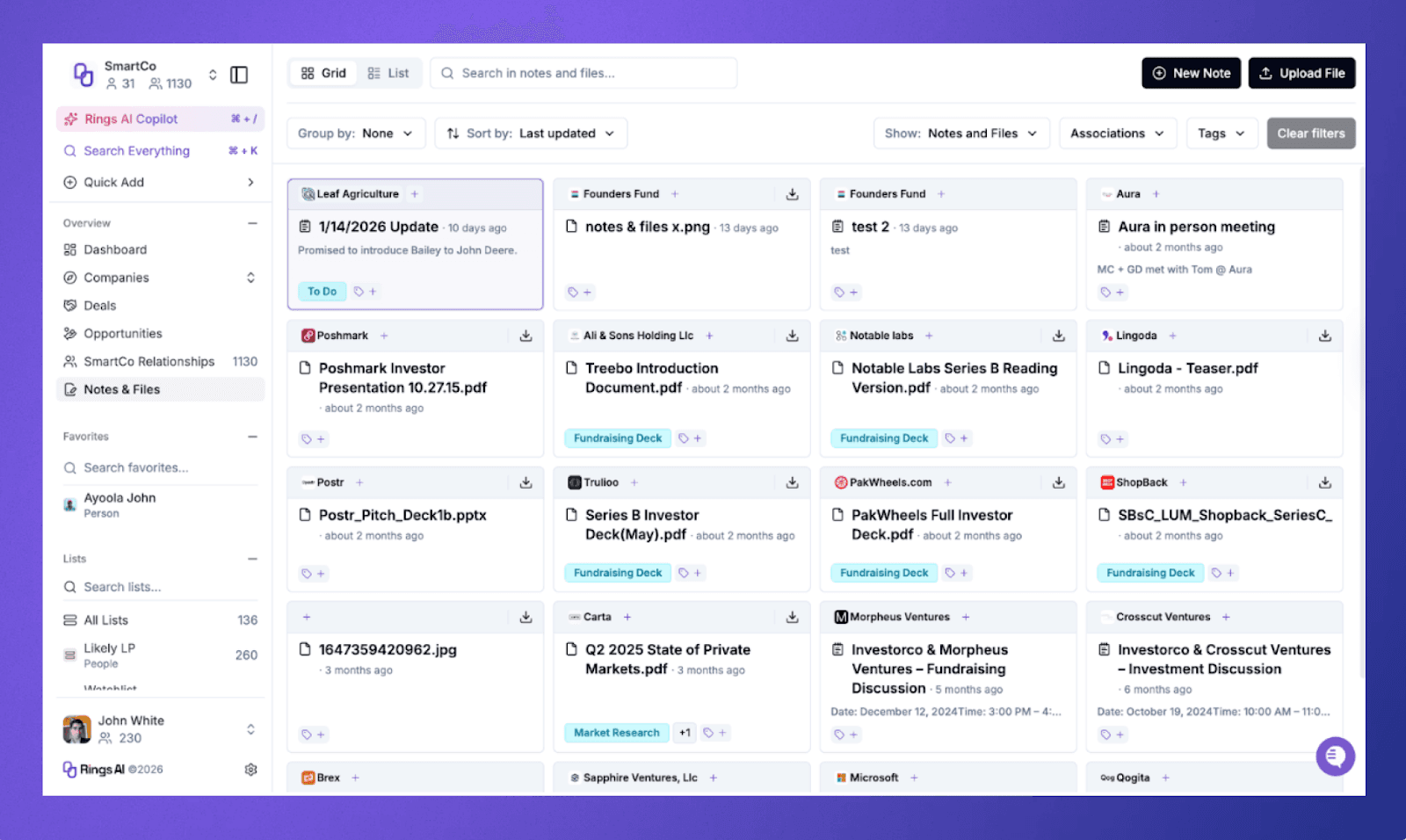
Keep every note, file, and meeting update organized and connected to your deal pipeline with Rings AI.
A CRM database serves as the system of record for contacts, companies, and deals. But on its own, it mainly stores information. The real advantage comes when that data is enriched with intelligence that helps teams act on it.
Rings AI builds on top of CRM data by turning relationship and activity signals into actionable insights. It aggregates information from communication channels, relationship networks, and company activity to surface opportunities that might otherwise remain hidden.
Instead of manually searching through contacts, emails, and meeting notes, teams gain visibility into:
Warm introduction paths within their network
Relationship strength across contacts and companies
Emerging opportunities based on market activity and signals
Pre-meeting intelligence that provides context before conversations
This additional layer of intelligence helps sales and business development teams prioritize the right opportunities and engage stakeholders with better context.
In relationship-driven industries, this visibility can significantly improve pipeline quality and deal velocity.
Learn more about deal sourcing.
Turning CRM Database Into Actionable Intelligence
A CRM database forms the operational backbone of modern sales organizations by providing the structure needed to manage relationships, track deals, and forecast revenue.
Without it, organizations struggle to maintain visibility across relationships, deals, and pipeline performance.
However, as sales environments become more complex and deals involve multiple stakeholders, simply storing contact and deal information is no longer enough. Teams also need the ability to interpret that data, identify meaningful signals, and act on opportunities at the right moment.
That shift, from storing data to generating actionable insight, is what enables teams to manage relationships more strategically and move deals forward with greater confidence.
Book a demo with Rings AI to see how it helps strengthen your pipeline.