
CRMs can be exciting to unbox but the real challenge comes after the wrapping’s off. Once the initial thrill fades, many teams realize they’re not sure how to make the most of their new system.
Many blame the platform. But the thing is, even the most feature‑rich CRM can’t save an organization that hasn’t defined how it wants to build and manage customer relationships.
A solid CRM strategy bridges that gap. It lays out the blueprint for attracting, nurturing, and retaining customers in ways your systems can actually execute. When done right, it transforms CRM from a data repository into a relationship growth engine, turning every touchpoint into a deliberate, measurable step toward loyalty and revenue.
Below, we discuss what goes into a great CRM strategy, its key components and benefits, and how tools like Rings AI help you align technology with business outcomes to build lasting customer relationships.
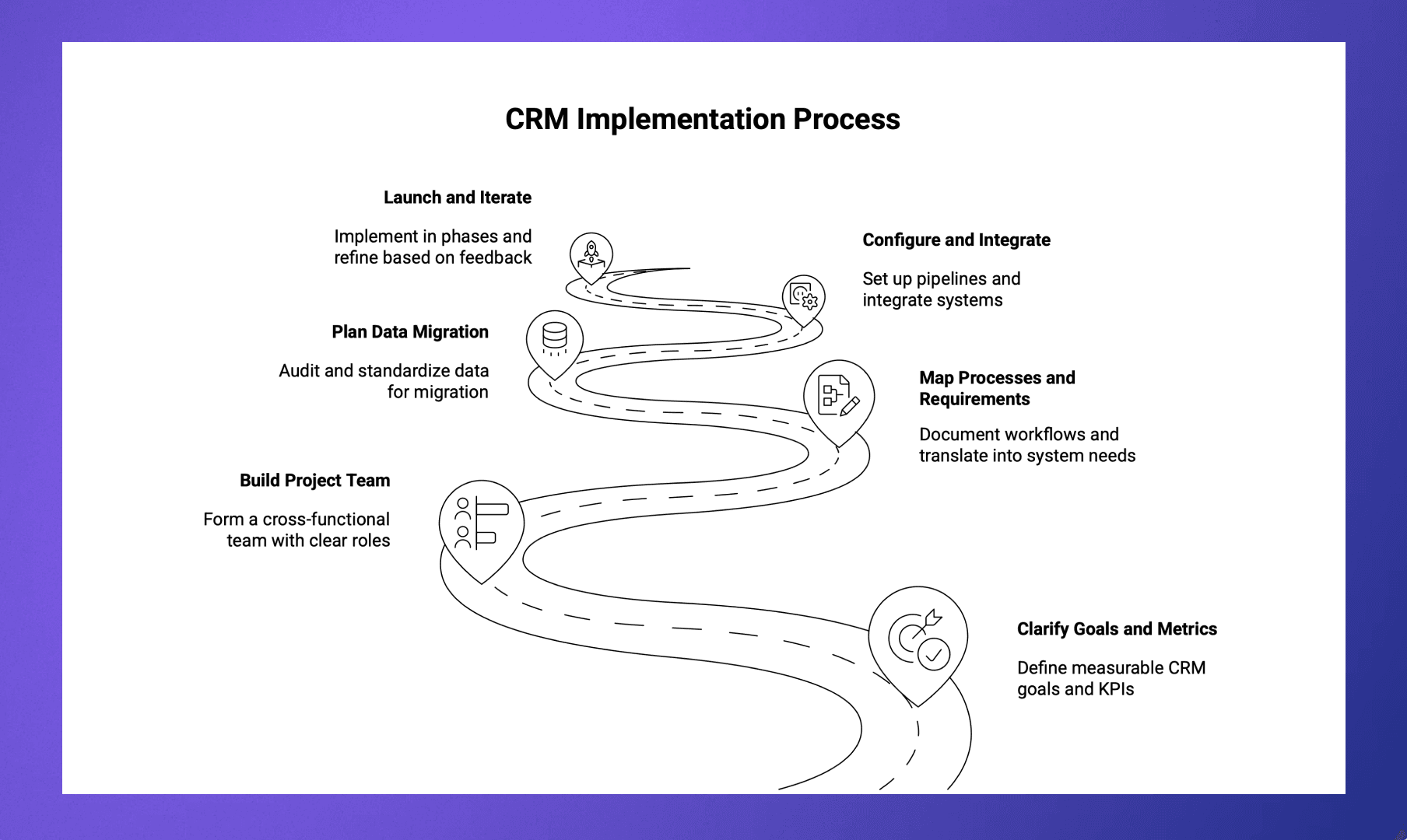
What is a CRM Strategy?
A customer relationship management (CRM) strategy is your company’s structured approach to managing interactions across the entire customer lifecycle, from relationship activation to customer service and advocacy. It guides:
Who you target and support?
When and why you communicate?
How you deliver consistent experiences?
What tools and metrics you’ll use to measure success?
What a Good CRM Strategy Includes
A great CRM strategy is built from several interlocking components that collectively define how relationships are built, sustained, and grown.
The most robust CRM strategy should incorporate:
1. Vision and goals
This defines the purpose of your CRM, whether it’s to accelerate sales cycles, improve customer support, expand lifetime value, or unify relationship intelligence. Goals must be measurable and tied to business outcomes like churn reduction or revenue per account.
2. Customer segmentation and targeting
Not all customers have the same needs. A good CRM strategy uses data to segment customers by size, value, or behavior and then tailors workflows, campaigns, and engagement accordingly.
3. Processes and workflows
Every team, from marketing to customer success, operates within defined processes. Document how leads are captured, qualified, and nurtured; how onboarding flows; and how renewals or upsells are tracked.
4. Data management and technology stack
This includes your CRM platform(s), integrations, and the data standards that keep customer information clean and consistent. Proper governance ensures the CRM remains trustworthy and usable.
5. Measurement and optimization
Clear KPIs like conversion rate, retention, NPS, or average deal size allow continuous improvement. Layer in dashboards and scorecards to track progress and identify gaps.
6. Change management and training
Finally, even the best strategy fails without people. Make training and adoption integral parts of the plan, ensuring colleagues understand why the CRM helps them, not just how it works.
Why Having a CRM Strategy is Essential
Developing a strategy isn’t just about hitting numbers and ticking off boxes on your workflow. A structured and sustainable CRM approach delivers multiple long‑term advantages:
Unified customer view
Connect data across departments, giving you a holistic 360° view of each customer. Everyone from sales to support can see history, preferences, and latest interactions, eliminating silos and repeated effort.
Predictable sales performance
When built well, your CRM strategy streamlines lead management, tracks pipeline health, and automates forecasting. You gain real visibility into which deals move, which stall, and which relationships drive outcomes.
Smarter customer retention and upsell
Customer relationships aren’t static. A mature CRM strategy uses relationship tracking and engagement scoring to spot at‑risk clients early and prioritize personalized outreach.
Operational efficiency
Automating data capture and workflows saves hours of manual entry. It ensures data accuracy, faster reporting, and less duplication across teams.
Data‑driven decision making
With clean, unified data, leadership gains real insight into trends like who buys, when they buy, and what drives satisfaction or churn. It turns intuition into informed strategy.
Scalability
A CRM with a clear strategy scales alongside your company, supporting new regions, teams, and verticals without starting from scratch.
4 Best Practices to Build a Successful CRM Strategy
A strong CRM strategy isn’t built overnight; it’s the result of aligning people, processes, and technology around a shared vision for customer growth. The most successful organizations treat CRM as a living system that evolves with their business.
Here are four best practices to help.
1. Align teams and processes
Your CRM strategy only works if the entire organization rows in the same direction.
Unify marketing, sales, and customer success on shared definitions of what qualifies as a lead, what an opportunity stage means, and how handoffs work. Create open feedback channels so front‑line teams can refine workflows based on real-world use.
2. Choose and customize the right CRM platform
Selecting your CRM is a strategic decision, not just a one-off purchase. Your platform should enable your process instead of creating more roadblocks and silos.
When evaluating systems, focus on:
User adoption: Is the interface intuitive and mobile‑friendly?
Automation: Can the system automatically pull data from calls, emails, or calendars?
Integration: Does it fit into tools your teams already rely on?
Scalability: Will it support future growth and new data models?
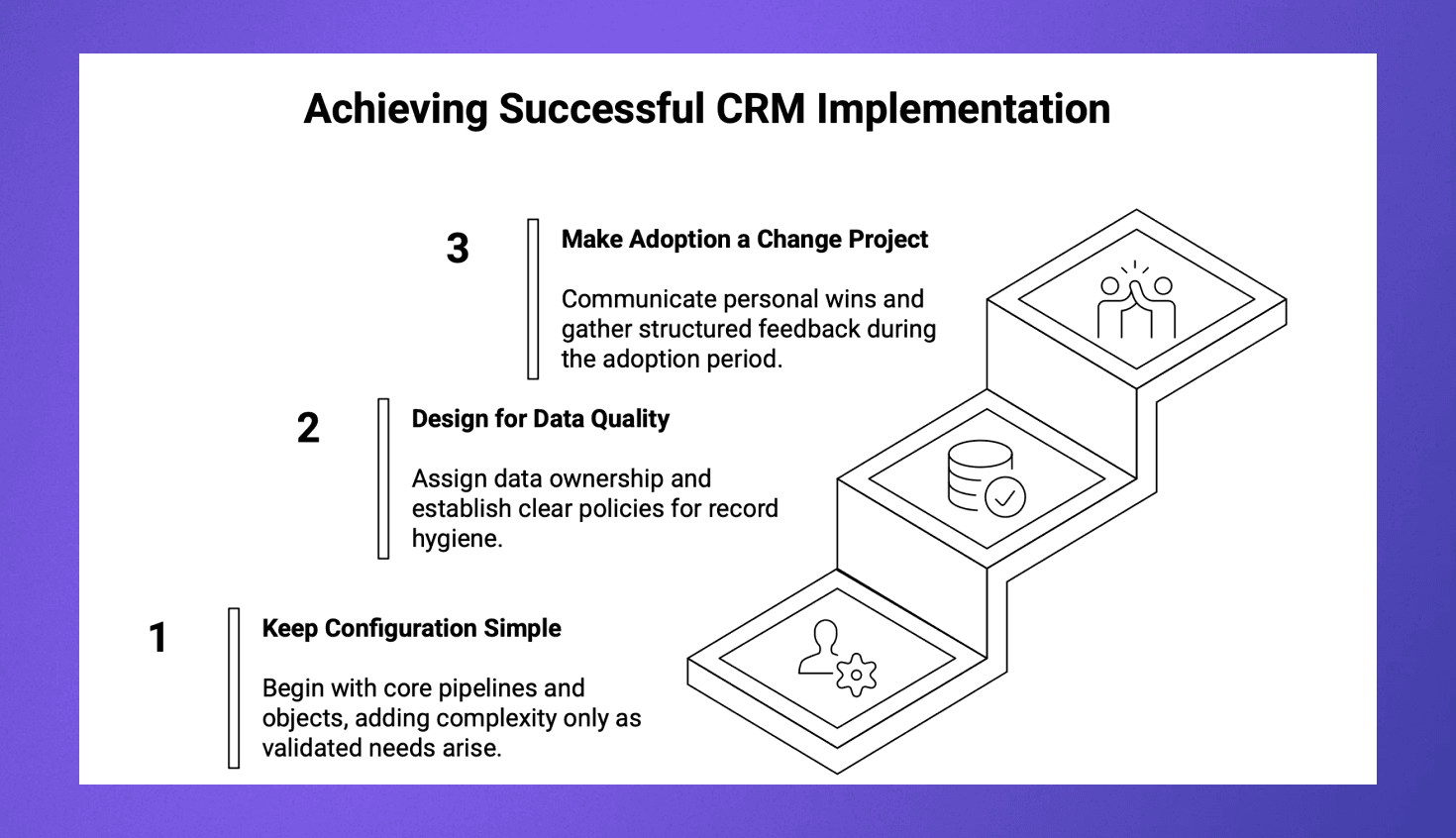
Start with minimal customization to encourage adoption, then expand based on validated needs.
3. Set up data management and governance
Data is the foundation of any CRM strategy. Poor data leads to poor decisions.
Implement clear ownership by role. For example, marketing manages leads, sales owns opportunities, and operations maintains account hierarchies. That’s why it’s important to build regular cadence reviews and dashboards so data health becomes a visible business metric.
Rings AI, for example, supports this step through automated data capture and enrichment, ensuring your CRM always reflects reality without manual updates.
4. Measure, optimize, and evolve
Remember to adapt your processes and treat the CRM as a living framework. Set quarterly reviews across departments. Evaluate engagement metrics, data quality, and performance KPIs. Use dashboards and relationship intelligence to identify hidden opportunities and under‑nurtured accounts.
This cycle of feedback and optimization is what turns a static CRM deployment into an agile growth platform.
How Rings AI Elevates Your CRM Strategy
A truly modern CRM strategy requires automation and intelligence, not manual data entry. Rings AI helps companies put strategy into motion with advanced CRM capabilities, including:
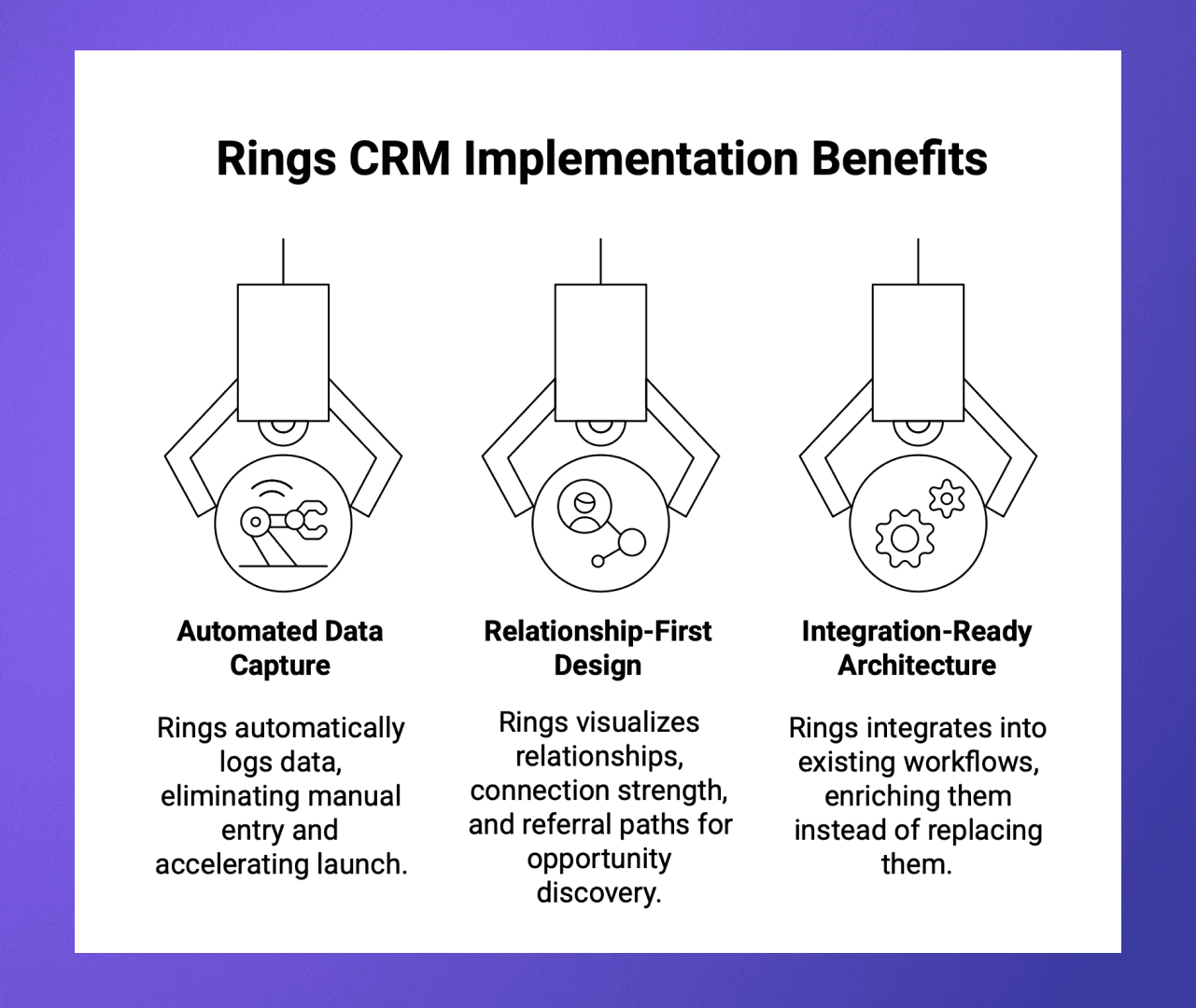
Automated data capture: Rings AI syncs data from email, meetings, and messages, building accurate contact networks automatically.
Relationship mapping: Instantly see who knows whom and how strong each relationship is, empowering warm introductions, surfacing hidden connections, and reducing churn risk.
Cross‑functional collaboration: Shared views bring sales, marketing, and leadership into alignment around real relationship dynamics.
Integrations: Rings AI connects effortlessly with Salesforce, HubSpot, and other CRMs, elevating your current stack instead of replacing it.
Build Relationships That Scale With Rings AI
A successful CRM strategy is not about managing databases; it’s about managing trust at scale. When customer interactions feel coordinated, informed, and personal, revenue flows.
That’s why Rings AI make it seamless to build and activate your CRM strategy across the organization. The next-generation platform automates data enrichment, maps real relationships, and centralizes intelligence so your CRM strategy runs on truth, not manual inputs.
It’s time to transform CRM from a record into a relationship engine, and Rings AI is built to make that happen. Book a demo to get started.
Learn more about private equity CRM platforms and CRM for venture capital firms.