
Artificial intelligence (AI) is rapidly becoming part of the day-to-day work of investment banking. What began as a way to automate back-office processes is now influencing almost every stage of the deal cycle, from sourcing targets to preparing pitchbooks and conducting due diligence.
Deloitte predicts that generative AI could increase front-office productivity at major investment banks by 27% to 35% by 2026.
Tasks such as updating financial models, reviewing documents, and generating performance summaries once required days of research and coordination. With AI, many of these tasks can now be completed in a fraction of the time.
As a result, bankers are spending more time on higher-value activities such as advising clients, building relationships, and evaluating strategic opportunities.
Where AI is Making an Impact
AI in investment banking refers to the use of technologies that help banks identify opportunities earlier, move faster during live deals, and make more informed decisions. The greatest value of AI in investment banking comes from its ability to process large amounts of information quickly.
Bankers deal with enormous volumes of company data, market updates, financial records, contracts, and relationship information. Much of that information is too broad and changes too quickly to track manually.
AI helps firms cut through that complexity. It can identify acquisition targets, summarize markets, draft presentations, review contracts, test valuation scenarios, and surface risks in far less time than traditional processes allow.
Importantly, AI is not replacing the work of investment bankers. The final decisions still depend on judgment, industry knowledge, and relationships. Instead, AI is becoming a tool that supports bankers throughout the deal cycle by helping them spend less time gathering information and more time acting on it.
JPMorgan Chase, Goldman Sachs, UBS, and BNP Paribas have all rolled out internal AI tools to help employees draft pitchbooks, summarize documents, analyze markets, and prepare for meetings.
The sections below look at the investment banking functions where AI is already creating the greatest impact.
Key Use Cases of AI in Investment Banking With Examples
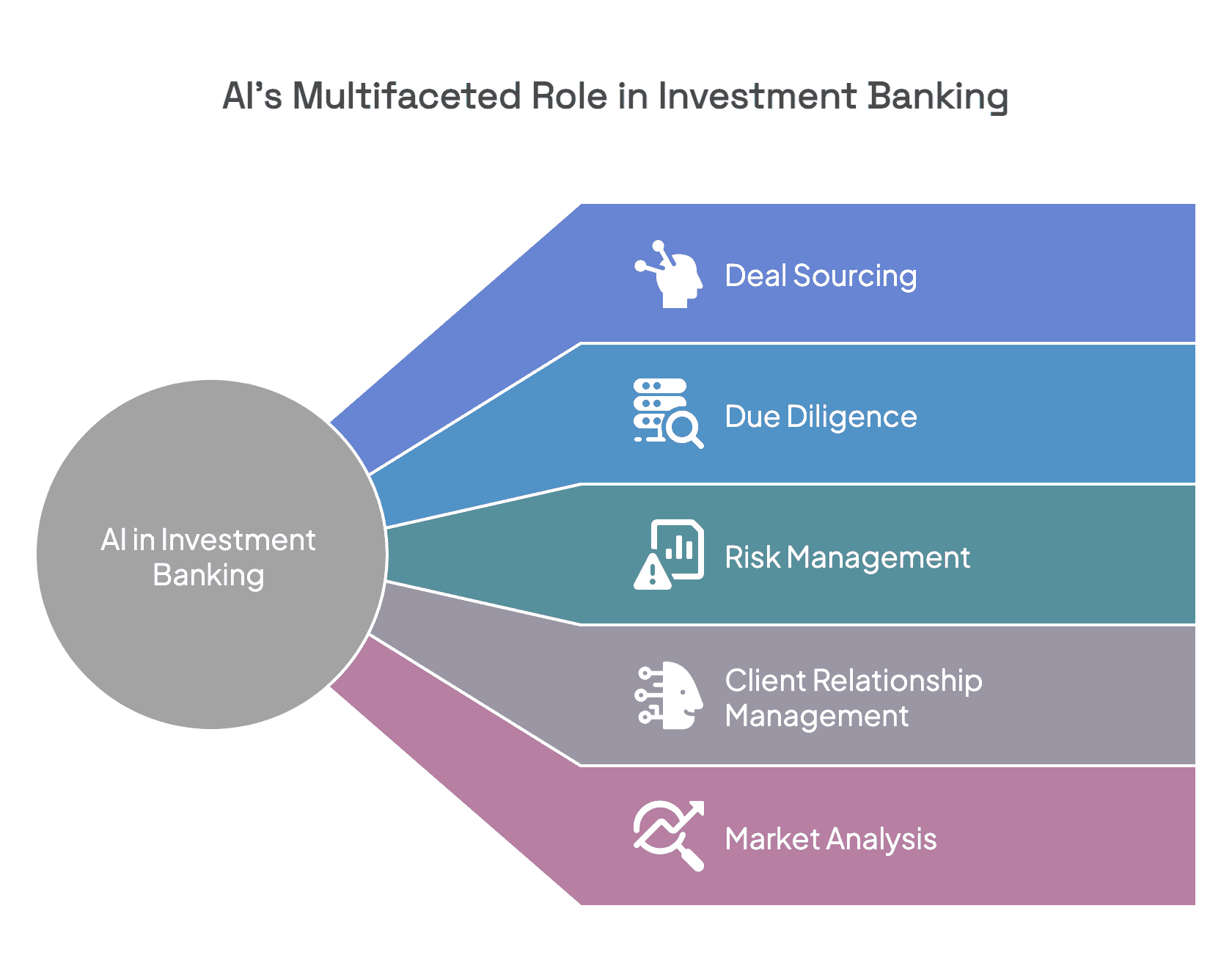
AI for deal sourcing and origination
Investment banks increasingly use AI to identify potential acquisition targets, investors, and buyers. AI can scan market activity, funding rounds, hiring patterns, leadership changes, and transaction history to identify companies that may soon become acquisition candidates or seek capital.
Relationship intelligence often determines whether a firm gets into a process early or not at all. For example, investment banking teams use Rings AI to map relationships across investors, executives, and companies. The platform identifies likely introduction paths and highlights which relationships are most relevant before outreach begins.
AI for pitchbooks and presentations
Pitchbook preparation is one of the most time-consuming parts of investment banking. Analysts spend hours pulling company data, building market slides, writing summaries, and formatting presentations.
Generative AI can now draft large portions of that work automatically. It can pull financial data, summarize industry trends, draft investment theses, and prepare company profiles in minutes rather than hours.
Several banks have already deployed internal systems for this purpose. Goldman Sachs uses its GS AI Assistant to help employees “draft complex documents and initial content for performance analysis.” UBS has launched an M&A co-pilot to support deal teams.
AI for due diligence
During due diligence, bankers often review thousands of pages of contracts, financial statements, and legal documents. AI allows firms to process that information far faster than a human team alone.
Natural language processing tools can extract key clauses, flag unusual terms, compare contracts, and identify potential risks. Rather than reading every document line by line, bankers can focus only on the sections that require deeper analysis.
JPMorgan Chase uses its internal LLM Suite across investment banking workflows, including document review and transaction analysis, which saves an estimated three to six hours per week.
AI for risk and compliance
Investment banks also use AI to monitor transactions, communication, and internal activity for potential risks. AI systems can review emails, calls, and transaction patterns in real time to detect suspicious activity, insider trading concerns, or compliance violations.
A recent example comes from Goldman Sachs, which is working with Anthropic to assess cybersecurity and operational risks created by new AI systems.
The Most Common AI Tools Used in Investment Banking
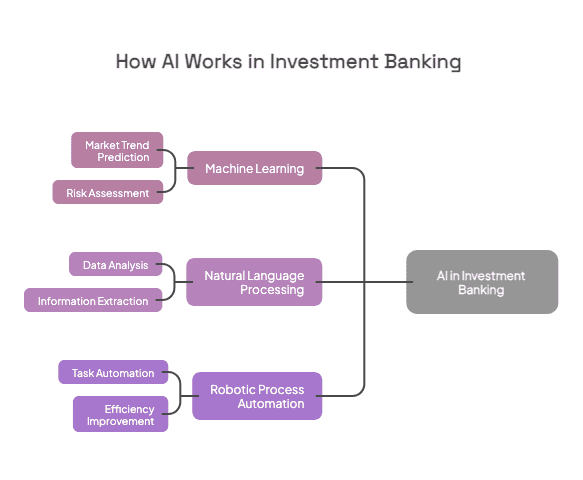
Investment banks use several categories of AI tools rather than a single platform.
Generative AI tools
Generative AI tools help investment bankers create content faster. They are commonly used to draft pitchbooks, summarize research, prepare client emails, and turn meeting notes into structured action items. Many banks now use internal AI assistants and large language models to produce first drafts that bankers can refine rather than creating everything manually.
Predictive analytics tools
Predictive analytics tools use historical and real-time data to identify patterns and forecast likely outcomes. Investment banks use them to estimate company performance, assess credit risk, predict market trends, and identify acquisition targets or investors that are most likely to be relevant. These tools are especially useful when bankers need to evaluate multiple scenarios quickly.
Relationship intelligence platforms
Investment banking depends heavily on relationships. Bankers need to know which contact already knows a CEO, which investor is active in a sector, which executive recently changed roles, and which relationship is most likely to lead to a meeting.
Traditional CRMs do not provide that visibility. Most only track basic contact details and deal stages. Relationship intelligence platforms go further by mapping networks, identifying hidden connections, and highlighting the best next step.
For a closer look at the leading platforms in these categories, read our guide to the 5 best investment banking tools for 2026.
Trends Shaping AI in Investment Banking
Several trends are likely to define how AI develops within investment banking over the next few years.
AI is becoming part of every banking workflow
Banks are moving beyond small experiments. They are now embedding AI directly into everyday workflows. More firms are creating internal AI teams and appointing executives to lead AI strategy. For example, JPMorgan Chase recently appointed a new COO for its commercial and investment banking division with responsibility for data and AI strategy.
Smaller teams will do more
AI is changing the economics of investment banking. Small teams can now handle more work because AI reduces the need for manual research and repetitive analysis. Boutique firms can compete more effectively with larger banks because they can deliver similar output with fewer people.
Human judgment will matter more
AI can generate information, but it cannot replace judgment. The best investment bankers will combine AI with industry expertise, experience, and relationships. AI can help identify targets and generate documents, but bankers still need to decide which opportunities are worth pursuing and how to position a deal.
Governance and accuracy will become more important
AI creates new risks alongside new opportunities. Banks must ensure that AI-generated outputs are accurate, compliant, and secure. Incorrect numbers, flawed assumptions, or unverified content can create serious problems in investment banking.
As AI adoption grows, firms are investing more in governance, validation, and training. Many are also building internal rules around how employees use AI.
The Future of AI in Investment Banking
AI is changing investment banking, but it isn’t changing the core of the industry. Investment banking still depends on judgment, relationships, and trust.
What AI does is make those strengths more effective. It helps firms move faster, analyze more information, and focus their attention where it matters most.
Relationship intelligence is likely to have the greatest long-term impact because access and timing often determine which firm wins a mandate.
Rings AI gives investment banking teams a clearer view of those networks than traditional CRMs ever could. It helps firms identify the right opportunity, find the best path to the decision-maker, and move deals forward more efficiently.
The platform continuously enriches relationship and company data using more than 100 million data points, helping teams keep contact and company information current.
If you want to see how AI-powered relationship intelligence can improve your deal flow and client coverage, book a demo with Rings AI today.