
Venture capital investing is built on uncertainty. Investors fund companies that are often early, evolving quickly, and still shaping their market position. Because of this, making the right decision requires more than just a compelling pitch deck.
That’s why venture capital firms rely on a structured due diligence process before committing capital.
Due diligence helps investors verify assumptions, uncover potential risks, and determine whether a startup truly has the potential to grow into a high-value company. It moves the conversation from excitement to evidence.
This guide will walk through what venture capital due diligence means and how the process typically works. We’ll also cover a practical VC due diligence checklist and the best practices investors use to evaluate opportunities more effectively.
What is Venture Capital Due Diligence?
Venture capital due diligence is the process investors use to evaluate a potential portfolio company before investing. It involves reviewing the company’s business model, financial health, team, technology, and market opportunity.
At its core, due diligence answers three critical questions:
Is the opportunity large enough to justify the investment?
Does the team have the capability to execute?
Are there hidden risks that could affect long-term returns?
Unlike private equity investments, which often rely on stable financial performance, venture capital investments focus more heavily on future potential and growth trajectory. Startups or early-stage ventures may not yet be profitable, so investors rely on signals like product-market fit, market timing, and founder capability.
For this reason, venture capital due diligence is both analytical and relationship-driven. Investors evaluate numbers, but they also evaluate people.
The Venture Capital Due Diligence Process
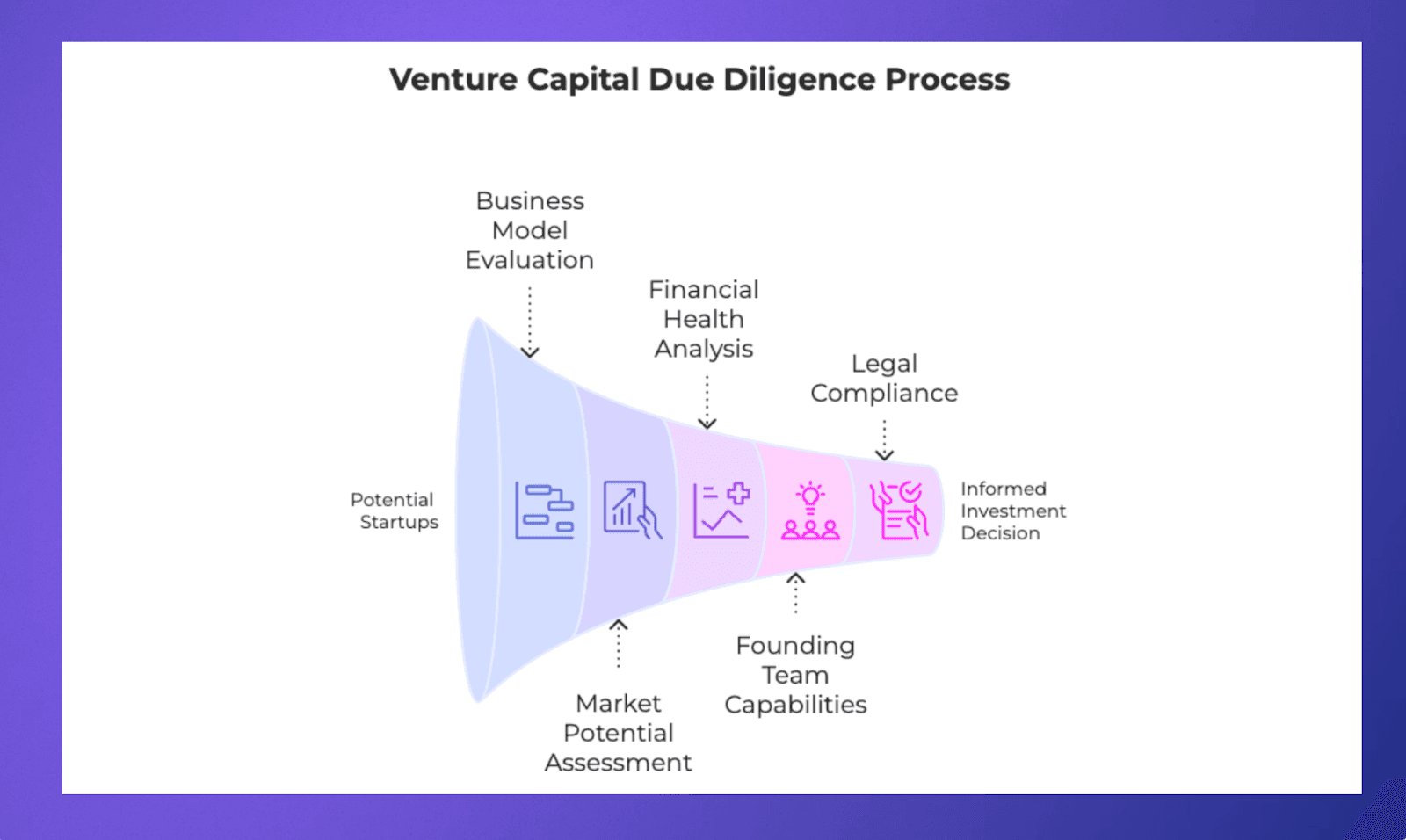
Although each firm has its own workflow, most venture capital firms follow a similar multi-stage process when evaluating a deal.
1. Initial screening
The due diligence process usually begins after a startup has completed its initial pitch and captured investor interest. At this stage, investors review basic information, such as:
Pitch deck and business overview
Market opportunity
Product and technology description
Funding history and cap table
The goal is simple: determine whether the opportunity fits the firm’s investment thesis and sector focus. If the opportunity aligns, the deal moves into deeper analysis.
2. Market and industry analysis
Once a deal passes the initial screening, venture capital firms analyze the market dynamics surrounding the company. This typically includes evaluating:
Total addressable market (TAM)
Industry growth trends
Competitive landscape
Market timing and regulatory environment
A strong early-stage venture often operates in a rapidly expanding market where demand is increasing faster than supply.
Investors are not just asking whether the product works. They are asking whether the market opportunity is large enough to generate venture-scale returns.
3. Product and technology evaluation
Next, investors examine the startup’s product or technology in detail. This stage often involves:
Product demos
Technical architecture reviews
Security and scalability assessments
Intellectual property verification
For technology companies, investors may bring in technical advisors or industry experts to evaluate whether the product is defensible and difficult for competitors to replicate.
A product that solves a real problem is valuable. A product that also builds defensible advantages becomes significantly more attractive.
4. Founder and team assessment
In venture capital, the founding team often matters more than the product itself. Early-stage startups pivot frequently, so investors look for teams that demonstrate:
Strong domain expertise
Execution capability
Adaptability under uncertainty
Leadership and hiring ability
Due diligence here often includes:
Background checks
Reference calls with former colleagues
Interviews with early employees or advisors
Many venture capital firms believe that exceptional teams can adapt to changing markets, even if the original product evolves.
5. Financial and business model review
Financial due diligence helps investors understand the economic engine behind the startup. They typically look at:
Revenue model and pricing strategy
Unit economics
Burn rate and runway
Customer acquisition cost (CAC)
Lifetime value (LTV)
Because early-stage companies often lack long financial histories, investors focus more on growth efficiency and underlying assumptions than on historical profitability.
The question becomes: Does the business model scale predictably as the company grows?
6. Legal and compliance checks
Before finalizing an investment, venture capital firms also review legal and structural details. This typically includes:
Corporate structure
Intellectual property ownership
Cap table and equity distribution
Existing investor agreements
Regulatory compliance
Legal diligence ensures there are no structural issues that could complicate future funding rounds or exits.
Venture Capital Due Diligence Checklist
When evaluating multiple companies and managing an expanding pipeline of opportunities, it becomes easy to overlook important details. A venture capital due diligence checklist provides a structured framework for reviewing opportunities across key areas.
While the exact diligence process varies across firms, most venture investors evaluate a similar set of factors. They typically assess areas such as market opportunity, product strength, financial model, and the capabilities of the founding team.
Overall, a checklist helps investment teams stay consistent in their evaluation process. It also makes it easier to compare multiple opportunities and identify which companies deserve deeper attention.
Below is a practical venture capital due diligence checklist.
Company overview
Mission and long-term vision
Product offering and differentiation
Company history and milestones
Market opportunity
Total addressable market (TAM)
Market growth rate
Competitive landscape
Product & technology
Product roadmap
Technical infrastructure
Intellectual property and patents
Financial health
Revenue model
Burn rate and runway
Unit economics (CAC, LTV, margins)
Team & leadership
Founder experience
Leadership structure
Hiring plans and culture
Customer validation
Customer acquisition channels
Retention metrics
Testimonials or case studies
Legal & structural review
Cap table accuracy
Investor agreements
Regulatory compliance
The purpose of this checklist isn’t to eliminate uncertainty. Instead, it helps investors reduce risk and validate assumptions before committing capital.
Pro-tip: During due diligence, investors collect large amounts of information, including founder conversations, financial documents, and internal notes. Organize this information inside a venture capital CRM so diligence notes, interactions, and deal data remain centralized as opportunities progress through the pipeline. |
4 Best Practices for Venture Capital Due Diligence
Strong venture capital firms refine their diligence processes over time. The goal is not only to evaluate deals thoroughly, but also to do it efficiently.
Here are some best practices used by leading VC firms.
1. Focus on signal, not just data
Startups generate large amounts of information during diligence. However, not all data points are equally meaningful.
Experienced investors focus on signals, such as:
Founder-market fit
Customer enthusiasm
Early product adoption
Market timing
These signals often provide deeper insight than financial spreadsheets alone.
2. Use structured frameworks
Many venture capital firms use structured evaluation frameworks to ensure consistency across deals.
For example, investors may rate companies across dimensions such as:
Market opportunity
Product differentiation
Team quality
Growth potential
Using a repeatable framework helps investment teams compare opportunities objectively.
3. Validate assumptions with external sources
Pitch decks often present optimistic projections. Good diligence verifies these assumptions through independent research.
Investors may speak with:
Industry experts
Customers
Former employees
Market analysts
These conversations often reveal insights that internal documents cannot provide.
4. Track relationships and interactions
Venture capital is fundamentally a relationship-driven industry. Investors rarely evaluate a company in a single meeting. The diligence process can involve dozens of conversations with founders, advisors, and industry contacts.
Keeping track of these interactions helps investors understand:
Who introduced the opportunity
Which partners have interacted with the founders
Where warm introductions exist across their network
Without a clear system for tracking these relationships, valuable context can easily get lost.
Why Relationship Intelligence Matters in Venture Capital
One of the most overlooked challenges in venture capital due diligence is relationship visibility.
Deals rarely appear randomly. They often emerge through networks of founders, operators, advisors, and previous investors.
Understanding these networks helps venture firms:
Identify trusted references
Discover first-degree connections
Validate founder reputations
Access warm introductions to customers or experts
However, many venture capital teams still track these relationships across emails, spreadsheets, and disconnected tools. As deal flow grows, it becomes harder to maintain a clear view of who knows whom and where meaningful introductions may exist.
This is where an extended relationship management (XRM) platform becomes valuable. Platforms like Rings AI automatically map connections across founders, investors, and industry contacts, giving venture teams a clearer view of their network.
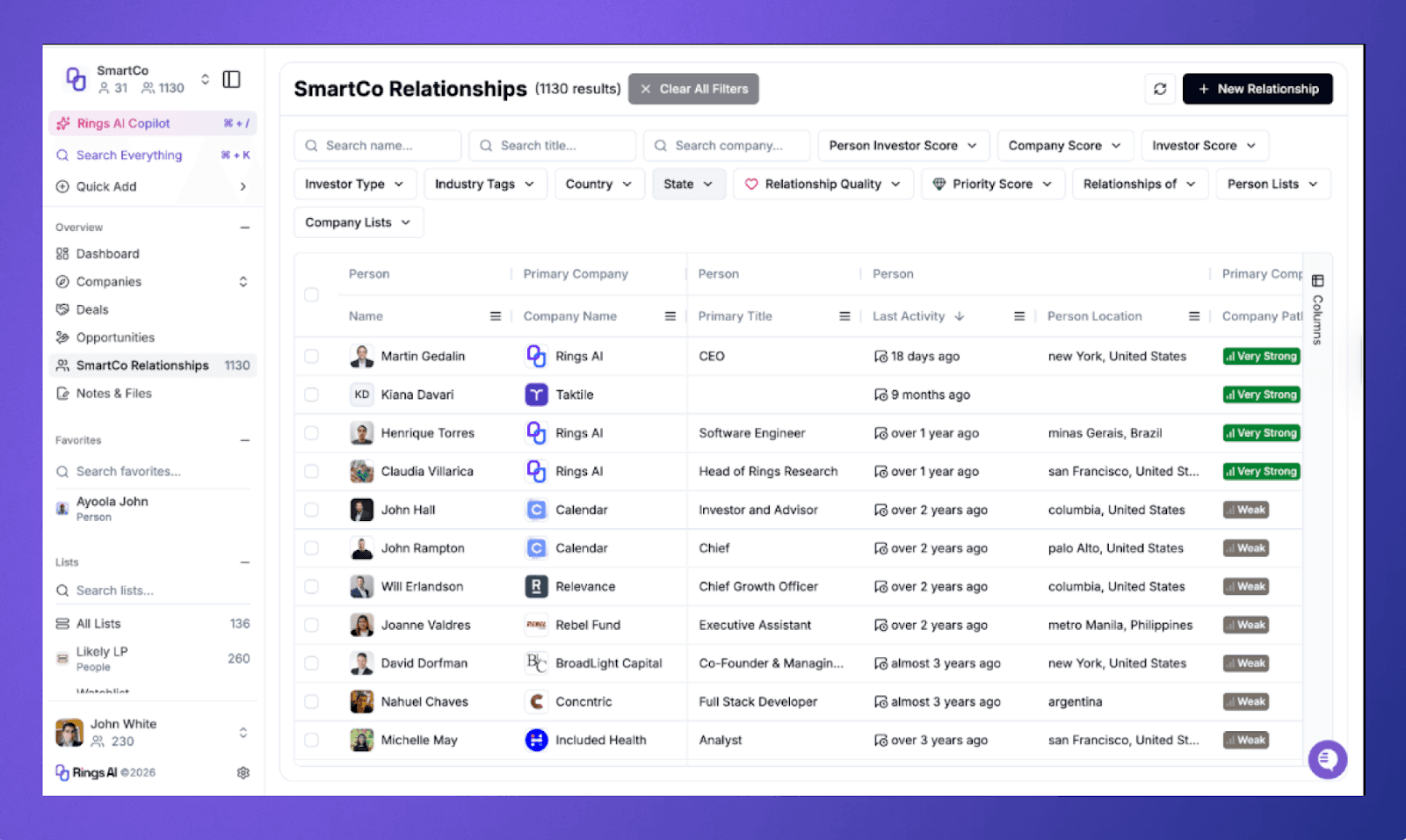
Rings AI relationship view showing key contacts, companies, and relationship strength across your investment network.
Instead of manually piecing together introductions, investors can quickly identify relationship paths that help validate opportunities or open new conversations.
Streamlining Venture Capital Due Diligence with Rings AI
Due diligence becomes far more efficient when investors have full visibility into their networks, deal flow, and interactions.
Rings AI helps venture capital firms organize the information that powers smarter investment decisions. Instead of relying on scattered notes and spreadsheets, the platform centralizes:
Founder and investor relationships,
Deal sourcing activity,
Email and meeting interactions,
Important diligence notes in one workspace.
This visibility allows investment teams to track deal progress across the pipeline, review past conversations with founders or partners before meetings, and keep research, notes, and documents connected to each opportunity.
This level of relationship intelligence helps venture capital teams evaluate opportunities faster while reducing the risk of missing critical signals during due diligence.
If your firm wants to make deal sourcing and diligence more structured, Rings AI provides the visibility needed to move from intuition to informed decisions.
Book a demo to explore how Rings AI supports venture capital due diligence workflows.