

Sales teams today operate in an environment saturated with data. Prospects leave signals across emails, company announcements, hiring activity, industry news, and online research.
But more data doesn’t automatically lead to better decisions. Many teams still struggle to identify which prospects are worth pursuing, when the timing is right, and who inside their network can help open the right door.
Sales intelligence helps solve this challenge by bringing together company data, behavioral signals, and relationship insights in a structured way.
This article explains how sales intelligence works, the tools that power it, and the strategies high-performing teams use to turn data into real sales outcomes. We’ll also look at how platforms like Rings AI combine relationship intelligence and market signals into actionable sales intelligence that improves deal flow.
What is Sales Intelligence?
Sales intelligence refers to the process of collecting and analyzing data about companies, prospects, and market activity to help sales teams make better decisions.
As the amount of available business data has grown, organizations have increasingly relied on sales intelligence platforms to gather and organize information in real time. These tools pull insights from multiple sources, such as company databases, digital signals, and professional networks, and present them in a structured format that sales teams can easily act on.
This capability is especially important today, as B2B buyers conduct extensive research before engaging with vendors. Sales intelligence tools equip teams to personalize outreach with stronger context and remain competitive in increasingly data-driven sales environments.
Types of Data Used in Sales Intelligence
Sales intelligence platforms combine several types of data to generate actionable insights. Each category helps sales teams better understand prospects, identify buying signals, and approach deals more strategically.
Data Type | What It Includes | Why It Matters |
Firmographic Data | - Industry | Helps sales teams determine whether a company matches their ideal customer profile. |
Contact & Organizational Data | - Job titles | Identifies decision makers and influencers involved in purchasing decisions. |
Behavioral Signals | - Website visits | Indicates when a company may be actively evaluating solutions or entering a buying cycle. |
Relationship Data | - Shared contacts | Helps teams identify warm introductions and trusted paths into target organizations instead of relying on cold outreach. |
How Sales Intelligence Helps Modern Sales Teams
Sales processes have changed significantly over the last decade. Deals now involve more stakeholders, longer evaluation cycles, and greater competition.
Without strong visibility into prospects and relationships, sales teams risk spending time on opportunities that never progress. Sales intelligence addresses these challenges in several ways.
Better prospect targeting
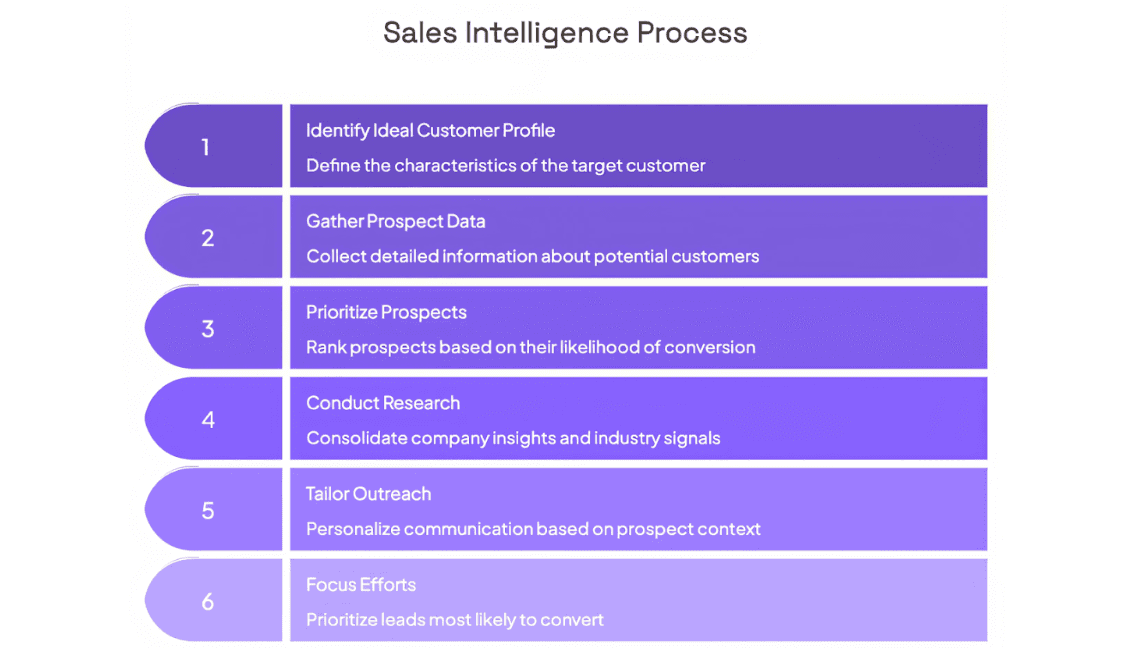
Sales intelligence tools provide detailed company and contact data that help teams identify prospects matching their ideal customer profile. AI-based prospect scoring further helps teams prioritize the companies and decision-makers most likely to convert.
Faster research
Sales intelligence consolidates company insights, funding activity, leadership changes, and industry signals in one place. This helps teams quickly understand a prospect before starting a conversation.
More personalized outreach
Sales intelligence gives teams the context needed to tailor outreach using relevant signals like company news, strategic initiatives, or recent growth activity.
Better deal prioritization
Sales intelligence platforms highlight leads most likely to convert based on engagement signals, company momentum, or relationship proximity, helping teams focus their efforts where it matters most.
Types of Sales Intelligence Tools
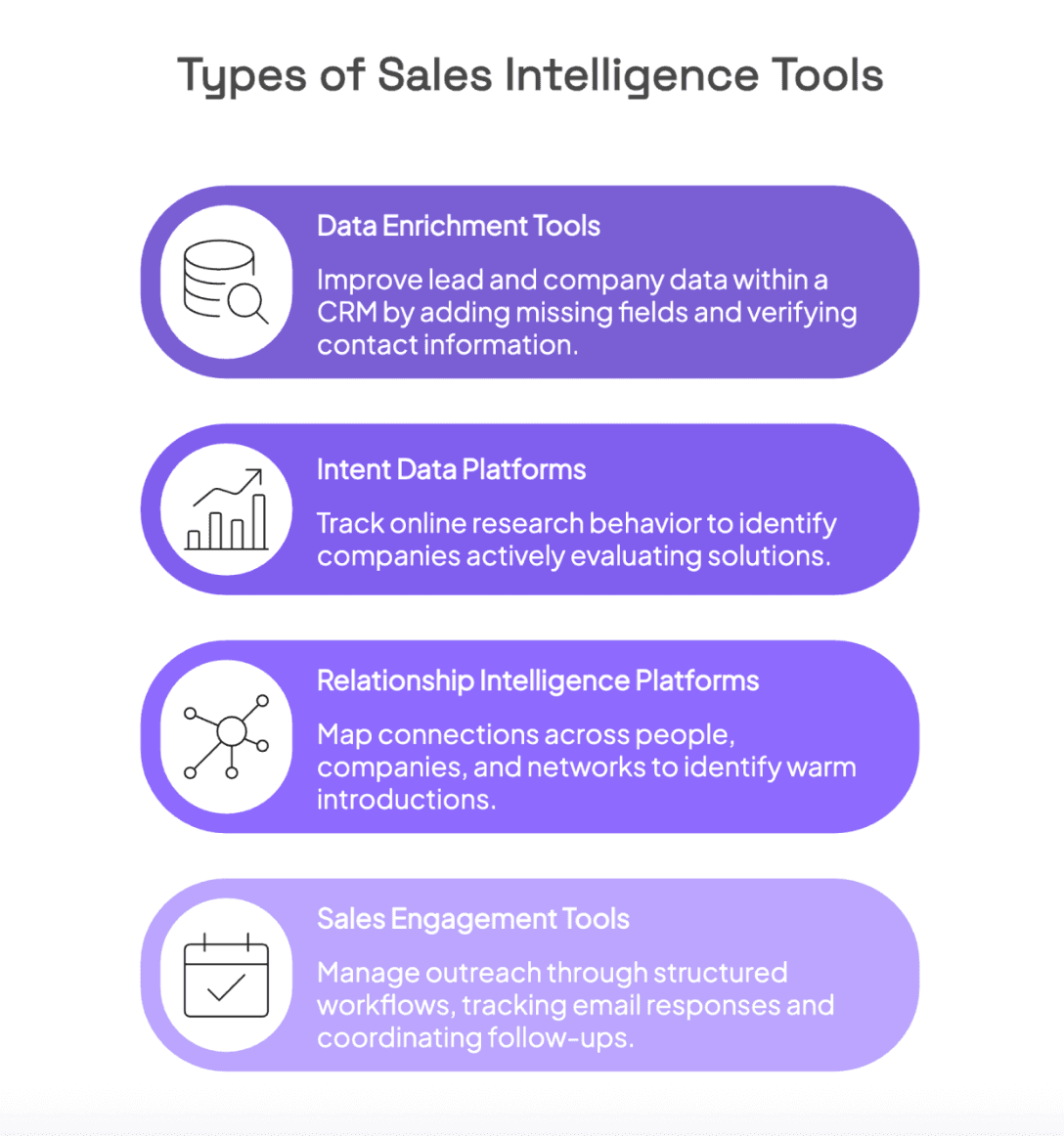
Sales intelligence platforms generally fall into several categories depending on the type of insight they provide. Many organizations combine multiple tools to create a complete intelligence stack.
Data enrichment tools
Data enrichment platforms improve lead and company data within a CRM. They add missing fields, verify contact information, and update company attributes so sales teams always work with accurate information.
Intent data platforms
Intent data tools track online research behavior to identify companies that may be actively evaluating solutions. If multiple employees from the same organization research a specific category, the platform may flag that company as a potential opportunity.
Relationship intelligence platforms
Relationship intelligence platforms focus on mapping connections across people, companies, and networks. They analyze communication history, shared contacts, and relationship strength across an organization’s network.
This makes it easier to identify warm introductions, understand who already knows a prospect, and determine the best path into a conversation.
These insights can be especially valuable for industries where deals depend heavily on relationships and trust.
Sales engagement tools
Sales engagement platforms help teams manage outreach through structured workflows. They track email responses, calls, and meeting activity while coordinating follow-ups.
Some sales intelligence platforms like Rings AI include these capabilities directly, while others offer them as standalone tools that integrate into a company’s existing sales stack.
Sales Intelligence vs. Traditional CRM: What’s the Difference?
Sales intelligence and CRM systems are closely related but serve different purposes.
A traditional CRM primarily acts as a system of record. It stores contacts, deals, notes, and activity history so teams can track pipeline progress.
Sales intelligence, on the other hand, focuses on generating insights that help teams identify and prioritize opportunities.
In practice, sales intelligence platforms often feed valuable insights into the CRM. For example, a CRM might track a deal’s progress, while a sales intelligence platform highlights new companies to pursue or signals when a prospect becomes more likely to buy.
Together, these systems create a more complete view of the sales pipeline.
Sales Intelligence Strategies That Drive Results
Access to intelligence tools alone doesn’t improve outcomes. The real impact comes from how consistently teams apply insights within their sales process.
Below are practical sales intelligence strategies that high-performing teams use to turn insights into measurable results.
1. Define a strong ideal customer profile
Sales intelligence works best when teams know exactly which companies they want to target. Your ideal customer profile may include:
Industry segments
Company size
Revenue range
Geographic focus
Technology stack
Once defined, sales intelligence tools can surface companies that closely match these attributes.
2. Track market trigger events
Certain events often indicate potential buying opportunities. Examples include:
Funding announcements
Leadership changes
Market expansion
Hiring spikes
Product launches
Tracking these events allows sales teams to reach out at the right time with relevant conversations.
3. Prioritize warm introductions
Cold outreach has become increasingly difficult as inboxes grow crowded. Warm introductions, however, dramatically improve response rates. Sales intelligence platforms that map relationship networks help teams identify existing connections that can facilitate introductions.
4. Align sales and marketing signals
Marketing teams generate valuable intent signals through content engagement, webinars, and campaigns. When these insights are shared with sales teams, they provide a clearer view of prospect interest and help improve outreach timing and relevance.
5. Focus on opportunity quality
Sales intelligence allows teams to shift from volume-based prospecting to opportunity-focused engagement. Instead of reaching out to hundreds of companies, teams can concentrate on prospects that demonstrate a strong fit and meaningful buying signals.
Best Practices for Implementing Sales Intelligence
Introducing sales intelligence tools requires more than simply adopting new technology. Teams also need the right processes to use insights effectively.
Here are several best practices that help organizations maximize the value of sales intelligence.
Maintain clean data
Sales intelligence systems rely on accurate, well-structured data. Establish strong data hygiene practices and implement a formal data governance model to ensure information remains trustworthy and usable at scale.
Train teams to use insights
Sales teams need clear guidance on both where to find intelligence and how to use it effectively in their sales process. This includes practical training on using the sales intelligence software and strategic coaching on interpreting data and turning insights into meaningful conversations.
Regular training sessions help teams stay comfortable with the tools and adapt as new data sources and features evolve.
Integrate tools into existing workflows
Sales intelligence is most effective when it’s embedded within the tools teams already use, such as CRM, email, and calendar systems. Integrating intelligence signals directly into these workflows ensures insights appear at the right moment and are consistently used in day-to-day sales activities.
Track performance improvements
Organizations should regularly measure how sales intelligence impacts core revenue metrics, such as lead conversion rates, pipeline quality, sales cycle length, and win rates. Establishing clear benchmarks and tracking changes over time helps teams evaluate whether intelligence insights are improving decision-making and deal outcomes.
How Rings AI Powers Modern Sales Intelligence
Sales intelligence has become a critical capability for modern sales organizations. As markets grow more competitive and deals involve more stakeholders, teams need better visibility into prospects, relationships, and timing.
Having a sales intelligence platform that combines prospecting, relationship intelligence, and contact management helps teams identify stronger opportunities and close larger deals more effectively. This is where Rings AI, an all-in-one data-enriched CRM, plays a key role.
Rings AI helps teams map connections across their networks to identify warm introductions and hidden opportunities that might otherwise go unnoticed. Its proprietary AI scoring highlights high-potential prospects, while automatically capturing interactions so teams can track every relationship and deal touchpoints in one place.
The platform also enriches relationship data with over 100M+ data points, providing deeper context on companies, contacts, and market activity. This allows sales teams to spot relevant opportunities earlier and approach conversations with stronger insight.
Book a demo with Rings AI to see how it can help you turn missed opportunities into successful deals.