

A capital call is the mechanism private equity firms use to draw committed capital from limited partners when funds are needed. Instead of transferring the full commitment upfront, LPs provide capital over time as investments are executed, fees are incurred, or expenses arise. This structure allows firms to deploy capital with precision while maintaining flexibility across the fund lifecycle.
For investor teams, capital calls are not only financial events but also communication touchpoints with LPs. Each notice, update, and follow-up contributes to the broader relationship, especially when multiple calls occur across the same fund or over successive funds. Maintaining consistency and clarity across these interactions requires access to prior communication and accurate LP-specific context.
This becomes more important as teams manage overlapping activities, including fundraising and ongoing investor engagement. A clear view of LP history supports more coordinated outreach and reduces reliance on fragmented records. Platforms designed around relationship data, such as Rings AI’s investor-focused CRM support this by keeping communication and context connected over time.
Capital Calls Explained in Private Equity
A capital call is a formal request to LPs to transfer a portion of their committed capital. The amount is tied to immediate fund needs such as investments, fees, or expenses.
LPs do not fund commitments upfront. Capital is drawn over time as required, based on fund activity and deployment pace. Each capital call is a defined event with timelines, notices, and expectations. These occur multiple times across the life of a fund and often involve the same LPs.
From an investor relations standpoint, every call adds to the ongoing communication history with each LP. Keeping these interactions connected supports consistency across future outreach.
How the Capital Call Process Works
The capital call process follows a defined sequence tied to investment activity and fund operations. Each step requires coordination across internal teams and consistent communication with LPs.
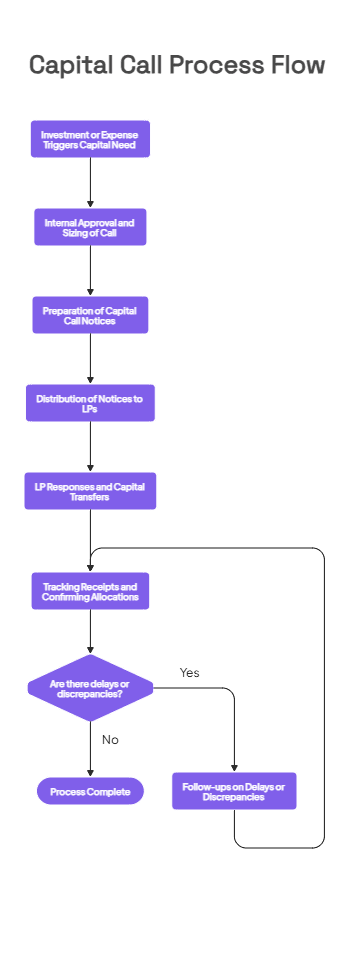
Investment or expense triggers the need for capital
A new investment, management fee, or fund expense creates the requirement to draw capital from LP commitments.
Internal approval and sizing of the call
The firm determines the total amount required and allocates it across LPs based on their commitments.
Preparation of capital call notices
Notices are drafted with details on amount, purpose, payment instructions, and deadlines.
Distribution of notices to LPs
Communications are sent to LPs through formal channels, often alongside supporting documentation.
LP responses and capital transfers
LPs review the notice and transfer funds within the specified timeframe.
Tracking receipts and confirming allocations
The firm monitors incoming payments and reconciles them against expected amounts.
Follow-ups on delays or discrepancies
Investor teams manage reminders, resolve issues, and ensure completion across all LPs.
Clear documentation and consistent communication across these steps support smoother execution.
Where Friction Shows Up for Investor Teams
Investor teams manage capital calls across multiple LPs, funds, and internal stakeholders. Execution often depends on how well communication and context are handled across these moving parts.
Communication spread across email threads, documents, and internal tools
Limited visibility into LP-specific context during active capital calls
Disconnect between deal teams and investor relations on timing and messaging
Difficulty tracking prior interactions tied to the same LP across multiple calls
Manual follow-ups required to manage delays, confirmations, and exceptions
These gaps reduce consistency in LP communication and slow down coordination.
What Matters When Managing Capital Call Communication
Capital call communication requires consistency across LPs and coordination across internal teams. Each interaction should reflect prior context and current fund activity without introducing gaps or duplication.
Clear, structured communication with each LP, including purpose, timing, and expectations
Access to prior interactions to ensure continuity across repeated capital calls
Coordination between deal teams and investor relations on messaging and timing
Visibility into ongoing LP communication across the team
Consistent tracking of follow-ups, confirmations, and exceptions
Maintaining this level of consistency depends on how communication and relationship data are managed. Systems built to retain full interaction history, such as Rings AI’s communication tracking capabilities support more reliable execution across repeated capital calls.
Learn more about deal sourcing and deal flow management.
How Rings AI Supports Capital Call Communication
Rings AI supports investor teams by keeping LP communication and interaction history connected across fundraising and fund operations. This allows teams to manage capital call communication with consistent context and shared visibility.
Centralized LP interaction history - All emails, meetings, and notes are tied to the LP and their organization, providing a complete view of prior communication before and after each capital call.
Visibility across the team - Relationship data is accessible across the firm, ensuring that investor relations and deal teams operate with the same information.
Context for each interaction - Teams can review past discussions, commitments, and responses before sending notices or following up with LPs.
Coordination across workflows - Capital call communication sits alongside broader LP engagement, including fundraising and ongoing updates, without requiring separate systems.
Rings AI is designed for teams that prioritize continuity in LP relationships and need reliable access to communication history across repeated interactions. Book a demo to see how Rings AI supports LP communication across capital calls.