

Lead scoring comes from sales, so it is easy to assume it stays there. Rank your buyers, work the warmest ones first, ignore the rest until they show signs of interest. But strip away the sales context and what is left is just a way of dealing with a problem every investor knows well: more opportunities than time, and no obvious order to work them in. The choice is whether you sort them by instinct, or by a system.
Because investors are selling too, even if it never feels like it. When you raise, you’re pitching your firm to Limited Partners (LPs) and funds. When you source, you’re convincing the best founders to pitch you instead of the firm down the street. You’re trying to win a relationship, and you cannot give all of them equal weight, so the ones showing real interest and real fit should get your time first.
That is the whole idea behind AI lead scoring for investors. In this article, we discuss what it is, how it works, and what you can do to take advantage of it.
What is AI Lead Scoring?
AI lead scoring is using machine learning to rank and prioritize leads based on how likely they are to convert. It can be a startup you're going to fund, or an LP that wants to invest in your fund.
The machine learning model ingests lots of data points per lead: firmographics (company size, industry, revenue), behavioral signals (email opens, demo requests, pricing page visits, product usage), and engagement patterns. It then outputs a score, usually 0 to 100, that estimates conversion probability. The Artificial Intelligence part means the weights aren't hand-coded by a human.

Instead of a salesperson eyeballing a list or using simple rules (like “anyone from a company with 500+ employees gets a high score”), the system learns from your historical data which signals actually predict a closed deal.
How Investors Can Use AI Lead Scoring
A score is a starting point, not a verdict. It reflects the patterns in your past data, which means it can miss the outlier and repeat old biases if you let it. Used well, it does not replace your judgment. It clears the noise so your judgment goes to the calls that actually need it.
Scoring shows up in a few distinct areas of investing:
Sourcing the right founders
Score companies against the deals you have actually done well on. Signals like sector, stage, hiring pace, and how recently they raised can flag a company worth a conversation while the round is still quiet, instead of once it is competitive.
Triaging inbound
Most firms see far more inbound than they can review properly. A score sorts it so a partner's first hour goes to the founders most likely to fit, not to whoever happened to email first.
Prioritizing LP outreach
When you raise, the same logic points at people instead of companies. An LP who opened your last two updates, has backed funds at your stage, and replied quickly last time is a warmer call than a name on a list. Scoring puts the warm ones first.
Keeping relationships from going cold
A score also catches the LP or founder you have not touched in months but should have. The signal here is the absence of activity, not the presence of it.
The signals worth scoring
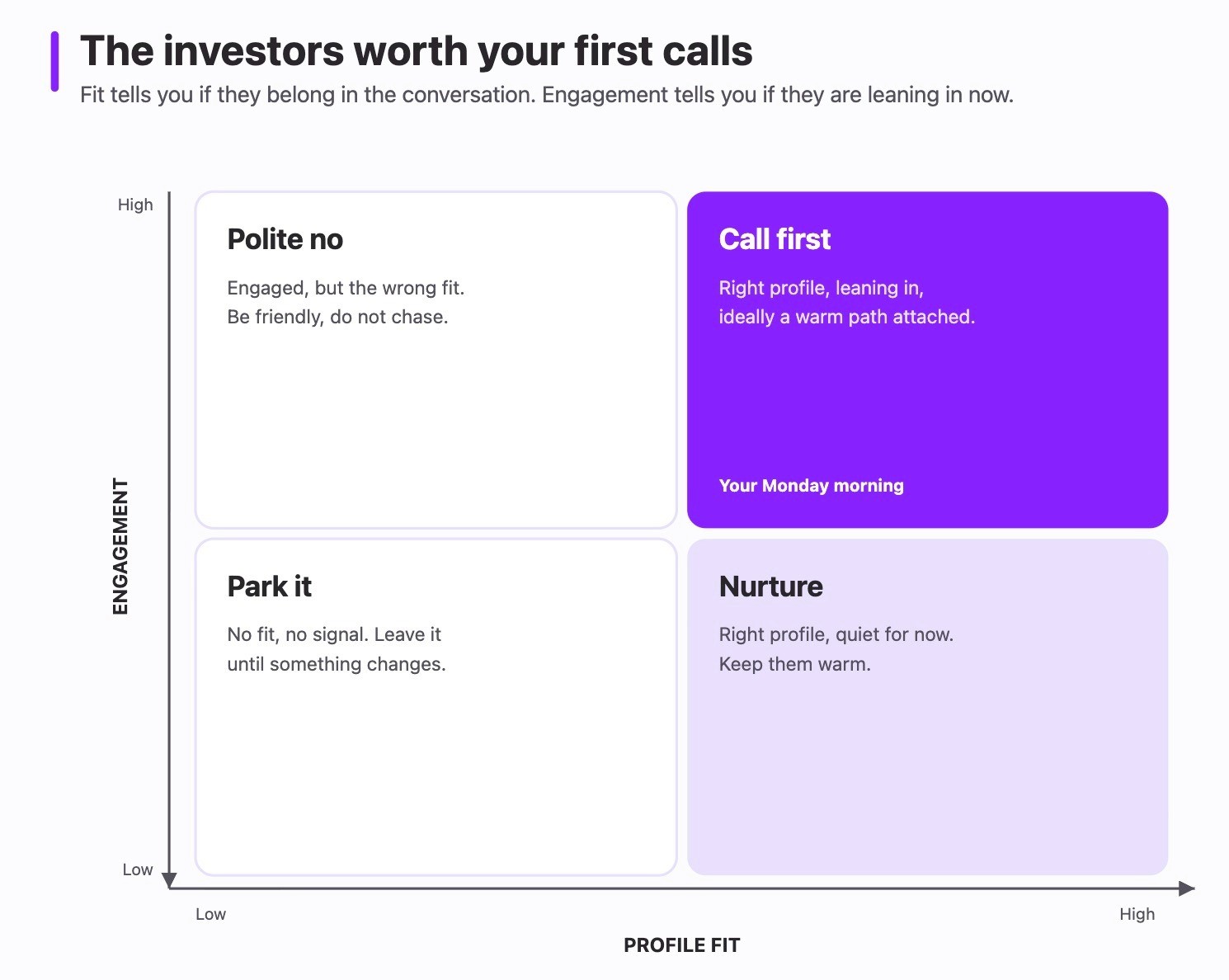
Most of the weight comes from three kinds of signal. Profile fit tells you whether an investor belongs in the conversation at all. Engagement tells you whether they are leaning in right now. Relationships tell you whether you have a real way in.
Profile signals: sector preference, check size, stage focus, geography, and recent investment activity
Engagement signals: email opens and replies, meeting history, response speed, and questions they send back
Relationship signals: whether someone on your team already knows them, and how strong that connection is
The combination is what matters. High profile fit with no engagement is a nurture target. High engagement with weak fit is usually a polite no. The investors worth your first calls score well on both, and ideally have a warm path attached.
How to Get Started with AI Lead Scoring
You don’t need a data science team or a year of setup to start scoring. You need a clear outcome, the right inputs, and the discipline to check the model against reality. A rough version that ships beats a perfect one that never does.
A good order looks like this:
Decide what a win actually is. Scoring toward a closed investment is a different model than scoring toward an LP commitment or a first meeting. Pick one outcome per score. A model trying to predict three things at once predicts none of them well.
Feed it your track record. Your wins and passes are the training data. The system learns which early signals tended to precede your best outcomes, so the more honestly your history is recorded, the sharper the score. This is the part that makes it AI rather than a rules sheet.
Start with signals you already trust. Begin with a handful you know matter, like sector fit, stage, recent activity, and engagement. Resist the urge to throw in every field you have. A few strong signals beat 50 noisy ones, and you can add more once you see what moves the needle.
Check the scores against your gut. For the first few weeks, read the ranking next to your own judgment. Where they agree, you build trust. Where they clash, you learn something, either about the model or about a blind spot of your own. Recalibrate from there.
Make it a habit, not a project. A score is only useful if you act on it. Build it into how the week starts, so the ranked list is the thing you open before you open your inbox.
None of this works on a hunch about your data. It works on the data itself.
What Makes Scoring Actually Work
The process behind scoring is the easy part because AI takes care of it. The hard part is what you feed it. A score is only as good as the signals underneath it, and most of those signals are sitting in places a scoring model never sees.
Think about where the evidence of a relationship actually lives:
The email thread where an LP said the timing wasn't right, but to come back next fund
The meeting six months ago where a founder mentioned they were about to raise
The note a colleague typed after a conference but never shared
The deal history that shows what your firm has actually done well on
Spread across separate inboxes, calendars, and a spreadsheet someone updates when they remember, none of it can be scored. The model sees a fraction of the picture and ranks accordingly, which is how you end up trusting a number built on a quarter of the truth.
Scoring works when all of that sits together at the person and company level. Every email, meeting, and note attached to the relationship it belongs to, and kept that way across deals and years rather than reset each time something closes. That is what turns scattered activity into a signal worth ranking.
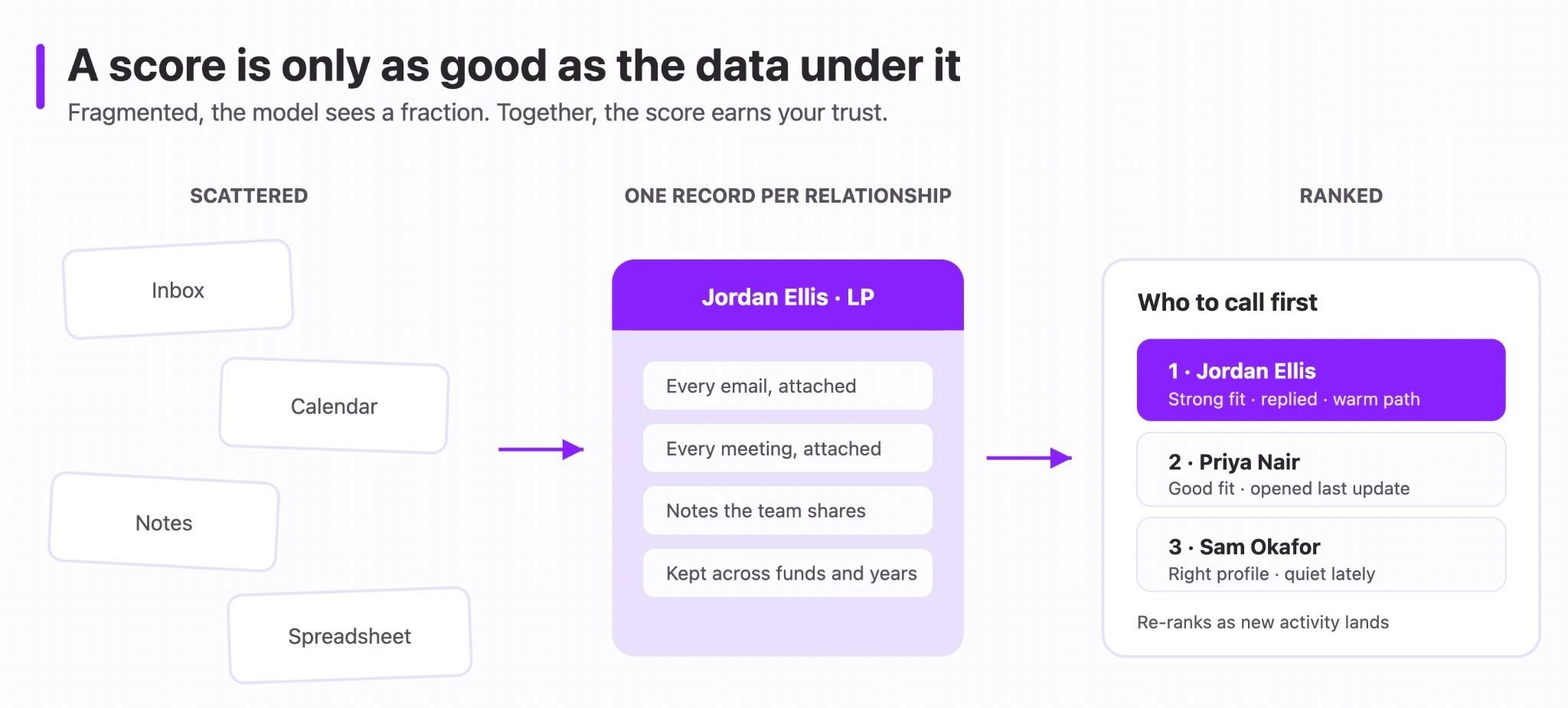
The rule of thumb is that if your data is fragmented, a score will be confidently wrong. If it is complete and current, the score earns your trust.
Freshness matters as much as completeness. A reply that came in this morning, a meeting that just happened, a founder who went quiet for three months: these should move the ranking on their own, without anyone remembering to update a field. A score built on last quarter's activity is just a tidy way of being out of date.
How Rings AI Makes Lead Scoring Work for Investors
The reason a relationship's history ends up scattered is that most CRMs treat a person as a deal to close and file away. Rings AI is a CRM built for investors, where people and companies are permanent. Every email, note, meeting, and bit of deal history stays attached to the relationship it belongs to, across funds and years, instead of resetting when something closes.
That is the foundation scoring needs. When the signals live in one place and stay current on their own, ranking who to work next stops being guesswork.
On top of that data, Rings gives investor teams:
Team-wide email and meeting capture, so activity lands against the right person without manual logging
Relationship strength scoring across the whole team, so you can see who actually has the warmest path to an LP or a founder
A sourcing engine with round-by-round venture data, for finding deals before they get loud
A shared notes and files hub, so the context one partner has is context the whole firm has
The relationship-strength piece is the part that maps most directly to everything above. It reads the real signals in your team's email and meeting history and tells you how strong a connection actually is, so warm access becomes something you can see rather than something you ask around for.
If you want to see what AI lead scoring for investors looks like when all of this is connected, book a demo. We’ll show you how Rings surfaces relationship strength across your team and helps you decide who to call first.