
According to research published in Forbes, companies waste up to 71% of the internet leads they generate, just because response and follow-up break down after the form fill. In the same research, the average company took nearly 47 hours to respond to a new lead, and sales teams made just 1-2 attempts before moving on. As a result, only about 27% of leads were ever contacted at all.
That gap between interest and action is where lead nurturing is supposed to work. But nurturing only helps if it’s timely, persistent, and structured.
This guide focuses on powerful lead nurturing strategies for 2026, along with 3 real campaign examples and best practices that help you respond faster, stay relevant longer, and move leads forward instead of letting them quietly disappear.
What is Lead Nurturing
Lead nurturing is the process of staying in touch with a potential customer after they show interest, until they are ready to make a decision. Most people are not ready to buy the moment they fill out a form, download a guide, or request a demo. They need time, reminders, and useful information to move forward.
For example, someone downloads a pricing guide from your website.
On day one, they receive a short email confirming the download and explaining what they will find inside.
Two days later, they get an email that answers a common question customers ask at this stage.
A few days after that, they see a case study showing how a similar company solved the same problem.
At the end of each message, there is a clear and low-pressure next step, like booking a call or reading one more resource. Lead nurturing usually picks up after initial prospecting, once someone has shown interest and entered your pipeline.
At its core, lead nurturing is about timing and consistency. You follow up quickly, you continue to show up in relevant ways, and you make it easy for the lead to take the next step when they are ready. This usually happens through a mix of emails, messages, content, and sometimes calls, spread over days or weeks.
Why is Lead Nurturing Important
Lead nurturing helps prevent leads from going cold. But that's just a part of the full story. To see why it matters, it helps to look at the full range of benefits, not just the obvious ones.
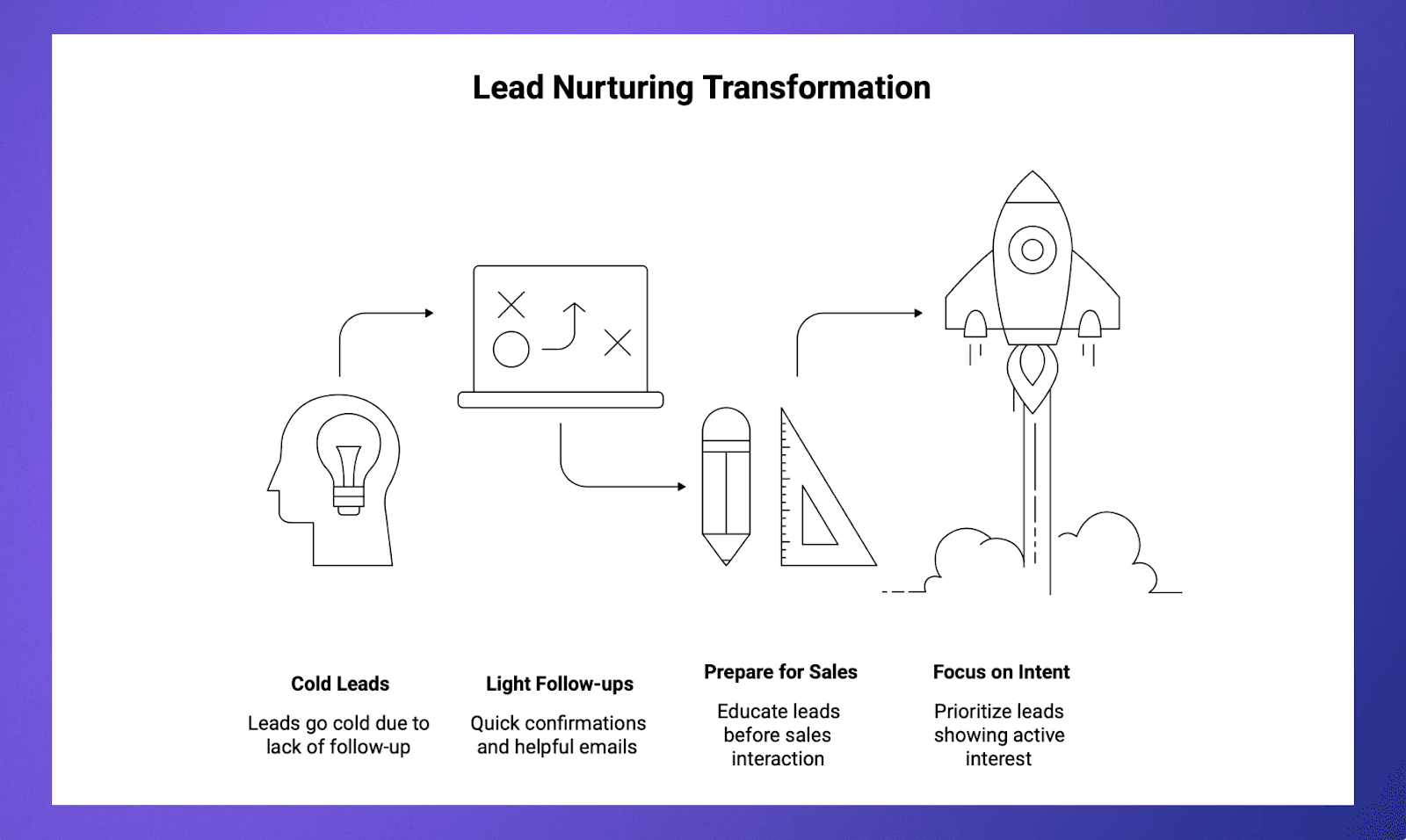
It stops leads from going cold
Most leads do not convert because there is a long gap after the first interaction. Interest fades. Context is lost. The lead moves on.
Lead nurturing fills that gap with light, relevant follow-ups that keep the conversation alive.
This can be as simple as:
A quick confirmation right after sign-up
A helpful email a few days later
A reminder that you are available when they are ready
Over time, these small touches prevent good leads from disappearing just because no one stayed in touch.
It prepares leads before sales steps in
Lead nurturing does a lot of the early work quietly. By the time a lead talks to the sales team, they may have already:
Read a guide or case study
Seen how your product or service is used
Understood what your brand stands for
This changes the tone of the conversation. Sales spends less time explaining basics and more time understanding fit and timing. Calls feel more focused, and leads feel more confident about the next step.
It helps teams focus on the right leads
Not every lead is worth the same level of attention. Lead nurturing creates signals based on engagement, such as opens, clicks, replies, or content consumed. These signals help teams understand who is actively interested and who is not ready yet.
Instead of chasing every lead equally, sales can prioritize those showing consistent intent. This leads to better use of time, fewer stalled deals, and a healthier pipeline built on real interest rather than guesswork.
5 Strategies That Help You Nurture Leads Effectively
These 5 strategies will work with any type of industry or audience type.
1. Respond early, then stay present without hovering
The first response sets the tone for the entire relationship. When someone fills out a form or downloads something, they are paying attention in that moment. A fast response acknowledges that interest and reassures them that their action mattered.
After that initial reply, the goal shifts. You are no longer trying to react instantly. You are trying to stay visible without becoming noise. This usually means spacing follow-ups over time and giving leads room to engage at their own pace.
Some teams make the mistake of front-loading everything into one week. Others disappear after the first email. Nurturing works best when the early response is quick, and the follow-up is steady and intentional.
2. Adjust content based on what the lead already knows
Leads come in with very different levels of understanding. Some are just starting to explore a problem. Others already know what they want and are comparing options.
If everyone receives the same sequence, parts of it will feel irrelevant.
Early-stage leads often benefit from:
Clear explanations of the problem
Common mistakes or misconceptions
Simple examples that help them frame their situation
While later-stage leads usually look for:
Proof that the solution works
How it applies to their specific context
Practical details that reduce uncertainty
When your nurturing reflects what the lead already understands, the messages feel helpful instead of repetitive.
3. Let engagement shape your follow-up
Lead nurturing is not just about sending content. It is also about observing behavior and responding to it.
Some leads open every email, click links, and explore multiple resources. Others skim once and go quiet. Treating both the same usually leads to wasted effort.
Engagement can guide decisions like:
When to introduce a sales conversation
When to continue educating
When to pause outreach altogether
This does not require complex scoring models. Even simple signals can help you prioritize attention and avoid pushing leads before they are ready.
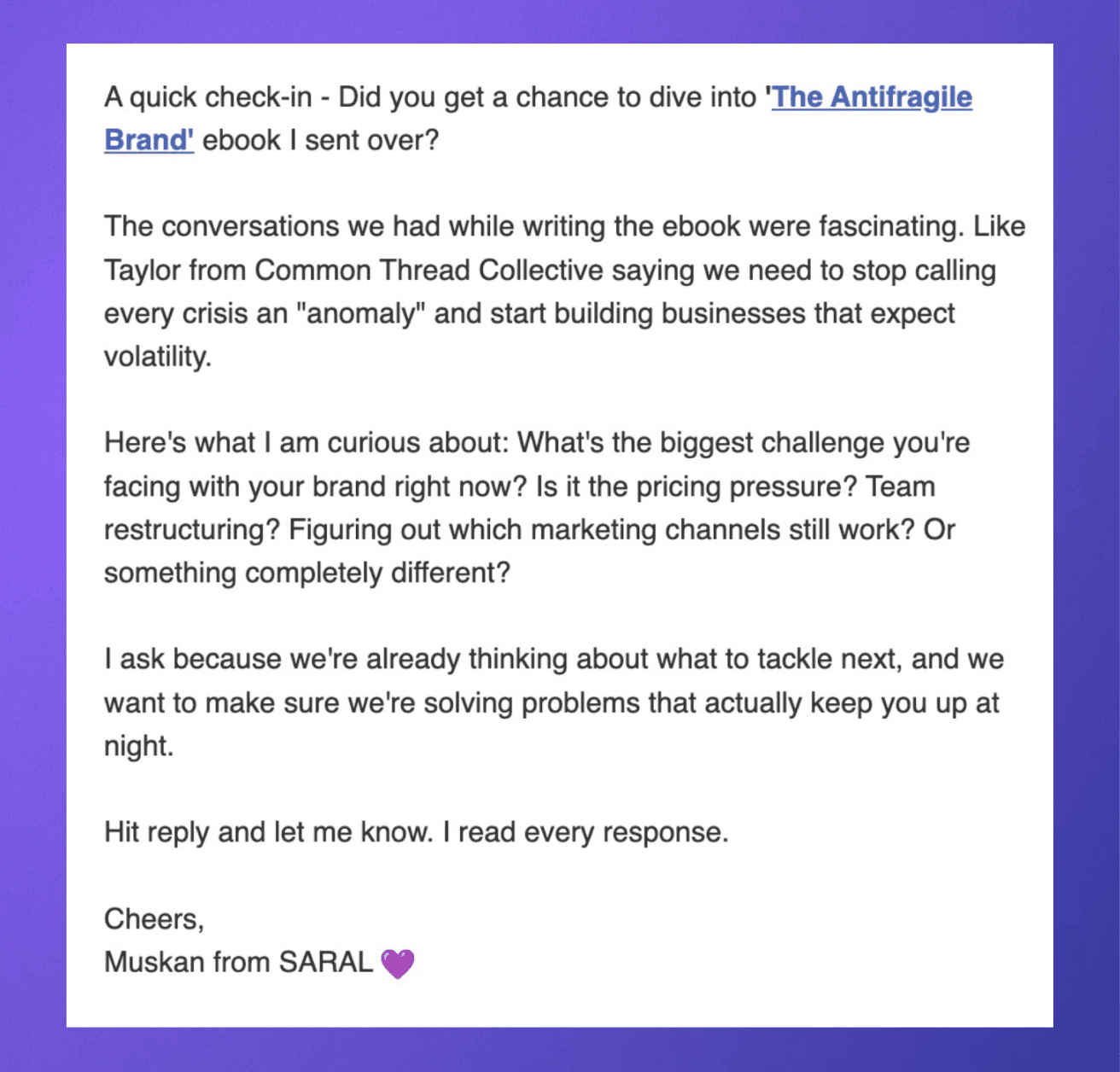
Below is a good example of lead nurturing that prioritizes understanding the lead before deciding what to send next.
4. Make each touchpoint do one clear job
Many nurturing campaigns fail because they try to accomplish too much in a single message. Long explanations, multiple links, and unclear calls to action make it harder for leads to decide what to do next.
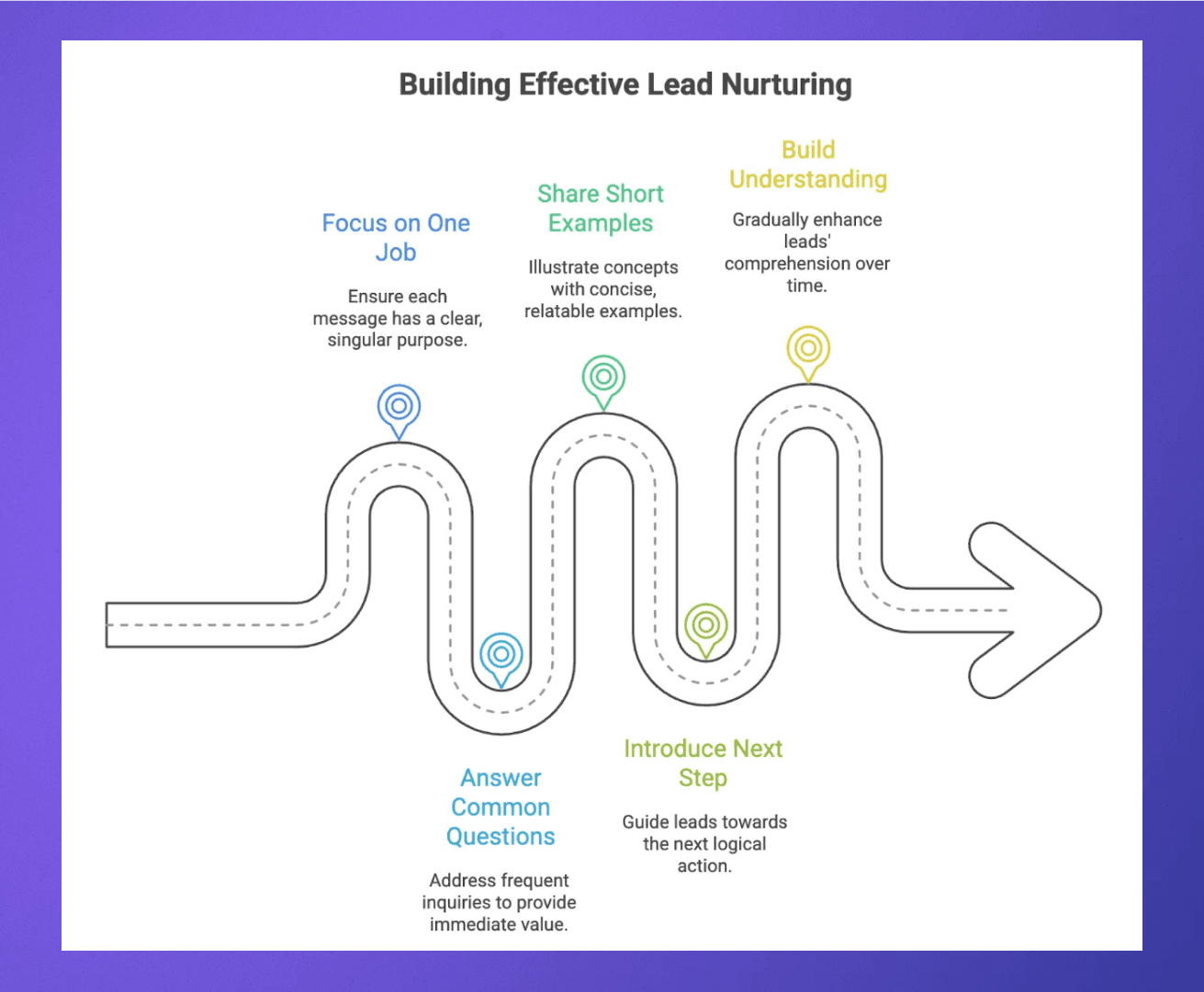
A single email might aim to:
Answer one common question
Share one short example
Introduce the next step
That focus makes the message easier to read and easier to act on. Over time, a series of clear, focused messages builds understanding more effectively than one dense overview.
5. Design for long decision cycles
Not all leads convert quickly. Some take weeks or months to move forward due to internal discussions, budgets, or timing.
Lead nurturing supports these longer cycles by keeping your brand familiar during the waiting period. When priorities shift or the timing becomes right, the lead does not need to rediscover you. The relationship already exists.
This is especially important in higher-consideration purchases, where consistency and reliability matter as much as the initial pitch.
Lead Nurturing Campaign Examples With Templates
Example 1: New lead follow-up after a content download
This is used when someone downloads a guide, checklist, or report and has shown early interest.
The focus here is to acknowledge the action, add context, and guide the lead toward a next step without pressure.
Email 1: Sent immediately
Subject: Your download is ready
Hi {{First name}},
Thanks for downloading {{resource name}}. You can access it here: {{link}}.
This resource is meant to help with {{problem or goal}}. Many teams use it as a starting point to understand what to focus on first.
If you have questions as you go through it, feel free to reply to this email.
Email 2: Sent a few days later
Subject: How people usually use this guide
Hi {{First name}},
A quick follow-up on the {{resource name}} you downloaded.
Most people start by looking at {{specific section or idea}}. It helps clarify {{key takeaway}} before thinking about next steps.
Here’s a short example that shows how this plays out in practice: {{link}}
Example 2: Education-based nurturing for early-stage leads
This works well when leads are researching and not ready to speak with sales. The emails might explain common mistakes, trade-offs, or patterns teams see when they deal with the same challenge.
Email template
Subject: One thing to know about {{topic}}
Hi {{First name}},
When teams start thinking about {{topic}}, they often run into {{common issue}}. It usually happens when {{context or cause}}.
A simple way to handle this is to {{practical advice}}. This tends to work well because {{reason}}.
If you want to explore this further, this example explains it in more detail: {{link}}
You can repeat this format weekly, each time focusing on a different question or misconception.
It builds trust without pressure. Leads learn at their own pace and begin to associate your brand with insight rather than outreach. When they are ready to move forward, they already feel familiar with how you think.
Example 3: Re-engagement for leads that went quiet
This is used when a lead has not opened or replied in a while.
The goal is to check in without assuming intent.
Email 1
Subject: Quick check-in
Hi {{First name}},
We haven’t connected in a bit, so I wanted to reach out.
If {{problem or goal}} is still something you’re working on, I’m happy to share a few ideas or point you to something useful.
If it’s no longer relevant, that’s completely fine too.
It brings genuinely interested leads back into the conversation and clears out those who are no longer a fit. This keeps your pipeline healthier and your follow-up more intentional.
Email 2: Sent a week later
Subject: Should I close the loop?
Hi {{First name}},
Just following up once more.
If now isn’t the right time, I can pause outreach. If you’d like to continue the conversation later, you can reply here or take a look at this update: {{link}}.
Lead Nurturing Works Better With Rings AI
Lead nurturing depends on context. Follow-ups only work when your team knows who the lead is, how they entered the pipeline, and what has already happened across emails, meetings, and handoffs. A CRM makes that visibility possible and boosts your business.
Rings AI is a CRM built for teams that rely on relationships to move deals forward. It automatically builds rich profiles from email, calendar, and LinkedIn activity, so context stays up to date without manual work. AI-powered scoring and buying signals help surface which leads are worth nurturing now, rather than guessing based on limited data.
For lead nurturing, this translates to:
Less time spent on data entry
Better timing using real signals
Clear visibility into engaged and inactive leads
Warmer outreach through existing relationships
Explore Rings.ai with a quick walkthrough and see how it can support your lead nurturing strategy.
Rings AI is the relationship intelligence platform built for teams that manage high-value, long-term relationships. Book a demo to see how Rings AI can support your team.
Learn more about XRM vs CRM or what is a CRM.