

When you're choosing a CRM for your venture firm, every tool will put its shiniest features in front of you. There's a demo for the latest AI thing, a slick automation, a feature nobody was asking for that somehow leads the pitch. It's easy to get pulled toward whatever looks most advanced.
The better question is what you actually need it to do. A CRM should serve your workflow, your team, and how your firm runs day to day. The most complicated feature or the newest one on the market doesn't matter if it doesn't fit the way you work. A firm sourcing seed deals has different needs than one managing a portfolio and a limited partner (LP) base across three funds.
So the goal isn't to find the tool with the longest feature list. It's to know which features move the needle for your firm, and to recognize the ones that are there for the demo and little else.
In this article, we'll cover the essentials every CRM should have and the features built for how modern venture firms actually work.
Quick Overview of 16 CRM Features for a Venture Capital Firm
Before we get into each one, here's the whole set in a single view. The table below shows every CRM feature worth looking for, what it actually is, and what it's good for:
Feature | What it is | Good for |
Contact management | A central record for every person and company, with details and history in one place | Keeping the context behind a relationship in one spot instead of scattered across inboxes |
Pipeline management | A live view of every active deal and the stage it's in | Seeing the whole book at a glance and knowing what needs attention |
Email & meeting capture | Logs every email and meeting against the right person and company automatically | An always-current activity history and an instant answer to “when did we last talk?” |
Notes & files | Notes and files that attach to the right people and companies on their own | Every note on a founder in one place, searchable later |
Dashboards & analytics | A configurable view that turns pipeline and activity data into metrics and trends | A fast read on the firm's state and where deals stall, without pulling a report |
Collaboration | Shared notes, comments, and visibility across the team | Keeping everyone aligned and avoiding duplicated outreach |
Automation | Handles repetitive work like data entry, reminders, and follow-ups | Cutting busywork so the team spends time on relationships, not upkeep |
Forecasting | Projects where the pipeline or capital deployment is heading | Planning fund pacing and deployment |
Campaign management | Tools for running outbound email campaigns and tracking engagement | Marketing and outbound motions; less central for an investment team |
Relationship mapping | Charts the firm's collective network and surfaces the warmest path to a founder or investor | Finding who on your team can actually make the intro |
Relationship strength scoring | Scores how well each team member knows a given contact | Knowing your real best way in, based on data rather than guesswork |
Built-in data & enrichment | Ships with millions of people and company records and keeps them current from outside sources | Starting from a full database instead of an empty one |
AI copilot & natural language search | Query the whole database in plain English | Pulling answers like “Series B companies where we have a warm intro” without building a report |
Deal & fund scoring | Rates companies and funds on signals like growth efficiency, momentum, and syndicate quality | Prioritizing outreach toward the strongest opportunities |
Privacy workspaces | Lets individuals or sub-teams work in secure spaces while still feeding shared intelligence | Keeping sensitive deals confidential without siloing the firm's network |
Meeting prep | Pulls email, notes, market, and web data into a single prep dossier | Walking into a call already up to speed |
The 10 CRM Key Features for VC Firms
We can't cover all 16 in depth without turning this into a manual, so here are the 10 that matter most for how a venture firm actually works. The rest still count, but these are the ones worth understanding before you choose.
Contact Management
This is the foundation, and everything else sits on top of it. A contact record holds every person and company you deal with, along with the history behind them: past emails, meetings, notes, and the deals they've touched.
What matters is how a tool stores that history over time. Most CRMs file activity under a deal or an opportunity, so when the deal closes, the context goes with it.
For a venture firm that's the wrong model, because the same founders and investors come back around for years. You want contacts and companies stored as permanent records, with history that builds up on the person instead of resetting every time a process ends.
Pipeline Management
Your pipeline is the live view of every active deal and the stage it sits in. A good one lets you see the whole book at a glance, spot what's stalling, and know where to spend attention without asking around.
What separates a CRM built for VC is flexibility in what a deal can be. A venture deal isn't one company and one contact. It can involve a founder, a few co-investors, and a banker who brought it in. Some early-stage deals don't even have a company yet, just a founder.
Look for a pipeline that can:
Attach multiple people and companies to a single deal
Be customized to your stages, sectors, and the fields you actually track
Capture email and meeting history against the deal automatically
Relationship Mapping
For an investment team, this is often the feature that earns the tool. Relationship mapping charts your firm's collective network and shows you the warmest path to a company you're trying to reach.
The better versions go beyond your direct contacts. Rings AI's Pathpower® maps the paths through everyone around a company, not just founders and employees, but the investors, board members, and advisors who can also get you in front of it. For any opportunity you're sourcing, you can see instantly who on your team has the best way in.
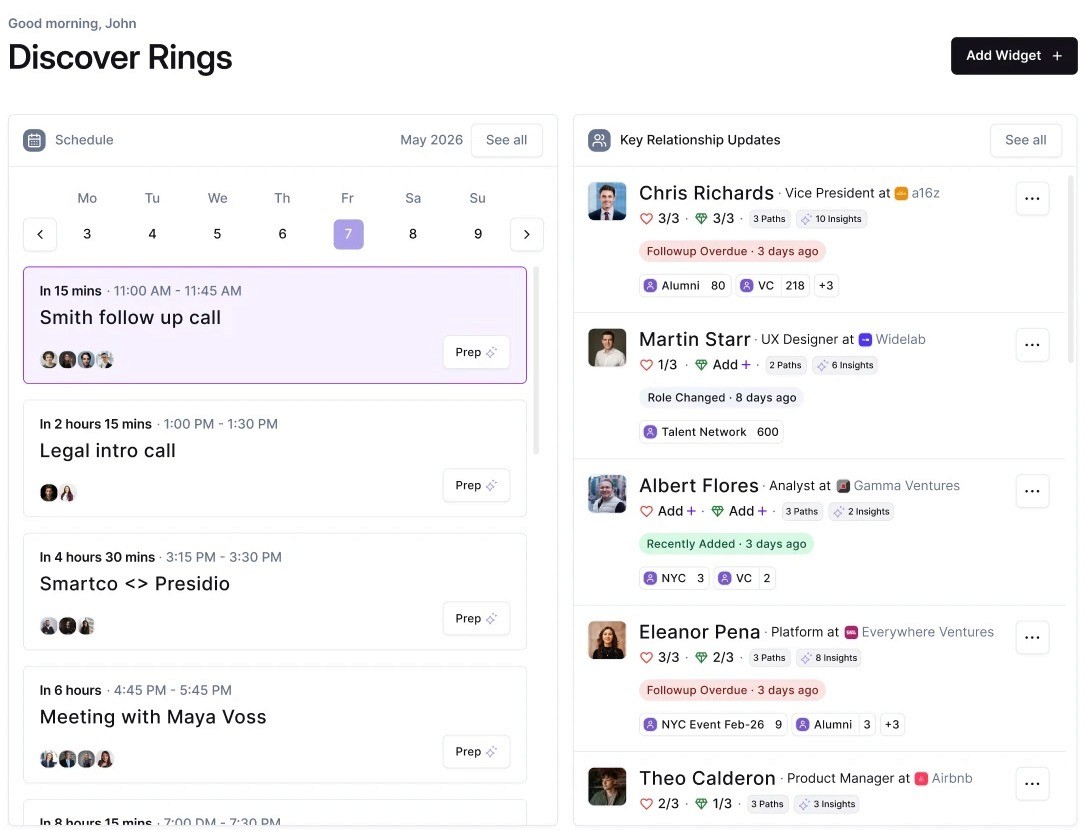
That turns cold outreach into a warm intro, and it means the firm's network works as one shared asset instead of living in individual inboxes and memories.
Email and Meeting Capture
A CRM is only as useful as its data is current, and manual logging is where most of them fall apart. Nobody reliably enters every call and email, so the record goes stale and trust in the tool erodes.
Automatic capture fixes this. Every email and meeting logs itself against the right person and company without anyone lifting a finger. That means the last time your team spoke to someone is always sitting next to their name, up to date, with no digging required.
It also means a fundraise or a deal that spans months never loses its thread. Every message and meeting stays attached to the relationship, so picking up where you left off doesn't require reconstructing the history by hand.
Dashboards and Analytics
Dashboards give you a fast read on the state of the firm, and analytics turn your pipeline and activity data into something you can act on. Instead of pulling a report every time someone asks how the quarter looks, the answer lives on a screen you configure around what your team cares about.
For a venture firm, useful views tend to include:
Where deals are concentrated by stage, sector, or partner
Which sources actually produce deals worth pursuing
How much the team is deploying and at what pace
Where relationships are going cold and need attention
This turns the activity your team is already generating into a clear picture of what's working and what needs a nudge.
Relationship Strength Scoring
Knowing that someone on your team is connected to a founder is one thing. Knowing how well they actually know them is another.
Relationship strength scoring reads the real signal behind a connection: how often people email and meet, how recently, and how two-sided the exchange is. It turns that into a score of who knows whom and how well. Rings builds this across the whole team, so you can see your firm's collective network with depth instead of a flat list of names.
Your best way into a company then comes from data, not a guess. When you need a warm intro, you know exactly who to ask.
Automation
Automation removes the busywork that pulls a team away from actual relationship building. The goal isn't a CRM that runs itself, which is a promise most tools can't keep, but one that handles the repetitive parts so people don't have to.
The work worth automating is the invisible upkeep: logging activity, filing notes to the right records, updating contact and company data, and flagging when a relationship has gone quiet for too long. Rings files each note into the right relationships on its own and keeps your network graph clean from your email as you work.
Compared to a sales CRM's heavy workflow rules, a relationship-led tool keeps automation lighter and more grounded. Enough to save hours a week without pretending the whole thing runs on autopilot.
Built-In Data and Enrichment
Some CRMs start empty and leave you to fill them. The better ones come preloaded, so the tool is useful from day one instead of after months of data entry.
Look for a CRM that ships with real market data built in. Rings starts with 150M+ people and company records and 30 years of round-by-round venture history, then overlays your own relationship data on top:
You see the full market, not just the contacts you've entered.
Your relationships sit on top of it, so you know what you can actually reach.
Records stay current from outside sources instead of going stale.
Starting from a full database rather than a blank one changes how quickly the whole system pays off.
AI Copilot and Natural Language Search
The value of AI in a CRM depends on the data behind it, and this is where a relationship-led system has an edge. Because a firm's entire history of emails, notes, deals, and market data lives in one place, the AI has enough context to be useful.
You ask questions and get real answers. Instead of building a report, you type something like “Series B companies where we have a warm intro” and get it back. Rings' intelligence draws on your team's actual activity, notes, and history, so the answers are rooted in what your firm knows rather than generic web results.
Be skeptical of AI claims when you evaluate tools, since many overpromise. The ones worth trusting are grounded in your own data.
Meeting Prep
Prepping for a call properly can eat half an hour. You have to pull up recent emails, re-read old notes, check what a company has raised, and look up who you're meeting. A CRM with enough context can assemble most of that for you.
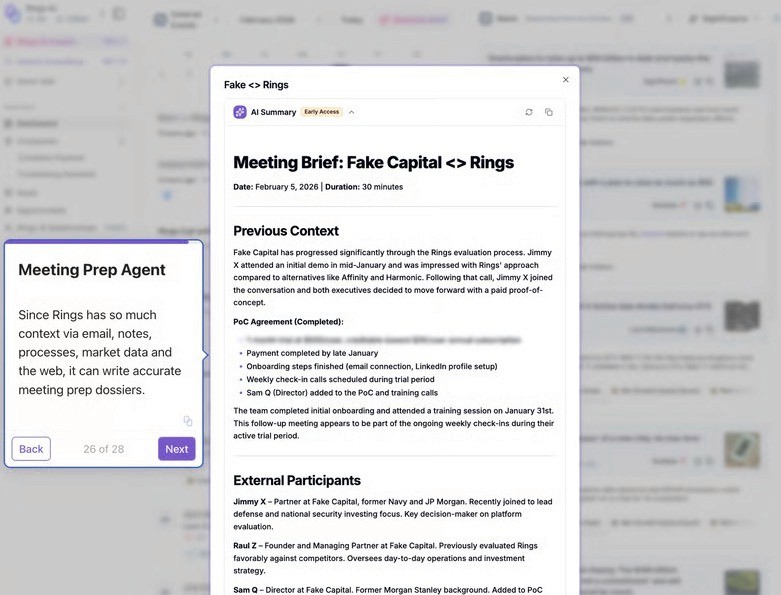
Good meeting prep pulls together everything you'd otherwise gather by hand:
Recent email and meeting history, so you know what was last discussed
Notes from past calls, recapped
Market data, like what the company has raised and deals in common with other investors
Web research on the attendees, their company, and recent news
The result is a single dossier that gets you up to speed before you walk in. Small per meeting, but across a team taking dozens of calls a week, it adds back real hours.
Choose Rings as Your VC Firm's CRM
A CRM designed for a sales team organizes everything around a deal that closes and disappears. That model doesn't fit a venture firm, where the same founders, co-investors, and LPs come back around for years, across funds and deals.
That's the gap Rings was built to fill. It came out of a venture fund, from a team that couldn't get traditional CRMs to manage relationships, deals, and fundraising the way investors actually need. So instead of retrofitting a sales tool, they rebuilt a CRM around people and companies as recurring relationships rather than one-time transactions.
Here's what your team gets with Rings:
Find your warmest way in. Pathpower® maps your team's paths to a company through everyone around it (founders, investors, board members, advisors), not just direct contacts.
Skip the data entry. Rings builds your relationship graph from your team's email on its own, so your network stays mapped without upkeep.
Answer “when did we last talk?” instantly. Activity history sits next to every person and company, no digging through inboxes.
Track a deal the way VC works. Attach any mix of people and companies to one deal, so the founder, banker, and co-investor all live on a single record.
Run every raise from one place. Manage multiple fundraises at once and let an LP be one or many people or companies.
See the market with your relationships on top. 150M+ records and 30 years of round data, with your relationships overlaid, so you know what you can actually reach.
Get AI answers rooted in what your team knows. Served intelligence draws on your activity, notes, and history, so you can trust the answer.
Keep every note where it belongs. Notes file themselves into the right relationships, one click from anywhere.
Reach LPs at scale, still personal. Segment LPs by any field and run bulk outreach from inside Rings.
Work your pipeline without leaving it. Integrated email lets you follow up, forward, or start threads inside the deal.
Switch CRMs without losing history. A human data team moves your process history over by hand from any major CRM.
Keep sensitive work private. Three layers of user-level privacy contain confidential deals while still feeding shared intelligence.
Take your relationships anywhere. Chrome extension across Gmail, LinkedIn, and the web, plus a full iOS app.
Every firm runs its relationships a little differently, so the best way to see whether Rings fits is to watch it work against your own pipeline, your own network, your own process. Book a demo and we'll walk through it with you.