
Customer relationship management (CRM) tools help sales teams organize contacts, track deals, and manage customer interactions throughout the sales cycle.
Among the many options available today, Zoho CRM has become a popular choice for businesses looking for an affordable and customizable platform. It’s widely used by small and mid-sized teams that want strong automation, integrations, and pipeline visibility without the enterprise-level cost of tools like Salesforce.
But while Zoho CRM offers impressive flexibility, it also has limitations that some growing organizations eventually outgrow. Many users report challenges with its complex interface, time-consuming setup, and limited relationship intelligence compared to newer AI-driven platforms.
This review explores Zoho CRM’s features, pricing, pros, and cons, along with some leading alternatives like Rings AI, so you can decide whether it’s the right CRM for your team in 2026.
What is Zoho CRM?
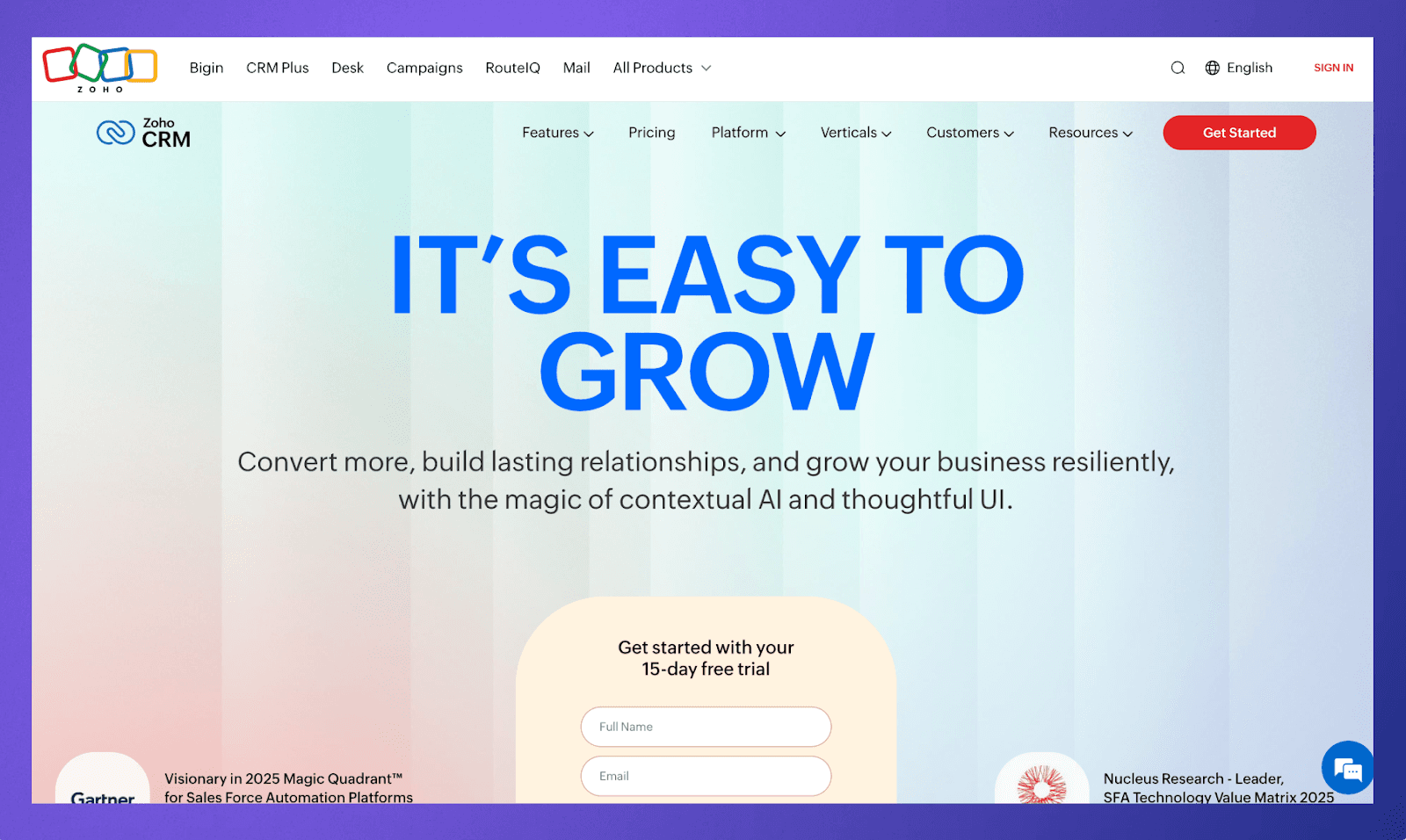
Zoho CRM is a cloud-based customer relationship management platform that helps businesses manage customer interactions, sales pipelines, and revenue operations in one system.
Part of the broader Zoho ecosystem, which includes tools for email, accounting, marketing automation, and customer support, Zoho CRM integrates with dozens of Zoho apps and hundreds of third-party tools. This enables teams to manage sales and customer data from a single platform.
Sales teams typically use Zoho CRM to:
Capture and organize leads
Track deal progress through pipelines
Automate routine sales tasks
Monitor sales performance with analytics
Manage communication with prospects and clients
However, like many traditional CRMs, its primary focus is on pipeline and contact management, rather than deeper relationship intelligence or network mapping.
Key Zoho CRM Features
Zoho CRM offers a wide set of tools designed to support the entire sales workflow, ranging from capturing leads to closing deals and analyzing performance.
Below are some of the platform’s most important features.
Lead & contact management: Store and organize prospect and customer data with interaction history, notes, and deal associations.
Sales pipeline management: Track deals across customizable pipeline stages to monitor progress and forecast revenue.
Workflow automation: Automate repetitive sales tasks, such as follow-ups, lead assignments, and status updates.
Multichannel communication: Manage emails, calls, live chat, and social messages from a centralized CRM interface.
Sales analytics & reporting: Build dashboards and reports to track conversion rates, revenue forecasts, and sales performance.
AI-powered insights (Zia AI): Use Zoho’s built-in AI assistant to predict deal outcomes, detect anomalies, and recommend next actions.
Customization & modules: Create custom fields, modules, and layouts to tailor the CRM to your sales process.
Integrations & ecosystem: Connect Zoho CRM with hundreds of tools, including email platforms, marketing apps, and accounting software.
Zoho CRM Pricing Breakdown for 2026
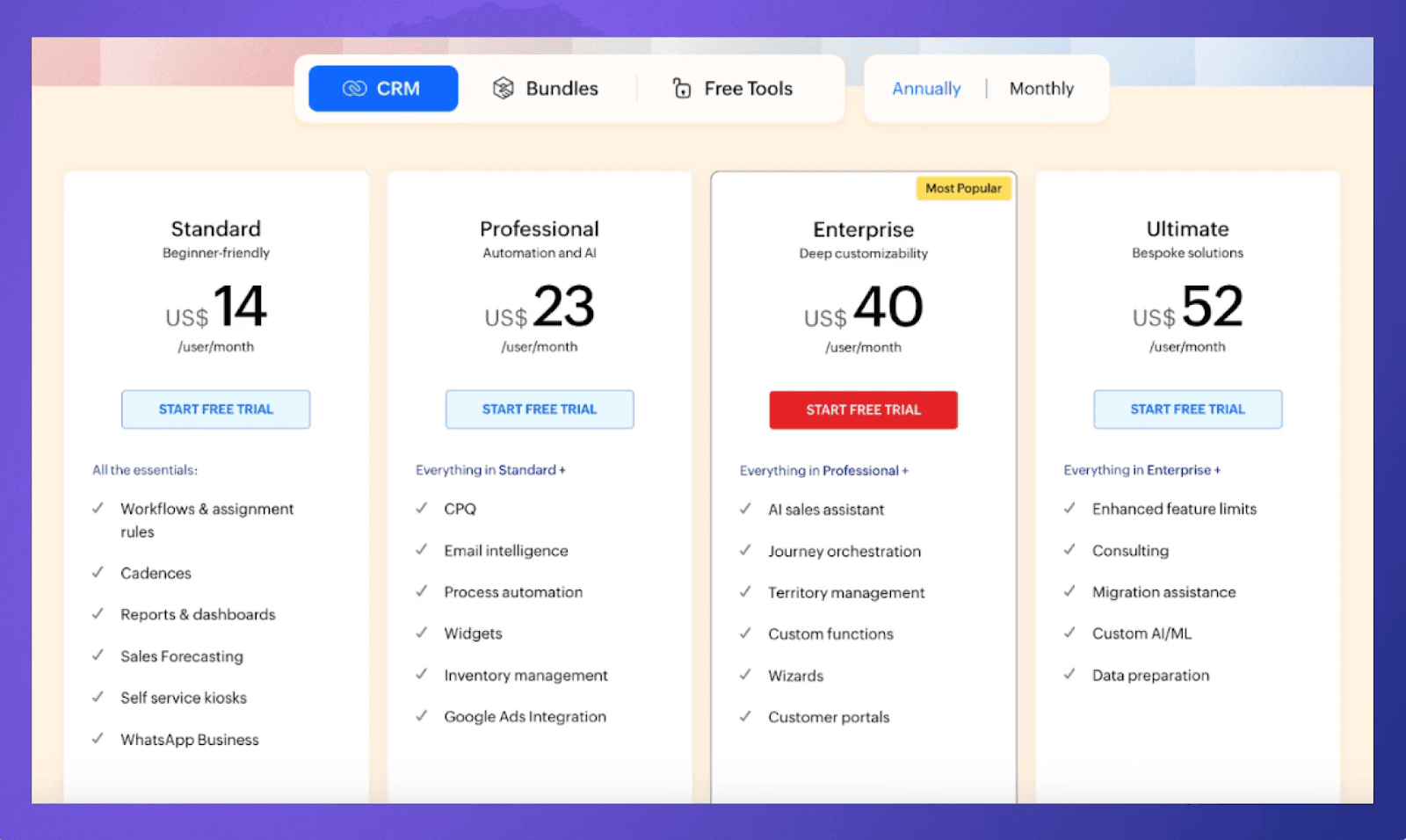
Zoho CRM offers a tiered pricing structure designed to accommodate teams of different sizes. It also offers a 15-day free trial.
Free: Supports up to three users and offers basic features like leads, documents, and mobile apps
Standard: $14 per user per month if billed annually, and includes workflow, reporting & dashboard, analytics, and more
Professional: Priced at $23 per user per month, billed annually. Adds more automation, inventory management, and deeper analytics
Enterprise: Costs $40 per user per month, billed annually. Includes additional features, such as an AI sales assistant, custom functions, etc.
Ultimate: $52 per user per month, billed annually. Includes enhanced analytics and additional data processing capabilities
Zoho CRM Pros and Cons
Like any CRM platform, Zoho CRM has both strengths and limitations depending on the needs of your organization.
Zoho CRM pros
Zoho CRM is one of the most budget-friendly CRMs, making it accessible for startups and small to mid-sized sales teams.
Businesses can tailor modules, fields, layouts, and workflows to match their specific sales processes and operational needs.
Zoho’s broader ecosystem, including Zoho Books, Zoho Desk, Zoho Campaigns, and Zoho Analytics, allows businesses to create a fully integrated operational stack.
Built-in workflow automation helps teams reduce manual work by automatically triggering follow-ups, task assignments, and status updates.
With email, phone, and social integrations built directly into the platform, teams can manage customer communication from one interface.
Zoho CRM cons
The interface can feel cluttered and overwhelming for new users because of the large number of modules, settings, and customization options.
Initial setup and configuration can take significant time, especially for teams that want to build custom workflows, pipelines, and automation rules.
Advanced reporting and analytics features are limited in lower pricing tiers, pushing many teams to upgrade to more expensive plans.
Zoho’s AI assistant, Zia, is only available in higher-tier plans, which means smaller teams on lower-priced tiers cannot access its predictive insights and workflow creation features.
The platform focuses primarily on contact records and pipelines, offering limited native relationship intelligence or network visibility for complex deal environments.
Top Zoho CRM Alternatives in 2026
While Zoho CRM works well for many businesses, some teams eventually look for alternatives that offer deeper analytics, simpler workflows, or stronger relationship intelligence.
Here are some of the top Zoho CRM alternatives.
1. Rings AI
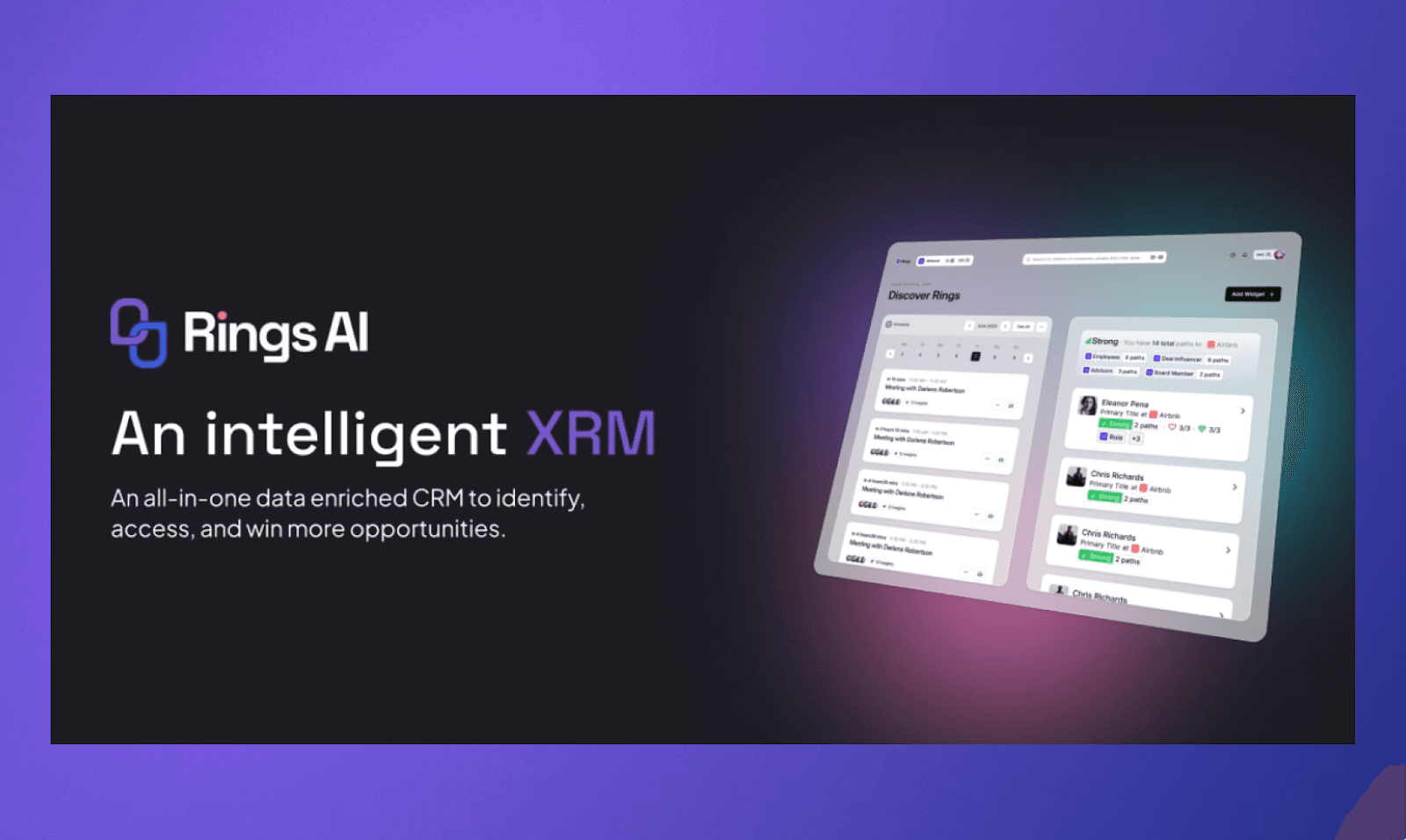
Rings AI takes a different approach to CRM by focusing on relationship intelligence rather than simple pipeline tracking. Traditional CRMs store contacts and deals, but Rings goes further by helping teams understand the relationships behind those deals.
Instead of relying on static records alone, Rings helps teams identify who knows whom, which relationships are strongest, and where the next opportunity may come from.
This approach is especially valuable for teams that rely heavily on networks and long-term relationships, including venture capital firms, private equity teams, investment banking groups, and other relationship-driven sales organizations.
Key features of Rings AI
Network visualization across contacts and organizations
Automated relationship mapping from email and calendar data
Real-time company intelligence and AI-powered opportunity discovery
Warm introduction tracking across your network
Pricing
Rings AI operates on an annual per-seat pricing model built for scaling organizations, making advanced relationship intelligence more affordable for growing teams.
2. HubSpot
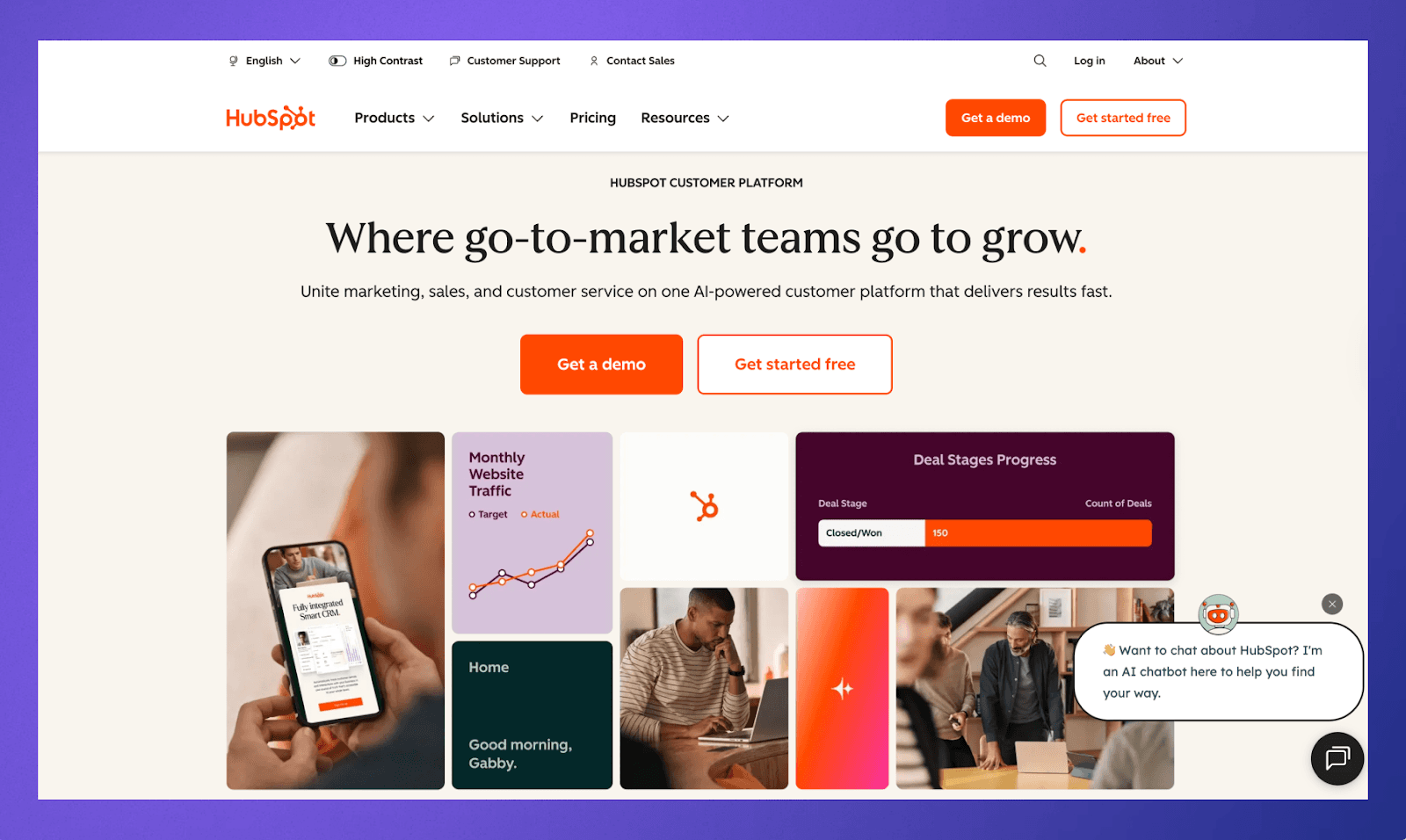
HubSpot is known for its user-friendly interface and strong marketing automation capabilities. It’s particularly popular among companies that want a unified platform for sales, marketing, and customer service.
Many teams adopt HubSpot for its ease of use and quick setup, although costs can rise significantly as businesses scale and add more advanced tools.
Pricing
HubSpot offers a free CRM with no expiration, making it easy for teams to get started. Paid plans begin with the Starter tier at $9 per seat per month (billed annually), with costs increasing as businesses add more contacts, automation capabilities, and additional hubs.
3. Salesforce
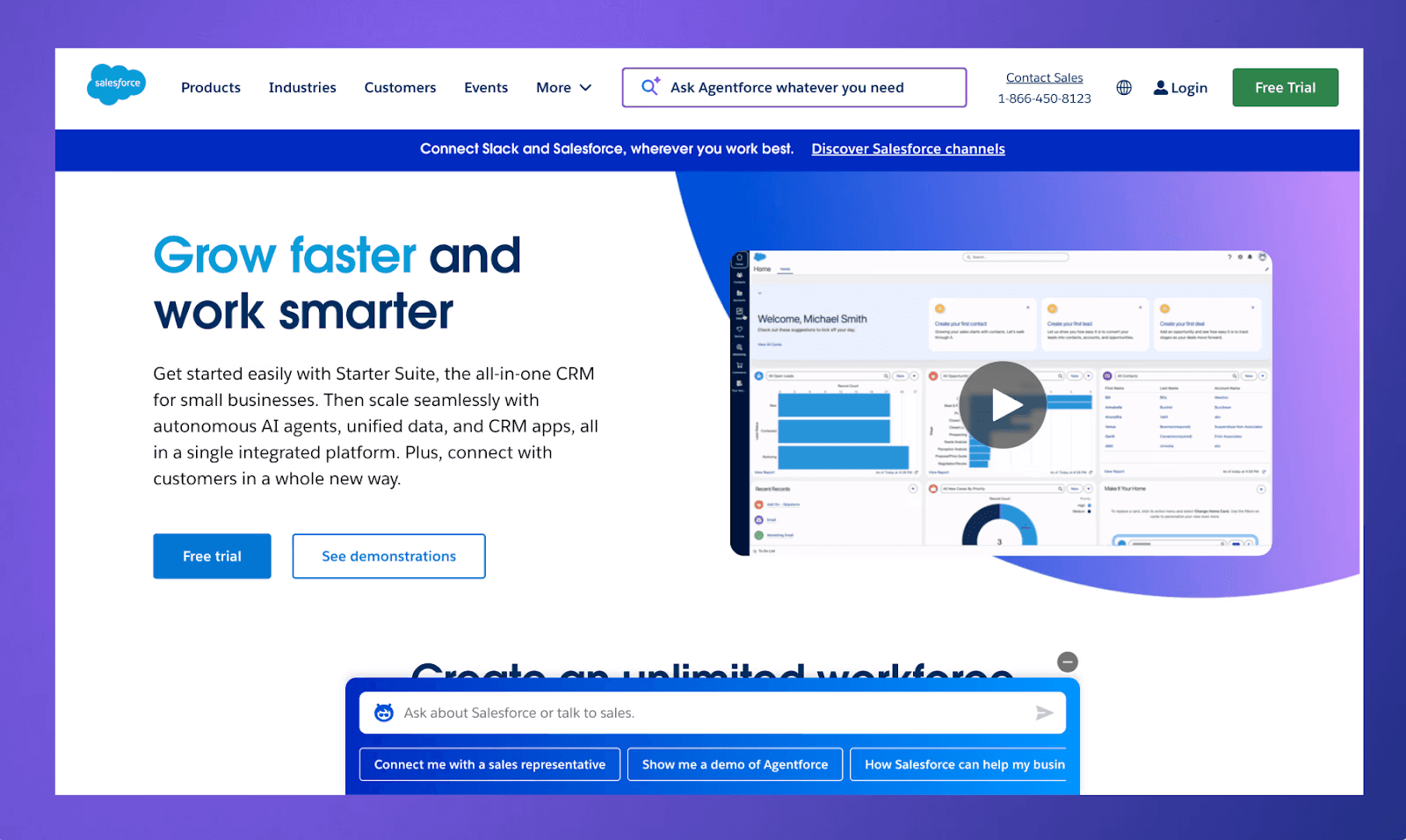
Salesforce remains the most widely used enterprise CRM. It offers extensive customization, integrations, and powerful reporting tools. That said, Salesforce often requires dedicated administrators and higher implementation costs, making it better suited for large organizations.
Pricing
Salesforce follows a tiered, per-user pricing model with several plans designed for different business needs.
Pricing typically starts around $25 per user per month for the Starter plan, while more advanced tiers like Professional, Enterprise, and Unlimited can range from $100 to $550 per user per month, depending on features and customization.
If you want to explore additional options, explore our full list of the best Zoho CRM alternatives.
Is Zoho CRM the Right Choice for Your Team?
Zoho CRM remains a solid choice for businesses looking for an affordable and flexible CRM with automation, customization, and a wide integration ecosystem. For many small and mid-sized sales teams, it provides the essential tools needed to manage pipelines, track customer interactions, and monitor sales performance without the cost of enterprise platforms.
However, as organizations grow and deal cycles become more relationship-driven, traditional CRMs like Zoho can fall short in areas such as relationship intelligence, network visibility, and AI-powered opportunity discovery.
Platforms like Rings AI address this gap by focusing on the relationships behind every deal. Mapping connections across your network and surfacing hidden opportunities helps teams identify warm paths, prioritize high-value prospects, and make better decisions about where to invest their time.
Looking for a smarter CRM? Book a demo with Rings AI.