
No magic revenue number or team size tells you it's CRM time. Some startups need one with five people. Others get by without one past twenty. The difference usually comes down to how relationship-dependent your business is and how much pain you're currently feeling from disorganization. If you're in a spreadsheet and things are working fine, you probably don't need to change anything urgently.
But if your team is growing, your pipeline is getting messier, and important conversations are slipping through cracks, it might be time. This article walks through the real signs that your startup needs a CRM, and what to look for in a CRM for startups.
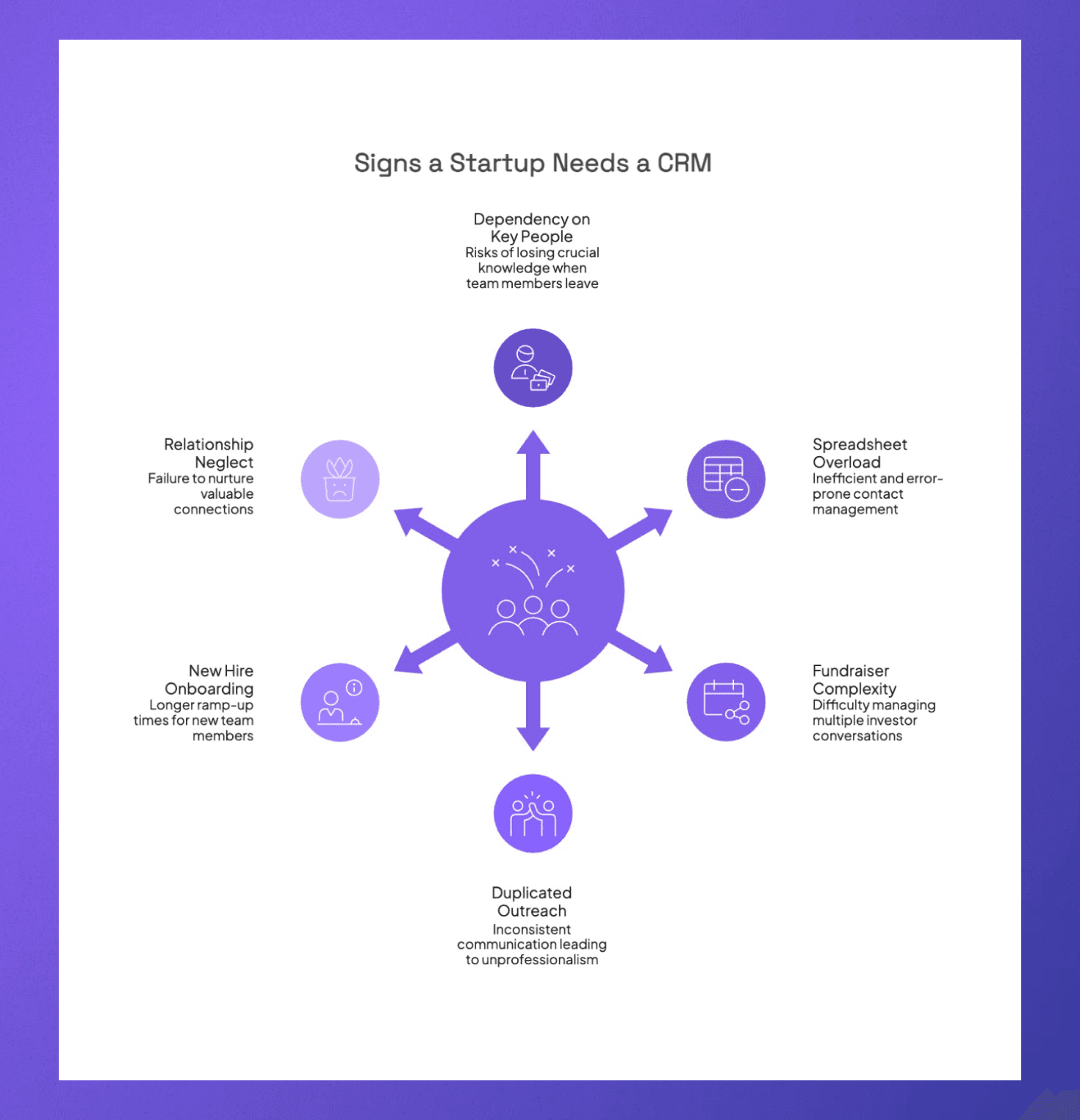
7 Signs Your Startup Needs a CRM
When the same problems keep showing up, and your current setup can't keep pace, it's usually time to consider getting a CRM for your startup.
1. Leads are slipping through the cracks
When your pipeline lives across five different inboxes and a shared spreadsheet that nobody updates in real time, things get lost.
An investor's intro sits unanswered because nobody knew it was their responsibility. A warm lead from a conference goes cold because the follow-up fell through between two people. A few missed opportunities might not sink the company, but the pattern compounds.
If deals are quietly dying because ownership is unclear and follow-ups aren't tracked, you're looking at a system problem that a spreadsheet can't solve.
2. Context lives in one person's head
Startups often run on tribal knowledge. The founder who took the first call remembers the conversation. The business development lead knows which partner at the VC firm is actually the decision-maker. That works when you're in a room with three people. It falls apart when:
Someone leaves for vacation, and a key relationship goes dark
A team member transitions to a different role, and their context leaves with them
New hires have no way to get up to speed on existing relationships
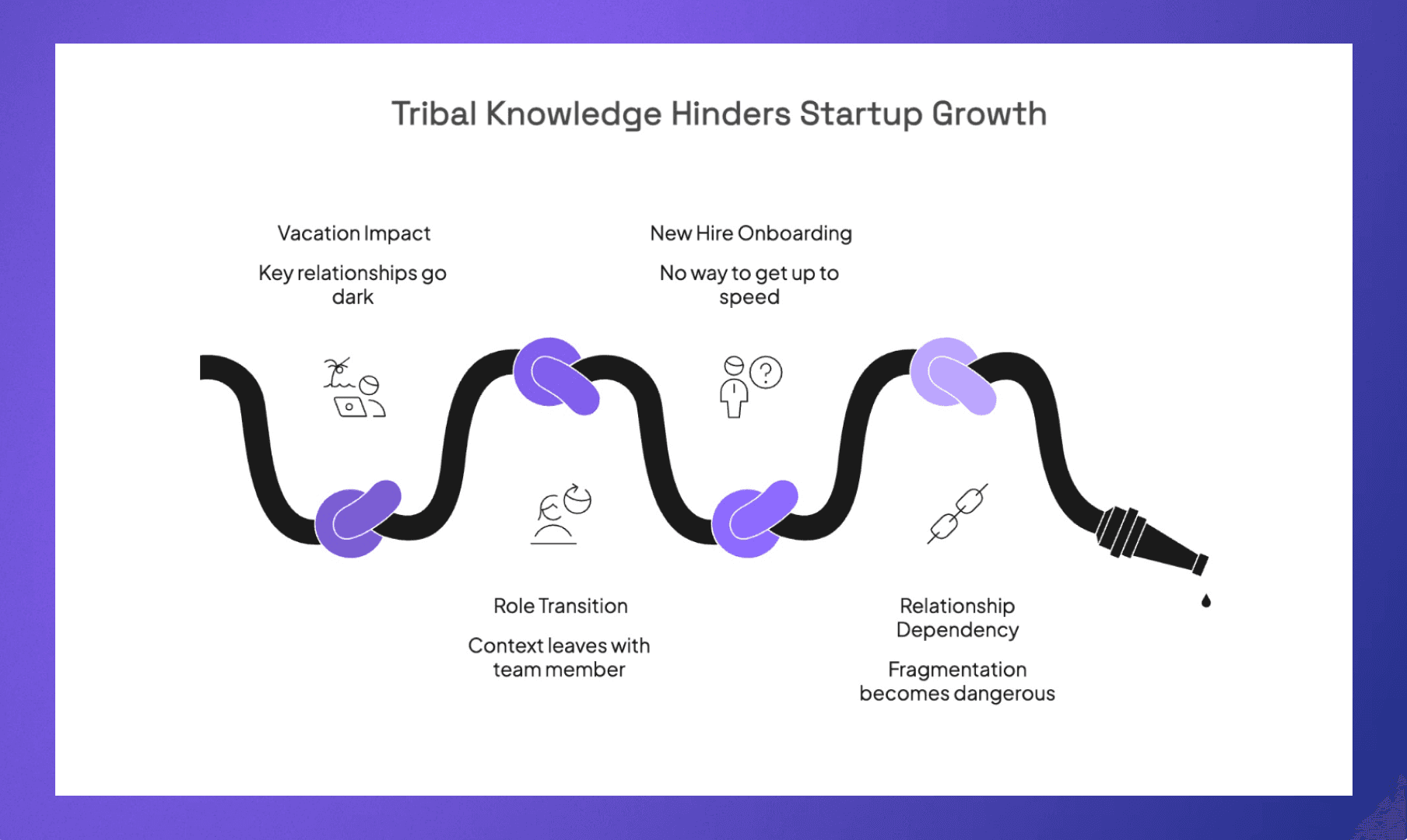
The more your business depends on relationships, the more dangerous this fragmentation becomes. You need context to live somewhere accessible, not in mental notes scattered across the team.
3. Your spreadsheet has become a full-time job
A contact spreadsheet typically starts with: name, company, email, status, notes. Then it grows. Someone adds color-coding. Another person creates a new tab for investors. A third invents a tagging system in column M that only they understand.
Before long, you're dealing with duplicate rows, conflicting updates, and formatting that breaks every time someone sorts the wrong column. If someone on your team is spending hours each week just maintaining your contact list, that time is coming from somewhere else. And the data still probably isn't accurate. When the overhead of managing your system starts rivaling the work it's supposed to support, the system has become the problem.
4. You're preparing for a fundraiser or a major sales push
Raising a round means running a structured, parallel process. You'll have dozens of investor conversations happening at once: names, intros, follow-ups, partner meetings, due diligence requests. Each firm moves at its own pace. Managing that complexity in a spreadsheet is technically possible, but it's stressful and error-prone.
The same applies to a concentrated sales push. When volume picks up and timelines tighten, a real system pays for itself quickly. You need clear visibility into where every conversation stands and what the next step is, without having to ask around or dig through email.
5. Team members are duplicating outreach
When there's no shared visibility into who's talking to whom, wires get crossed. Someone sends a cold email to a lead that another teammate already has a relationship with. An advisor makes an intro, not realizing it's already been done. These overlaps look sloppy to the people on the receiving end and signal that your team isn't coordinated.
This isn't a people problem. It's an infrastructure problem. Without a central view of your network and activity, duplication is inevitable as your team grows.
6. You're adding salespeople or business development hires
New hires can't operate off your mental model of the business. They need a system that shows them the full picture from day one:
What conversations have already happened
Who owns which relationships
What's in progress and what needs attention
Without that foundation, onboarding takes longer, ramp time increases, and early efforts get wasted on leads that were already in motion. A CRM gives new team members a running start instead of a blank slate.
7. You're losing track of relationships, not just deals
For some startups, the network itself is the asset. Investors, advisors, potential hires, and strategic partners. These aren't transactions to close and forget. They're relationships that compound over time if they're nurtured properly.
If your business depends on a growing web of connections, you need a system that tracks those connections with depth. Not just "who did we talk to," but "how strong is the relationship," "what's the history," and "who on our team knows them best." A CRM built for relationship-driven businesses treats people as recurring, not transactional, and that distinction shapes everything from data structure to how context is preserved.
When a CRM Isn't the Answer
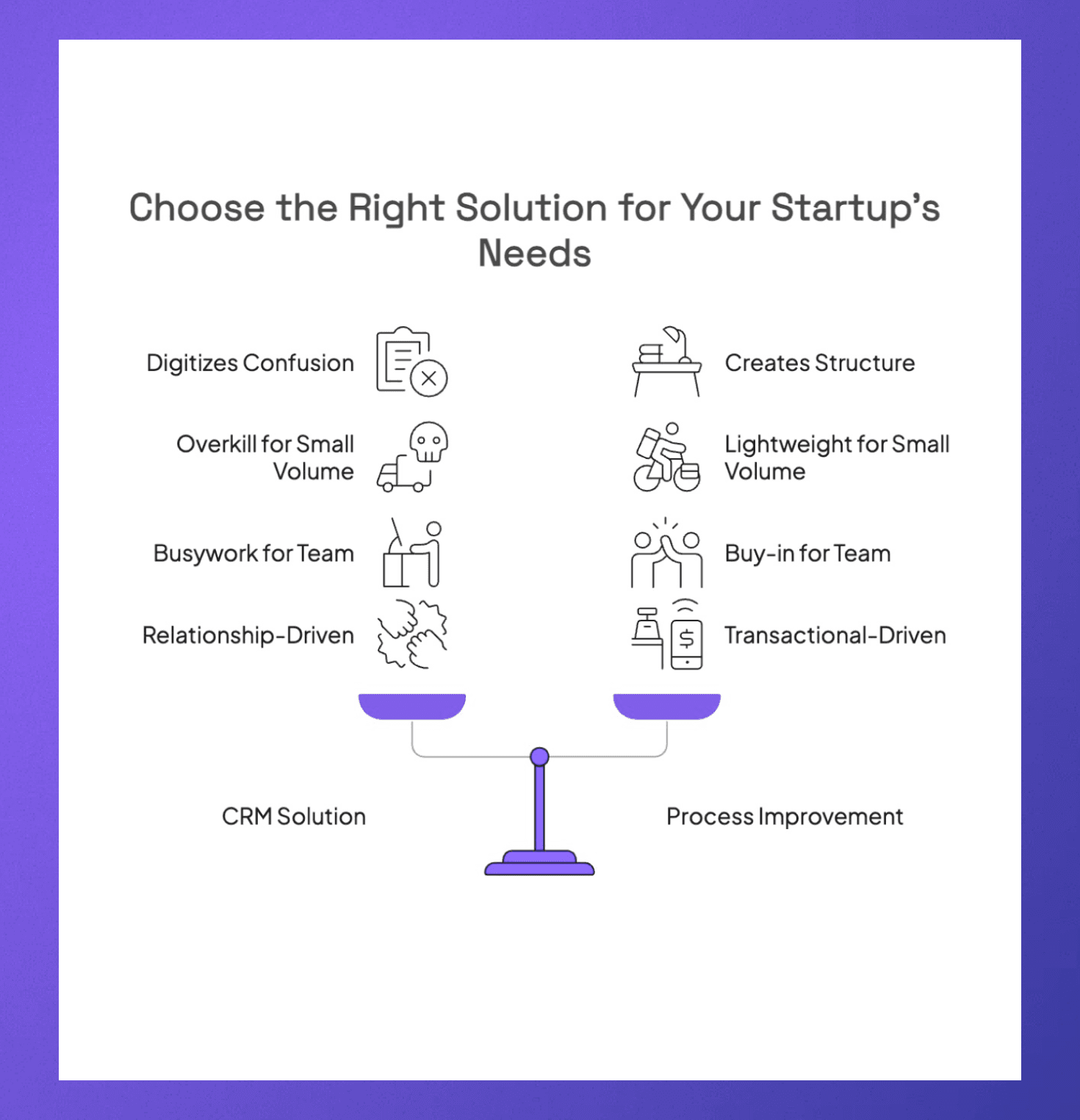
A CRM can solve a lot of problems, but it can't solve every problem. Before you commit to one, it's worth checking whether the real issue is something a tool can't fix.
Learn more about CRM for venture capital firms or deal flow management.
Your problem is the process, not the tools
Sometimes the issue looks like a CRM problem but is actually a workflow problem. Leads are falling through the cracks, follow-ups aren't happening, and nobody knows who owns what. A CRM seems like the obvious fix. But if your team doesn't have clear ownership over relationships, hasn't defined what a qualified lead looks like, or has no shared understanding of how deals move forward, adding a CRM just digitizes the confusion.
A CRM can enforce a process. It can't create one from nothing. If you don't have a basic agreement on how your pipeline works, the tool will become a dumping ground for unstructured data that nobody trusts or uses.
You don't have enough volume to justify the overhead
If you're talking to ten leads a month and everyone on the team already knows what's happening, a CRM might create more friction than it removes. There's setup time, learning curves, and the ongoing effort of actually keeping data current.
For very early-stage startups with small pipelines and tight-knit teams, simpler tools often work better:
A shared doc with key contacts and next steps
A lightweight task manager for follow-ups
A weekly sync where everyone shares updates verbally
The goal is to match the weight of your system to the complexity of what you're managing. Overkill creates drag.
Your team won't actually use it
A CRM only works if people put data into it. If your team sees the tool as administrative busywork, adoption will collapse within weeks. You'll end up with a half-populated system that's worse than useless because it looks like a source of truth but isn't.
Before investing in a CRM, pressure-test whether your team will actually adopt it. That means understanding their workflows, getting buy-in early, and choosing a tool that fits how people already work. The fanciest CRM in the market is worthless if your team treats it like a chore.
You're not in a relationship-driven business
Not every startup needs deep relationship tracking. If your model is high-volume, transactional, and largely self-serve, a heavyweight CRM built for nurturing long-term connections might be the wrong fit entirely.
Some businesses benefit more from:
Marketing automation tools that manage campaigns and lead capture
Lightweight sales tools focused on velocity and conversion
Support platforms that track tickets rather than relationships
Matching the tool to the actual shape of your business matters more than following a generic "every startup needs a CRM" playbook.
Why Startups Choose Rings AI as their CRM
When you do start evaluating options, prioritize systems that match how your startup actually works. If your business runs on relationships, whether that's investors, partners, or high-touch customers, you need a CRM built for that model, not one designed for high-volume transactional sales.
Rings AI is built specifically for relationship-driven businesses like startups.
It was built for relationship-driven businesses because traditional CRMs weren't. They were designed to track leads through a funnel and move on.
But for startups where the same people show up again and again as investors, advisors, customers, or partners, that model breaks down. Rings AI treats people as recurring, not disposable, and that shapes everything from how data is structured to how context is preserved over time.
Here is what it offers:
Automated data capture: Syncs your email, calendar, and meetings automatically; no manual entry, no falling behind on updates.
Team-wide relationship visibility: See who on your team knows who, surface warm intro paths, and avoid duplicate outreach.
Rich notes and files: Everything lives in one place, and Rings' AI can actually answer questions about your notes and history.
Fundraising intelligence: Access real-time data on funding rounds and investor portfolios; useful when you're raising or helping portfolio companies raise.
Customization that fits your workflow: Configure deal stages, fields, and views to match how you actually operate, not how a generic CRM thinks you should.
7,000+ integrations: Connects natively with Gmail, Outlook, Slack, HubSpot, Salesforce, LinkedIn, and thousands more via Zapier.
The right CRM doesn't just store contacts. It helps you understand your network, move faster on the opportunities that matter, and keep your whole team aligned as you scale.
Book a demo to see how Rings can help your startup.