
Email is like the dark horse of modern marketing operations: It dates back decades, unlike trending social networks, but continues to deliver exceptional ROI for businesses. That’s why, even in 2026, more than 50 years after email was officially created, it tops marketers’ lists as one of the most effective channels.
Still, the tools businesses use to make the most of their email strategies continue to evolve, opening up new opportunities for nurturing customer relationships and driving revenue.
That’s where CRM email marketing comes in. By connecting your campaigns to customer data and AI-powered insights through your CRM, you can craft more relevant, personalized messages that capture attention, drive clicks, and nurture leads automatically, without the need for constant manual effort.
This guide to CRM email marketing walks you through how to automate workflows, personalize at scale, and convert leads more effectively.
What is CRM Email Marketing?
CRM email marketing is the process of using your customer relationship management system as the single source of truth for email campaigns, personalization, and automation. Instead of managing siloed email lists, you can use your CRM to pull real‑time data on contacts, accounts, activities, and behaviors to send relevant messages that drive engagement and sales.
The magic happens through the platform: Your CRM tracks opens, clicks, replies, and bounces, feeding that intelligence back into contact records and scoring models. This creates a feedback loop where email performance informs sales prioritization and account nurturing. In practice, CRM email marketing combines marketing automation (sequences, A/B testing) with sales enablement (personalized outreach, meeting booking) for end‑to‑end lead conversion.
Key Benefits of CRM Email Marketing
CRM email marketing delivers measurable advantages over standalone by leveraging customer data for better relevance and attribution. Key benefits include:
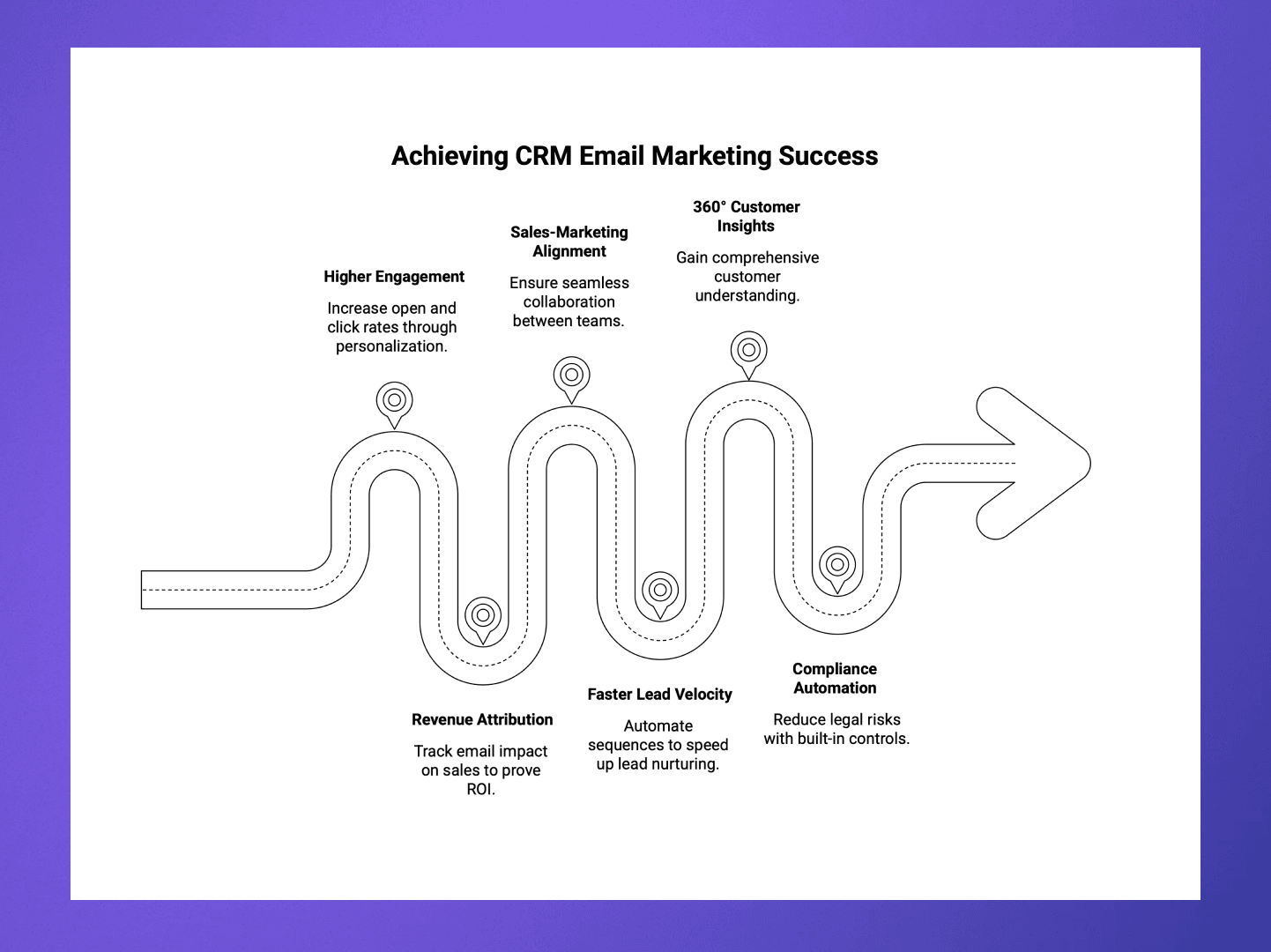
Higher engagement rates: Increase open rates and click rates through precise segmentation and personalization.
Revenue attribution: Track every email’s impact from click to closed-won deal, proving email marketing’s contribution to your pipeline.
Sales-marketing alignment: Shared customer timelines eliminate confusion, and email replies and meeting links log automatically to CRM records for instant sales context.
Faster lead velocity: Behavioral triggers like page visits and form fills launch instant sequences, reducing time spent on manual follow-ups
360° customer insights: Engagement data flows back to CRM scoring models, surfacing hot leads and at-risk accounts for proactive sales action.
Compliance automation: Built-in unsubscribe handling, suppression lists, and compliance controls reduce legal risk.
Step‑by‑Step: Building CRM Email Automation Workflows
CRM automation isn’t just a time-saver; it’s your ticket to turning one-off emails into a steady stream of revenue. Think of it like setting up a smart sales assistant that works 24/7, nudging prospects at just the right moment.
Here’s a straightforward guide to crafting workflows that actually move the needle:
1. Segment with CRM intelligence
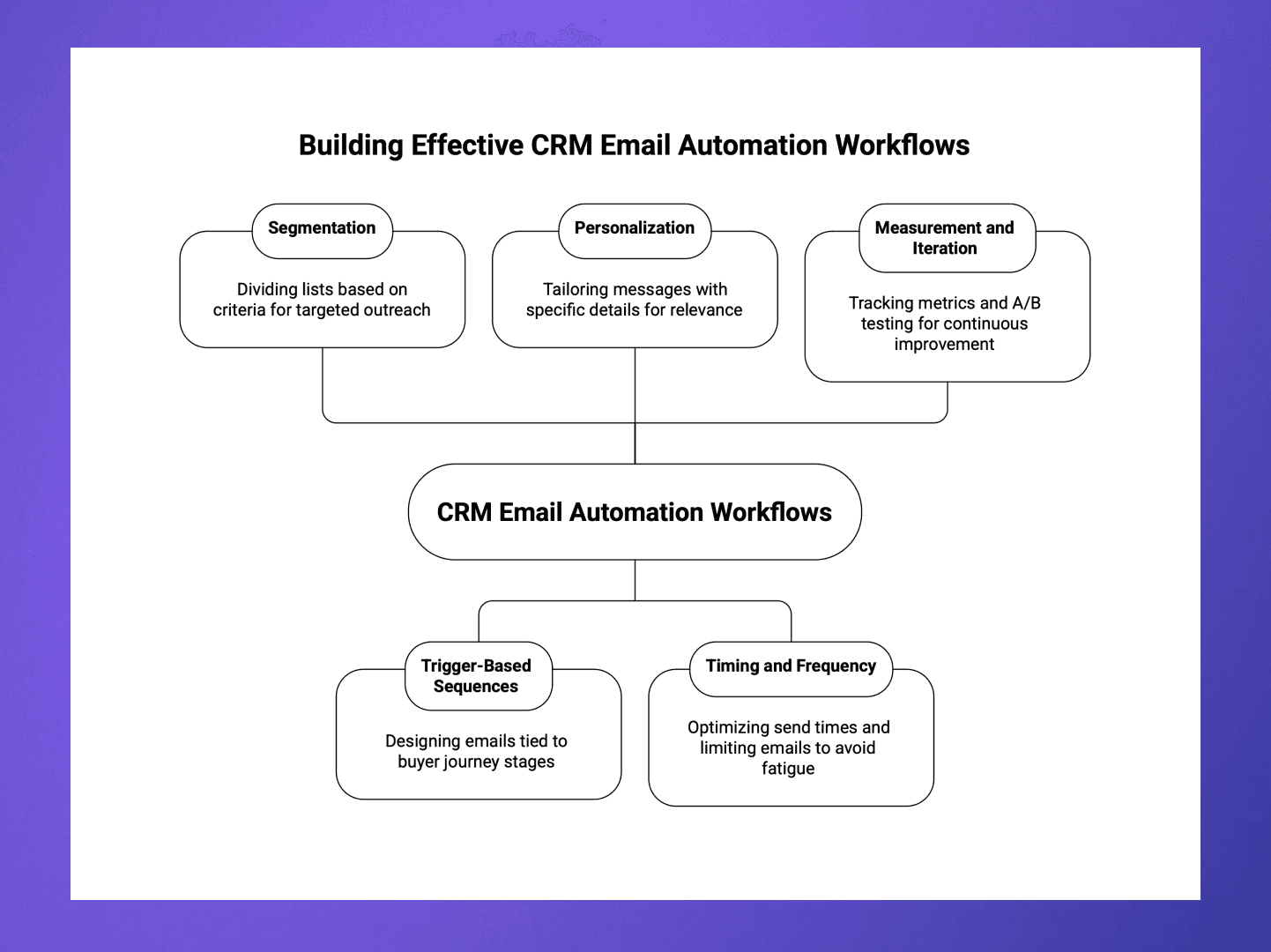
Start by slicing your list by industry, deal stage, engagement scores, or customer tenure for targeted outreach and segmented campaigns. Picture a “Q4 Expansion Opportunities” blast going only to customers who’ve gone quiet on upsells, that’s relevant, timely, and revenue-focused.
2. Design trigger‑based sequences
Next, design sequences tied to real buyer journeys: a warm welcome for fresh leads, steady nurturing for existing ones, or re-engagement for those who’ve ghosted.
3. Personalize interactions
Go way beyond basic personalization by weaving in specifics like “Loved your comment on our webinar” or nods to account milestones and shared contacts. This level of 1:1 relevance turns emails from interruptions or pesky check-ins into potential conversations. Your CRM’s full history makes this effortless and authentic.
4. Optimize timing and frequency
Fine-tune send times, like Tuesday and Wednesday mornings, and limit to one or two emails per week to avoid inbox fatigue. Lean on CRM activity logs to pause hot leads mid-sequence, ensuring you’re adding value, not annoyance.
5. Measure and iterate
Finally, track key email metrics like opens, clicks, conversions, and true revenue impact. A/B test subjects, send times, and CTAs, then iterate weekly. Watch your workflows evolve into profit machines.
CRM Email Marketing Best Practices for 2026
As your marketing strategy evolves, treat these best practices like your playbook for sending emails that people actually open and act on, no guesswork, just smart habits that pay off.
Maintain list hygiene: Regularly scrub hard bounces and suppressions to keep your sender reputation spotless, and check in with inactive contacts every few months to rekindle interest. Clean lists sail straight to inboxes instead of spam folders.
Write compelling subject lines: Aim for short, punchy lines packed with personalization, like calling out a name or teasing a specific benefit. These grab attention right away and don’t feel pushy.
Use strong CTAs: Focus on one crystal-clear action per email, like booking a demo or grabbing a guide, and make it a bold button to help drive clicks.
Ensure compliance: Always include a real physical address, effortless one-click unsubscribes, and honest subject lines, no tricks needed. Following the rules keeps you out of trouble, avoids customer service issues, and builds long-term trust.
Why Use CRM Email Marketing Tools
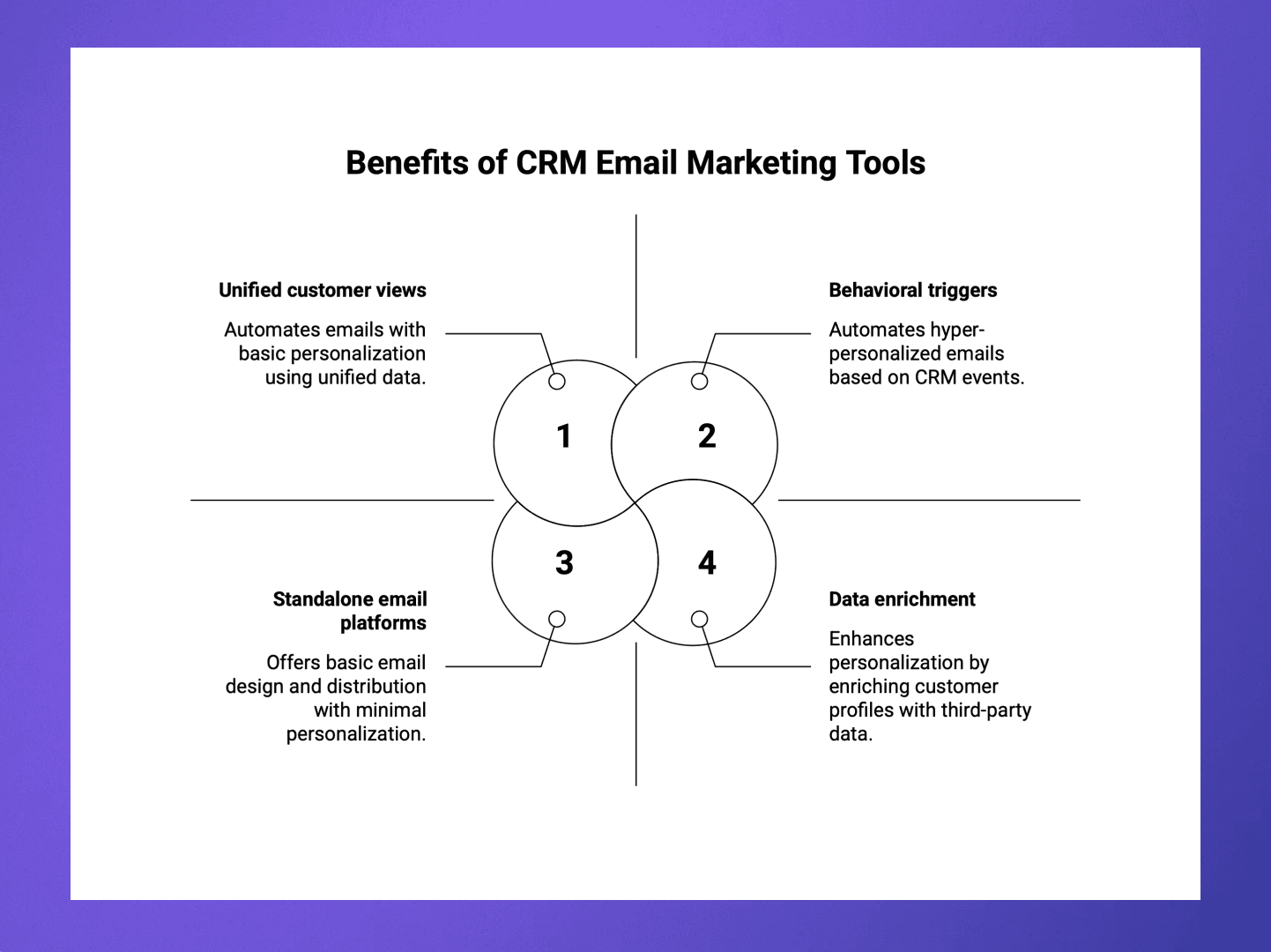
Standalone email platforms like Mailchimp excel at email design and automated distribution, but lack the rich context of a relationship intelligence CRM. When you use your CRM to devise and send segmented campaigns, you can unlock:
Unified customer views: Every email leverages full contact history, deal stage, and firmographics for hyper‑relevant messaging.
Behavioral triggers: Automate emails based on CRM events like opportunity creation, meeting booked, or contract signed.
Data enrichment: Enhance customer profiles with third-party data sources, such as job titles, company revenue, technology stacks, social profiles, and intent signals, ensuring emails reference the latest verified details for sharper personalization.
Commonly Used CRM Email Marketing Tools
Many email marketing platforms offer automation, segmentation, and tracking, making them popular choices for sales and marketing teams, such as:
Mailchimp: Audience segmentation, ecommerce triggers, multichannel support. Integrates via Zapier.
Constant Contact: Event management, SMS add-ons, simple lists. Lightweight for small teams.
Brevo: Transactional emails, send-time optimization, automations. Works with external CRMs.
ActiveCampaign: Behavioral automations, site tracking. Pairs with CRMs.
Campaign Monitor: Design tools, A/B testing. Connects to CRMs.
These tools handle basic email tasks effectively but fall short when it comes to relationship intelligence. Rings AI stands out with its focus on relationship mapping and AI-driven insights, revealing hidden connections like shared contacts or mutual interests that generic CRMs and email-only tools overlook.
Unlike standalone options, Rings AI unifies full interaction history, including emails, meetings, and social signals, into actionable 360-degree views for hyper-relevant campaigns. This depth drives higher engagement without siloed data or manual guesswork, turning routine emails into revenue-generating conversations.
Enhance Your Email Marketing Engine with Rings AI CRM
CRM email marketing can deliver unmatched ROI when built on clean data, smart automation, and relentless testing, turning your customer database into a conversion machine. In 2026, email marketing success belongs to teams that personalize at scale, trigger on behavior, and attribute revenue accurately.
Rings AI helps transform your email marketing from transactional to relational by overlaying real-time network data and AI insights. As a next-generation extended relationship management (XRM) platform, Rings can power your email operation with:
Relationship‑aware personalization: Gain instant visibility into mutual contacts, career changes, and funding events pulled from 100M+ data points.
Smart sequence triggers: Automate messages based on network strength, opportunity signals, or portfolio alignment.
7,000+ integrations: Sync your CRM with platforms HubSpot, Salesforce, and Gmail for real-time data syncing and tracking.
Ready to automate smarter and supercharge your campaigns with unique insights? Book a Rings AI demo to see relationship‑powered email in action.
Learn more about CRM for venture capital firms.